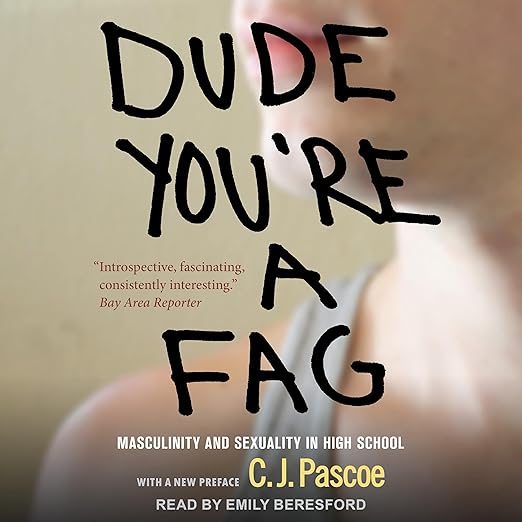
I came to Dude, You're a Fag through a recommendation from a colleague who teaches secondary education, not through the audiobook market, and that context matters. C. J. Pascoe's study has been circulating in sociology and gender studies classrooms since its original publication, and its title still stops people in their tracks in a way that the content inside quietly earns. What Pascoe produced from eighteen months of fieldwork at a racially diverse working-class high school is one of the more rigorous ethnographic examinations of how masculinity gets made, defended, and enforced among adolescent boys.
The audiobook version, narrated by Emily Beresford, arrived in 2021 and presents the material in a format that will reach readers who would never pick up a sociology monograph. That is largely a good thing, though it comes with the honest caveat that this is still, at its core, a scholarly text. One reviewer described it as a dry research study that reads like the scholarly piece it is. That is accurate, and listeners who approach it expecting the register of a memoir or reported narrative will need to recalibrate their listening mode before they begin.
How the Fag Threat Polices School Institutions
Pascoe's central argument is that the fag epithet, as deployed among teenage boys, functions less as a stable descriptor of sexual identity and more as a disciplinary threat available to any boy who fails to perform masculinity correctly. The slur is less about homosexuality than about failed heterosexual masculinity, and that distinction, which Pascoe documents through specific classroom observations, interviews, and recorded interactions, is genuinely illuminating. The fag is the ghost that haunts the performance of being a teenage boy, available to be invoked against anyone who steps out of a narrowly defined script of behavior and presentation.
What the book does well is follow this argument through the school's social institutions: the drama class, the auto shop, the hallways, the sports teams. Each setting has its own masculinity norms, and Pascoe traces how the fag discourse operates differently across them. The chapter on the school's dance program, where certain performances of masculinity are temporarily licensed and then reclaimed, is one of the more nuanced sections and worth listening to closely. The institutional analysis is the book's strongest feature, and it gives the fieldwork a structural coherence that pure description would lack.
Eighteen Months at River High, Minus Counter-Evidence
Pascoe spent eighteen months embedded in what she calls River High. The access she achieved is impressive, and the book benefits from the granularity of material that kind of sustained presence produces. One reviewer, a high school teacher, credited the book with giving her an entirely new perspective on teenage boys and with helping her develop concrete strategies for navigating their behavior in classroom and social settings. That practical utility, grounded in real observed behavior rather than theoretical abstraction, is part of what distinguishes this study from more purely theoretical work on masculinity and gender performance.
The critique that the book lacks counter-evidence, meaning examples of boys who successfully resisted or subverted the fag discourse, is a fair one and worth holding. Pascoe is building a case for a structural pattern, and structural arguments tend to suppress the exceptions that would complicate them. A reviewer with academic background noted that the book is poorly organized in sections and that it does not use counter-evidence, which are critiques that apply specifically to the rhetorical design of the argument rather than to the quality of the fieldwork itself. Both the strength and the limitation of this book come from the same source: Pascoe knows what she wants to argue and builds the evidence around that argument efficiently.
Beresford's Even Delivery Demands Focused Listening
Emily Beresford brings a clear, even delivery to the material that serves the book's expository nature well. She does not try to perform the ethnographic anecdotes dramatically, which would feel wrong for this kind of text. The narration is professional and clean, though it does not elevate the material in the way that a particularly skilled narrator can elevate literary nonfiction. What you are listening to is, essentially, a sociology text read aloud, and Beresford delivers that task without friction or affectation.
For listeners who engage with audiobooks primarily as a way of absorbing nonfiction content while doing other things, this works well. For those who listen primarily for the pleasure of a narrated performance, the experience will feel utilitarian. That is not a criticism of Beresford specifically but a reflection of what the material is and what the format can reasonably achieve with it. The density of the academic argument means that driving or exercising while listening will result in sections that need to be replayed; this is a book that rewards focused listening.
Essential for Educators, Not for Personal Narrative
This audiobook belongs in the listening queue of anyone who works with adolescents: teachers, counselors, school administrators, and parents of teenage boys. The framework it provides for understanding how masculine performance operates in educational settings has direct practical applications that multiple professional readers have noted. It is also valuable for listeners interested in sociology of gender, regardless of professional context, as a document of how these patterns have been empirically studied. Skip it if you are looking for a personal narrative or popular nonfiction in the vein of Malcolm Gladwell; the academic density of the original is still present and it requires a different kind of attention than narrative audiobooks demand. Also skip it if you expect deep engagement with stories of individual students; the institutional patterns are the subject, not the individuals who embody them.
A Few Questions About Dude, You're a Fag
Is Dude, You're a Fag primarily about gay teenagers, or does it cover straight boys too?
Primarily straight boys. Pascoe's central finding is that the fag discourse functions as a disciplinary mechanism for all boys regardless of sexual orientation, policing masculine performance broadly. Gay students appear in the research but are not the book's primary focus.
Does the audiobook format lose anything significant from the original print edition?
The original monograph has no photographs or data visualizations that would be lost in audio. The book is argument and ethnographic description throughout, so the format translation is clean. Some readers may find the dense academic prose easier to track in print, where re-reading is quicker than rewinding.