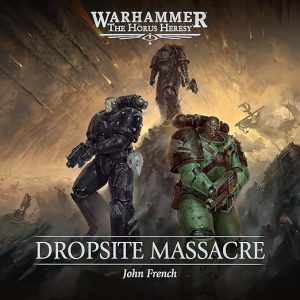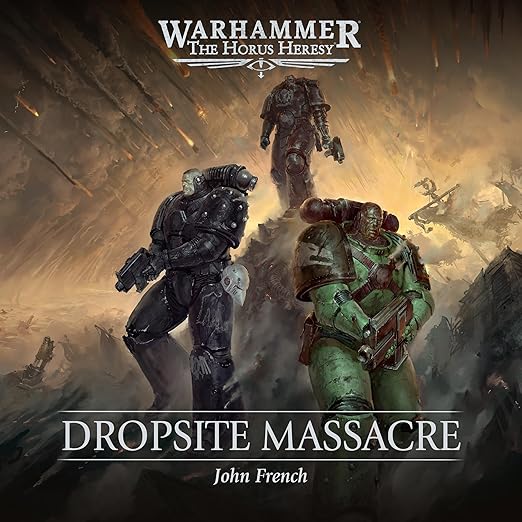
There are moments in long-running fictional universes where something so catastrophic happens that it gets referred to, for years afterward, simply by its name. Horus fans have a word for this: Isstvan V. I came to Dropsite Massacre having followed the Horus Heresy series through a substantial portion of its run, which means I knew what was going to happen the moment I saw the title. I knew who would survive and who wouldn't. I knew the shape of the betrayal and its scope. I started listening anyway, on a grey Thursday evening with no plans, and ended up listening far past midnight.
John French has written some of the most atmospherically precise fiction in the Black Library catalogue, and this novel is his most ambitious undertaking yet. The premise is both simple and devastating: the largest force of Space Marine legionaries and primarchs ever assembled is sent to end Horus's rebellion before it begins. They do not know they are walking into a slaughter. The reader does. Jonathan Keeble knows it. And the genius of the book is that the dramatic irony of this foreknowledge, knowing the ending before the first loyalist boots hit the ground on Isstvan V, is exactly what gives the story its power.
Our Take on Dropsite Massacre
One reviewer described Isstvan V as "the Order 66 of Warhammer" and that comparison is exactly right. Like the execution of the Jedi in Star Wars, the Dropsite Massacre is an event so culturally embedded in its fandom that its name alone conveys specific emotional weight. Also like that sequence, what makes a good depiction of it possible is not surprise but revelation of detail. We know the Jedi die. The power is in seeing Anakin's face when he makes his choice. French understands this and structures the novel accordingly.
What Dropsite Massacre adds to a story already known to readers is interiority, context, and moral complexity. Reviewer Jetpack noted that Ferrus Manus, previously depicted as a crazed, impulsive figure in other Heresy material, is here given a fear that drives his decisions and makes them comprehensible. That rehabilitation of a character previously flattened by the demands of plot is exactly the kind of work that the best historical fiction does, and it's what elevates this above a straightforward action narrative.
Why Listen to Dropsite Massacre
John French writes with a formal, almost liturgical register that suits the Warhammer 40,000 aesthetic without becoming parody. The vocabulary is elevated without being inaccessible, and the emotional architecture of the battle scenes is handled with more restraint than the genre sometimes produces. When the treachery is finally revealed and the slaughter begins, French has earned the reader's horror through careful preparation rather than shock-and-awe tactics.
Jonathan Keeble is the finest narrator in Black Library's stable for this kind of material. His voice carries the accumulated weight of a universe in which heroism exists primarily to be betrayed, and he modulates between the intimate interiority of character-focused passages and the sweeping scale of the battle with a command that lesser narrators can't sustain over eleven hours. Reviewer Dani offered the only significant criticism that lands fairly: the Siege of Terra series had recently been released, and because readers already knew how certain threads resolved, some of the Dropsite Massacre's revelations arrived with diminished impact. That's a consequence of reading this deep in a shared universe timeline rather than a flaw in the book itself.
What to Watch For in Dropsite Massacre
Reviewer Lou identified the Raven Guard sections as the book's strongest material, with the Alpha Legion passages close behind. This is an accurate assessment. The Raven Guard, whose entire identity is built around survival through concealment, experience the Dropsite Massacre differently than the Iron Hands or Salamanders do. Their sections have the quality of watching a trap close around people who have built their entire existence on avoiding exactly this kind of trap. The Alpha Legion passages add a dimension of deliberate ambiguity that French handles with characteristic intelligence.
The second wave of betrayal is shorter than the first, as reviewer Jetpack noted, but this is a structural decision that works. The first wave needs space and weight. The second is the confirmation, the proof that this was not an accident but a designed annihilation.
The Right Listener for Dropsite Massacre
Dropsite Massacre is designed for readers who are already deep in the Horus Heresy series and bring emotional investment in the characters and their fate. Reviewer Ethillion recommended it specifically for fans of the Warhammer 30K era, and that's the accurate target audience. Coming to this book without prior Heresy context would mean experiencing a technically accomplished war narrative without any of the accumulated grief that gives it its power.
For those readers, this is the Horus Heresy novel that the series has been building toward, and John French delivers it with the scope, detail, and emotional honesty that the event demands. Jonathan Keeble, as always, is the right guide for the dark.
Key Details
- Narration: Jonathan Keeble is the definitive voice for Black Library fiction, his gravitas and capacity for controlled intensity are perfectly matched to the weight of Isstvan V.
- Themes: Betrayal and the collapse of loyalty, the cost of idealism in a universe that punishes it, tragedy at civilizational scale
- Mood: Relentlessly dark and operatic, with the specific grief that comes from knowing how the story ends before it begins
- Verdict: The Horus Heresy finally gets the definitive account of its most catastrophic event, a book that fans of the series have waited years for, and that delivers with rare emotional weight.