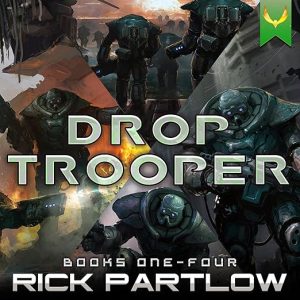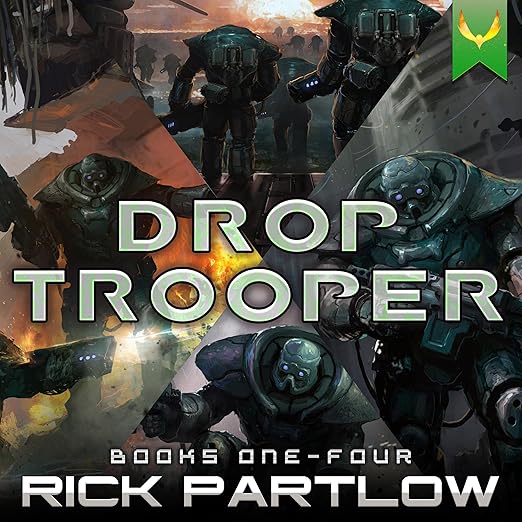
- Voice: James Patrick Cronin handles the military sci-fi register with appropriate intensity, sustaining thirty-three hours of action and character development without losing definition
- Big ideas: Identity and belonging in extreme circumstances, the cost of violence on the person committing it, loyalty constructed from nothing
- Atmosphere: Propulsive and visceral, with more psychological texture than the military sci-fi genre typically delivers
- Worth it?: Four complete books of military sci-fi that function as a genuine character study of someone building a self from scratch under conditions that should make that impossible.
I was skeptical of this box set in the way I am skeptical of most military sci-fi omnibuses. The genre has reliable pleasures and reliable limitations: the action sequences tend to be excellent, the technology plausibly imagined, and the character work often functional rather than genuinely invested. What I want from military sci-fi is what the best of it delivers, the experience of reading Haldeman's The Forever War or Scalzi's Old Man's War: the sense that the genre is using its particular machinery to examine something real about human beings under conditions of organized violence. I was not expecting to find that in a four-book package with cover art featuring armored battlesuits. I found it anyway.
Rick Partlow's Cam Alvarez is the kind of protagonist that the genre's best practitioners know how to build. He starts from nothing. No family, no friends, no meaningful attachments, no place in the world, and the choice between jail and the Marines is not really a choice between two options. It is the universe closing off every option except one, and the option available happens to be the military. What happens to Cam once he enters the drop trooper program is the story, and it is a story about someone who discovers, gradually and then all at once, that he is good at something, and that being good at something is not the same as knowing who you are.
The first volume, Contact Front, does the foundational work that the subsequent three books build on. Partlow establishes Cam's background with unusual specificity for the genre. His street-con past is not decoration. It has actual consequences for who he is under pressure, for how he reads people and situations, for the reflexive distrust that has to break down before the genuine belonging that the series is building toward can form. Reviewer Daniel J. Berglund notes that the book captures military life accurately, an observation that distinguishes it from the more fantastical end of military sci-fi, and that accuracy grounds the emotional developments in something that feels earned rather than convenient.
James Patrick Cronin's narration in the first book establishes the register that will carry the next thirty-plus hours. He gets the balance right: intensity without melodrama, the particular emotional flatness of someone describing violence they have survived and internalized, interrupted by moments where the suppressed experience surfaces despite the flatness. It is the right voice for Cam at the beginning of the story, and watching it develop across the subsequent volumes is one of the listen's quiet pleasures.
Highlights
One of the consistent observations across the reviews is that the series grows in ambition and emotional complexity as it progresses. Reviewer Scott Neville notes that the character development is the book's heart, particularly that Cam's growth is visible to everyone around him but not to himself. This is the fundamental dramatic irony the series is built on: Cam can see change in everyone except himself. He believes he is still operating from the street-con logic of self-preservation and distrust even as everything he does demonstrates that he has built genuine loyalty, genuine attachment, genuine identity from materials that should not have been adequate to the task.
The four books follow him through escalating military engagements and escalating personal stakes, and Partlow handles the escalation without losing the intimacy of the central character study. The alien enemy remains largely external, a force rather than a fully examined civilization, which is a genre convention Partlow accepts rather than challenges. The interest is not in the aliens. It is in what fighting them does to the people trained to do it, and in what Cam finds in himself when the fighting demands everything he has accumulated over four books' worth of hard experience.
Before You Commit to Drop Trooper Books 1-4
The omnibus format, four complete books totaling thirty-three hours, is a significant listening commitment, and the question it raises is whether the investment is consistent across all four volumes or whether some books are stronger than others. Reviewer Jim Halsey, noting that it started as a good sci-fi war story and developed into a very well done storyline with excellent characters and a genuinely satisfying conclusion, suggests the arc builds rather than levels off. That is the right structure for an omnibus: you want to start good and end better, and by the accounts of multiple reviewers, this one does.
Cronin sustains the thirty-three hours without audible fatigue, which is a genuine achievement for material this demanding. The action sequences require physical energy in the narration; the introspective passages require restraint; the dialogue requires differentiation across a growing ensemble of soldiers who accumulate history across thousands of pages. He handles all three registers with consistency. The listener who picks up the omnibus version is trusting the production and the narrator to carry a very long journey, and both of them do that work without making it feel like a burden.
Is This One for You?
Military sci-fi readers who want their genre to do psychological work alongside the action sequences should put this high on their list. The character depth places it toward the better end of the JN Chaney and Joshua Dalzelle comparison set that reviewers draw. Listeners who find military sci-fi primarily interesting for the tactical and technology elements will find those elements present and competently handled but not the primary emphasis. Reviewer Kindle Customer's warning about significant profanity in the first book, tapering considerably in subsequent volumes, is worth noting for listeners sensitive to that element. The overall rating of 4.6 across nearly a thousand reviews reflects an audience that found the full investment worthwhile.
Questions Listeners Ask
Do all four books need to be listened to in order, or can individual volumes stand alone?
The four books follow a continuous arc of character development. While each volume has its own complete story, the emotional payoff accumulates across all four, and listening out of order would significantly reduce the impact of the character work that forms the series' backbone.
How much does the military technology and alien world-building drive the plot versus the character story?
Character drives the plot. The battlesuits, tactical scenarios, and alien enemy are the environment rather than the subject. Partlow is using the military sci-fi setting to examine what happens to a person who has never belonged anywhere when they are forced into a structure that demands belonging.
Is James Patrick Cronin's narration consistent in quality across thirty-three hours of material?
Yes. Multiple reviewers note that the narration holds up, and Cronin manages the tonal range from intense action to psychological introspection without audible inconsistency across the full omnibus length.
How graphic is the violence, and is the profanity level consistent throughout all four books?
The violence is military-realistic rather than gratuitous. One reviewer notes substantial profanity in the first book that tapers significantly in subsequent volumes. Listeners sensitive to language may find the first book the most challenging in this regard.