The only sentence of narration praise anywhere on this audiobook listing was written about a different book. School Library Journal is quoted in the description saying that Suzy Jackson provides unique and recognizable voices for Charlie and the supporting characters, and the attribution at the end of that line changes what it means: on Wish. Wish is the earlier novel this one follows. The quote is a credential for the reader rather than a verdict on this recording, and the publisher has parked it at the end of the description anyway. The move is defensible, since the narrator is the same and the invented town is the same, and a character named Charlie turns up in both books.
Granddaddy's Hidden Money Could Buy the Guitar
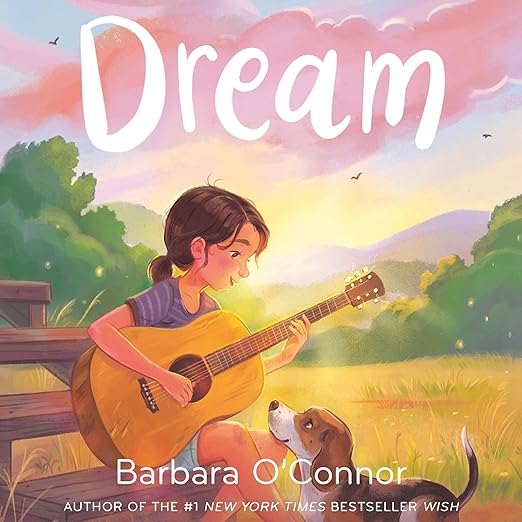
Dream works as a treasure hunt wearing the clothes of a songwriting story, or possibly the other way around. Idalee Lovett lives in Colby, North Carolina, in a huge family house rented out by the room while her mama tours with a cover band called Lovey Lovett and the Junkyard Dogs. A local radio station announces a songwriting contest and the winning entry gets recorded by an up-and-coming singer. Idalee wants it. She also wants the shiny blue guitar in an Asheville music shop, which she has decided will make the song possible, and she settles on funding the guitar by locating the money her late granddaddy hid somewhere in the house. A four-star write-up from September lays the shape out neatly: a young girl who doubts her own talent, convinced she needs a new instrument to write a good song, teaming up with her buddies to hunt a rumored fortune.
That plan is the book's best joke and its quiet thesis at the same time. Idalee has decided the obstacle is equipment, and the story spends its whole length proving her wrong without ever announcing it. Barbara O'Connor is returning to the same southern town that carried Wish, and the technique here is patience. The boarders in the house, the friends named Odell, Howard and Charlie, the dog called Wishbone, all get room to be themselves instead of functioning as plot furniture. Nothing accelerates. The contest deadline supplies just enough tension to keep a young listener moving forward, and everything else runs on the pleasure of a place that feels fully inhabited.
Idalee's Songs Are Words Waiting for a Voice
Four hours and eighteen minutes is a genuinely useful length for this age group, short enough to finish across a couple of trips or one weekend and long enough that Colby registers as a place rather than a backdrop. A write-up filed in February 2026 says the thing that matters most about a children's recording, which is that it left the listener wanting to go straight back to the beginning and do the whole thing again. Repeat listening is the real economics of this format inside a family, and a recording of this size is built for it in a way a fourteen-hour middle grade epic never is.
Music is the other argument, and the one that makes audio the right container. This is a book about songs: writing them, hearing one come out of a radio, a mother who sings other people's material for a living and a daughter who wants to write her own. Country songwriting is a spoken craft as much as a musical one, built on a turn of phrase landing at the right moment. If Idalee's songs appear on the page as text, they are words waiting for a voice. Spoken, they are the thing the book is actually about. Whether any melody makes it onto the recording is not stated anywhere on the listing, and it does not need to be, since the argument here is rhythm and phrasing rather than tune.
In Audio, Idalee's Name Is Just a Sound
Idalee's name has no settled spelling on this page, which is a small thing that tells you something larger. The description writes it as Idalee Lovett, one word. The write-up that reconstructs the boarding house spells it Ida Lee throughout, two words, and builds its entire account around eleven-year-old Ida Lee. Both spellings sit on the same page without either one flinching. None of it matters in audio, where a name is a sound and the question of spacing never arises, and that is exactly the point: listeners get a cleaner version of this character than readers do. Anybody planning to move a child from the recording to the printed page should expect the name to look slightly unfamiliar when it arrives.
Who is doing the reporting is the other thing worth weighing. Children's books get assessed by adults on behalf of children, and this page shows that seam plainly. One five-star entry runs to three words and reports that a daughter loves it. That is real information about whether the book lands on its intended listener, and it is not information you can use for anything else. Seventy-two ratings sit behind the 4.7 average with five of them carrying text, and most of that text is a grown-up describing a reaction they watched rather than one they had. Nothing dishonest is going on. It simply means the enthusiasm here should be read as evidence about children, which is the only evidence that really counts here.
Idalee Doesn't Get Everything and Ends Up Content
Target listeners are clear enough, roughly between eight and twelve, with the sweet spot sitting at the protagonist's own age. A write-up filed in November 2025 describes precisely that use case, sharing the book with an eight-year-old for a third grade reading fair project, and singles out what makes the effort worthwhile. Idalee messes up. She confesses to it. She does not get everything she wanted and ends up content anyway. Children's fiction promises that ending constantly and delivers it far less often, usually by quietly handing the child the thing they wanted after all. O'Connor declines, and that write-up noticed. The restraint is the difference between a book a child enjoys and a book a child remembers, and it justifies four hours of anybody's attention.
Nothing here is dangerous and the worst available outcome is disappointment, so a listener who needs stakes should look elsewhere. Pass as well if the household has already worn this exact register out, since cozy small-town middle grade with a plucky lead and a dog is a crowded shelf and Dream makes no attempt to stand apart from it. What it does instead is execute unusually well, and for a family that wants something warm, short and genuinely about music rather than merely decorated with it, this is a straightforward recommendation. Adults in the front seat will not suffer either, which is not nothing.
How many hours is the Dream audiobook?
Four hours and eighteen minutes, read by Suzy Jackson. The description credits it as a Macmillan Audio production from Farrar, Straus and Giroux, dated August 26, 2025. Most families will finish inside one weekend at that length, with nobody losing the thread.
Do you need to hear Wish before the Dream audiobook?
No. The description calls this a standalone companion, no series data appears anywhere on the page, and the plot resolves entirely on its own terms. Wish supplies the town and some returning texture, though nothing load-bearing carries across between them.
What age range is this aimed at?
This one is categorized as a children's title and tagged Music and Performing Arts, and the protagonist is eleven, which normally puts the floor near eight and the ceiling near twelve. The description flags nothing a cautious parent would want to preview first.
Is the songwriting contest the whole plot?
No, two engines run at once. One is the radio station contest with a recording deal attached. The other is the search for money a late grandfather hid somewhere in the family's rooming house. The guitar Idalee believes she needs is what ties the two together.