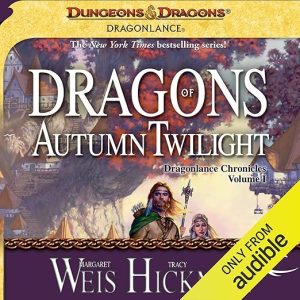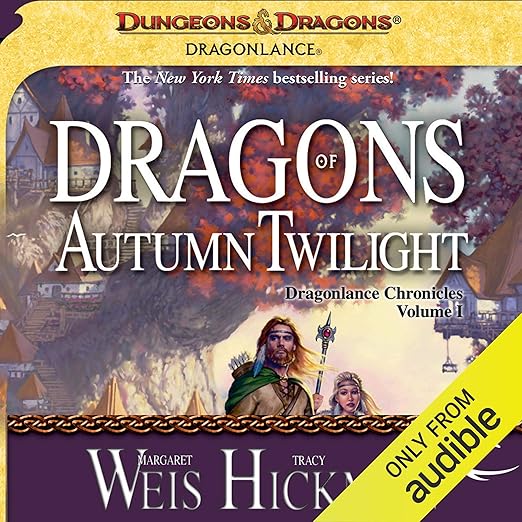
Dragonlance shaped an entire generation of fantasy readers, and returning to it in audiobook form feels less like nostalgia and more like archaeology. Listening to Paul Boehmer work through the sprawling ensemble of Dragons of Autumn Twilight over twenty hours, I kept catching details I had missed in earlier reads: the restless unease of the companions before the plot properly ignites, the careful way Margaret Weis seeds the world with spiritual absence before she fills it. This audiobook puts you directly inside that pacing, which is both its strength and its particular challenge.
The premise is deceptively simple. Lifelong friends reunite after years apart, each carrying secrets. A chance encounter with a woman bearing a magical crystal staff pulls them toward a conflict none of them wanted. The synopsis does not lie when it notes that no one expected them to be heroes. What it underemphasizes is how long Weis and Tracy Hickman take to build the world before the heroism arrives. In audio, that unhurried establishment becomes immersive rather than slow, provided you give it the room it needs.
Is Dragons of Autumn Twilight Worth Your Time?
Boehmer handles the tonal variety here with real skill. The Dragonlance Chronicles require a narrator willing to shift between Tasslehoff Burrfoot's chaotic energy, Raistlin Majere's rasp of dangerous intelligence, and Tanis Half-Elven's conflicted, steady center. These are not subtle characters, but they are characters who demand differentiation, and Boehmer delivers it consistently across twenty hours. One reviewer compared this favorably to The Lord of the Rings, and the comparison is not entirely unfair in terms of structural ambition, though Weis and Hickman aim for something more accessible, more grounded in the specific relationships among their companions. Boehmer's performance honors that accessibility without flattening the darkness beneath it.
What surprised me, listening rather than reading, was how early the sense of genuine threat arrives. The companions enter a world shadowed with rumors of war, yes, but also with rumors of gods who have withdrawn, of faith that has no object, of creatures that should not exist. That spiritual hollowness gives the narrative a weight that distinguishes it from simpler quest fantasy. Boehmer reads those quieter passages with appropriate gravity, not underlining them, just letting them settle into the silence between scenes.
Why Dragons of Autumn Twilight Works as an Audiobook
The audiobook format suits this book in one specific and important way: it disciplines your pacing. On the page, it is easy to skim the world-building passages in a rush toward the action. At twenty hours, Boehmer's narration insists on the full scene-setting, the long establishment of character dynamics, the slow revelation of what the crystal staff actually means. A listener from the original D&D module era noted that the book emerged from game sessions the authors played through before writing, and that origin is audible: the story has the rhythm of a campaign that builds pressure over many sessions before releasing it. Hearing it unfold that way, linearly and without the option to flip ahead, makes it substantially more effective than any previous reading I had given the text.
The encounter with Goldmoon and her staff, which the synopsis names as the catalyst, lands with proper weight in Boehmer's hands because of everything he has already built toward it. By that point, you know exactly who these people are to each other, what secrets each is keeping, and why the intrusion of genuine magic into their careful, small lives is so destabilizing. That context is the book's real foundation, and the audiobook gives it the time it deserves.
Weak Spots in Dragons of Autumn Twilight
Listeners new to Dragonlance should understand that this is the first of four books in the Chronicles, and the ending functions more as a chapter conclusion than a standalone resolution. Characters are established, stakes are set, losses are registered, but the larger shape of the conflict extends well beyond this volume. One reviewer who came to the book skeptical, having been warned off stories based on gaming modules, found it exceeded expectations, which reflects the actual accomplishment: Weis and Hickman managed to write something that transcends its tabletop origins. The audiobook version preserves that transcendence.
Be aware that the pacing in the first quarter of the runtime is deliberately unhurried. If you need immediate plot momentum, the opening hours will test you. But if you can surrender to the accumulation of atmosphere and relationship, the payoff is substantial. Boehmer's voice is a warm baritone that suits both the intimate campfire scenes and the larger confrontations equally well, which matters across a twenty-hour runtime. This is not a narrator who coasts.
Should You Listen to Dragons of Autumn Twilight?
Listeners who grew up with Dragonlance and want to revisit it in a format that honors its scope will find this version genuinely satisfying. Listeners coming to high fantasy for the first time and willing to invest in a long, ensemble-driven narrative will also find it rewarding. This audiobook works particularly well for those who prefer their fantasy rooted in character relationships rather than pure spectacle.
Skip it if you need a standalone story with full resolution, or if the twenty-hour commitment to a series opener feels prohibitive. Those already invested in faster-paced secondary-world fantasy may find the measured establishment of the first act frustrating. For everyone else, Boehmer's narration makes a solid case for why these companions, despite carrying secrets they will not yet speak aloud, earned their permanent place in the genre.
Key Details
- Voice: Paul Boehmer brings genuine weight to the Dragonlance ensemble, differentiating companions convincingly while keeping the epic scope grounded across 20 hours.
- Big ideas: Fellowship under pressure, reluctant heroism, the return of lost faith
- Atmosphere: Grand and nostalgic, with genuine darkness beneath the adventure surface
- Worth it?: Boehmer's performance makes this classic fantasy audiobook worth revisiting even if you first met these companions on the page decades ago.
Does Paul Boehmer differentiate the Dragonlance companions clearly enough in audiobook form?
Yes. Boehmer gives each companion a distinct register, from Raistlin's strained, cold delivery to Tasslehoff's excitable energy. Over twenty hours, the differentiation holds and makes it easy to follow whose voice belongs to whom without consulting the page.
Is Dragons of Autumn Twilight a complete audiobook story, or does it end on a cliffhanger?
It concludes the immediate conflict of this volume but is the first of the Dragonlance Chronicles series, so major narrative threads extend into subsequent books. Think of it as a strong first act rather than a standalone conclusion.
How does the audiobook handle the ensemble size, given how many named companions there are?
Boehmer manages the ensemble effectively across twenty hours by establishing each character's vocal identity early and maintaining it consistently. The size of the cast is one reason the runtime is necessary: Weis and Hickman take real time to establish each companion before the group is tested.