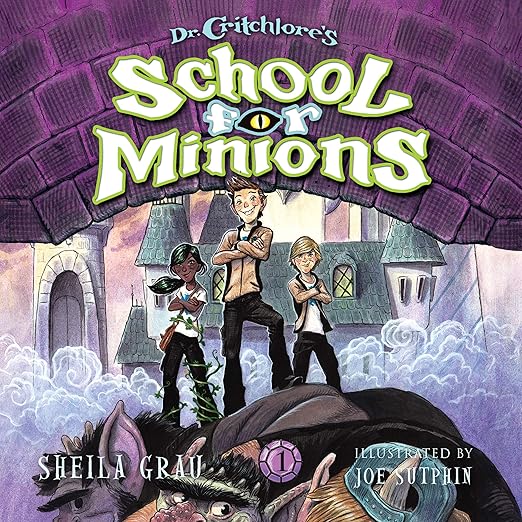
Middle-grade fiction that inverts the expected moral order, placing a young protagonist in a school designed to train evil henchmen rather than upstanding citizens, has a long tradition in children's literature. But Sheila Grau's Dr. Critchlore's School for Minions earns its place in that tradition by doing something harder than just inverting the premise. Runt Higgins, the twelve-year-old werewolf at the center of this audiobook, is not a reluctant villain or an undercover hero. He genuinely loves the school, believes in its mission, and experiences the threat to its existence as a genuine loss. That commitment to the character's perspective makes the comedy work and gives the mystery plot its stakes.
Nate Begle narrates the audiobook, and his work is a significant asset here. Middle-grade ensemble fiction lives or dies by the narrator's ability to distinguish between characters, and Begle manages Runt, the gargoyle Darthin, the tree nymph Syke, Dr. Critchlore himself, and a supporting cast of ogres, imps, and werewolves without the distinctions becoming caricatures. One reviewer noted the book is 'filled with deliciously fun characters,' and Begle's narration is the reason those characters feel vivid in audio rather than flat.
What Works
The premise is genuinely funny at the structural level. Courses like History of Henchmen and Introduction to Explosives are a delight as chapter headings alone, and Grau populates them with the kind of background detail that middle-grade readers who are paying attention will catch and appreciate. The school functions as a specific parody of the boarding-school fantasy genre, and the inversion works because Grau clearly loves the tropes she's playing with.
Runt's central problem, that he's been abandoned at the school as a baby and genuinely doesn't know how old he is or who his family is, gives the comic premise an emotional thread that keeps the story from being purely satirical. A reviewer who has a twelve-year-old son described this as having hooked 'a very reluctant reader,' and that kind of engagement tends to come from books that offer both the surface pleasure of funny situations and the deeper engagement of caring what happens to the main character. Runt is easy to care about because his loyalty and his gullibility exist in genuine tension, and Grau uses that tension well.
The mystery at the center of the plot, who is behind the series of disasters threatening to shut down the school? follows detective logic appropriate for the age group: clues are planted fairly, suspects have coherent motives, and Runt's solution emerges from observation and reasoning rather than luck. This matters because middle-grade mystery readers are often sophisticated consumers of the genre, and being respected by the author is part of what keeps them reading.
The mystery plot in this audiobook follows a model that middle-grade readers who love puzzle-box fiction will recognize and appreciate. Runt is an effective amateur detective not because he's smarter than everyone else but because his love for the school makes him more motivated and more attentive than students who are simply attending until graduation. That emotional investment in the outcome is what separates the mysteries that land from the ones that feel like exercises.
What to Watch For in Dr. Critchlore's School for Minions
This is the first book in a series, and it functions as an introduction to the world as much as a self-contained story. The mystery is resolved, but the larger questions about Runt's origins and his place in the school are clearly flagged as ongoing. Listeners who want complete closure should know they'll finish this audiobook with some threads still open.
The humor runs toward absurdism and wordplay, which is well-matched to Begle's narration but may not land for every middle-grade listener. Young readers who prefer adventure with more physical stakes over comic inversion may find the satirical layer a bit more oblique than they'd like. But reviewers consistently report that children who click with Grau's sensibility do so enthusiastically.
At six hours and fifty-six minutes, the audiobook is a comfortable length for middle-grade listeners who have built some stamina for longer formats. It's long enough to be a satisfying listen without demanding the kind of sustained commitment that longer series entries sometimes require.
Grau's narrative voice in this audiobook also handles a tonal challenge that middle-grade fiction often fumbles: the school is genuinely training students to be villains' assistants, and that premise requires the comedy to hold that reality at exactly the right distance. If the evil becomes too real, the book loses its lightheartedness. If it's too sanitized, the satirical premise collapses. Grau navigates this by keeping the stakes internal to the school rather than extending them into the world outside, and Nate Begle's narration honors that choice. The Introduction to Explosives course is funny because of how it's framed, as a normal school subject, not because of what it would actually mean. That instinct for keeping absurdism at the level of perspective rather than consequence is what makes Dr. Critchlore's School for Minions work as a family audiobook rather than something edgier than its age group warrants.
Who It's For
Young listeners between roughly eight and thirteen who enjoy school-based fantasy with humor will find this audiobook a strong match. It's particularly well-suited to reluctant readers who respond to comedy and to children who have already worked through similar series and want something that plays with the genre conventions they know.
Parents or educators looking for family listening that works for both adults and children should know that the humor operates at both levels, with jokes for young readers in the foreground and some drier satirical notes that older listeners will catch. Begle's narration makes it genuinely enjoyable rather than merely appropriate for shared listening.