Quick Take
- Voice: Kate Raworth reading her own work is the right call. Her voice carries the intellectual authority and restrained passion the argument demands, and she navigates the technical economic passages without losing the accessibility she built into the prose.
- Big ideas: Economic growth and its limits, social foundation and ecological ceiling, redesigning economic models for the 21st century
- Atmosphere: Urgent and rigorously argued, intellectually demanding but never dismissive of the nonspecialist
- Worth it?: One of the more important economic policy books of the last decade, and Raworth's self-narration makes the ten-hour listen feel like a direct transmission of her thinking.
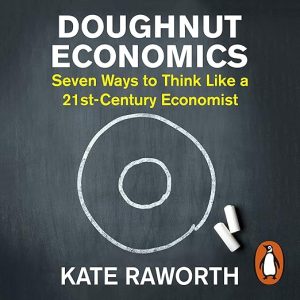
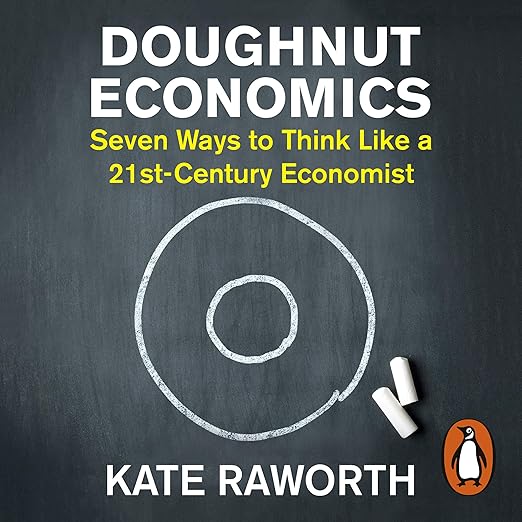
Kate Raworth's central image, a doughnut, is either a piece of genuine conceptual clarity or a clever piece of communication strategy, and possibly both. The doughnut's inner ring marks the social foundation below which no human being should fall: access to food, water, healthcare, education, political voice. The outer ring marks the ecological ceiling beyond which the planet's systems cannot safely be pushed. The space between them, the doughnut itself, is where economic activity should aim to remain. Doughnut Economics, narrated by Raworth herself in this ten-hour-plus audiobook, is the argument for why mainstream economics has never been designed to keep us there, and what it would take to redesign it.
The book was published in 2017, longlisted for the Financial Times and McKinsey Business Book of the Year Award, and has since become a reference text for a generation of economists, urban planners, and policymakers rethinking growth. Oxford academic and researcher Raworth identifies seven specific ways in which the economic models taught in universities and applied in government have failed: their concept of growth as inherently good, their treatment of nature as an externality, their assumption of rational economic man, their fixation on equilibrium. Each failure is a chapter, and each chapter maps to what a corrected model might look like instead.
Patient With the Mainstream Before Departing From It
Raworth's argument is not anti-economics. It is anti-a-specific-version-of-economics that she traces to a set of conceptual choices made in the mid-twentieth century and now taught as though they were laws of nature rather than design decisions. That distinction matters enormously for how you receive the book. She is not arguing that markets do not work or that growth is always destructive. She is arguing that an economic model designed around GDP growth as its primary metric, without upper limits set by planetary boundaries, is incapable of answering the right questions.
Reviewer Gary Moreau, who describes himself as a trained economist and corporate professional, writes that this book should be in a tier by itself and that it is truly transformative. That reaction from someone with insider credentials is worth noting. The book is not addressed only to the already-convinced; it is structured to move through the objections a conventional economist would raise and answer them in sequence. Raworth is patient with the mainstream view before departing from it, which is why trained economists find the argument harder to dismiss than they might expect.
The self-narration is a significant asset here. Raworth's voice is measured and precise, exactly what the subject demands. She does not perform urgency; she earns it through the accumulation of evidence and argument. When she reaches the sections on ecological limits and the mechanisms of climate feedback, the restraint in her delivery makes the material more alarming, not less.
Active Listening Rewards This Eleven-Hour Argument
For listeners without formal economics training, the audiobook is more accessible than the genre typically promises. Reviewer Maine Man, describing himself as an economics neophyte, notes that Raworth makes economic theory and history approachable without requiring the advanced calculus that university students would encounter. She uses well-chosen analogies and builds concepts incrementally rather than assuming background. The companion reference material available in the Audible library is worth downloading for the visual framework of the doughnut itself, which the audio describes but which is more immediately comprehensible as a diagram.
The running time of just under eleven hours is substantial. The book rewards the investment because each of the seven chapters is building the same core argument from a different angle, and the cumulative effect is considerably stronger than any single chapter would be in isolation. Listeners who engage actively, pausing to think through the implications of each corrected model before moving to the next, will find the audiobook a denser and more rewarding experience than passive background listening.
Rational Economic Man Has No Real-World Basis
The chapter on human nature, which addresses the myth of rational economic man, is among the strongest in the audiobook. Raworth draws on behavioral economics, neuroscience, and anthropology to show that the self-interested, utility-maximizing agent of mainstream economic models has no real-world basis. This is not a new argument, but she synthesizes it more cleanly than most and shows specifically how the assumption of rational economic man leads to policy failures rather than merely theoretical ones.
Her treatment of energy and nature's resources as factors that mainstream economics systematically ignores is a key thread to follow throughout the listening. She traces exactly how GDP growth can mask the depletion of natural capital that makes future growth impossible, and how economic models that treat nature as an infinite externality cannot, by design, account for what happens when limits are reached. For listeners concerned about climate policy and environmental sustainability, this is the chapter that lands with the most immediate urgency.
Stronger as Critique Than as Policy Blueprint
This audiobook is essential for anyone who works in economic policy, urban planning, sustainability, or any field where the question of how to measure progress is actively contested. It is equally valuable for the general listener who has found mainstream economic news coverage unsatisfying and wants a framework for understanding why GDP and stock market indices are poor proxies for human welfare. Raworth's writing is clear enough that no economics background is required, though some familiarity with basic economic concepts, supply and demand, GDP, monetary policy, will help in the early chapters.
Those looking for a practical policy program will find the final chapter, which sketches what a regenerative and distributive economy might look like in practice, more programmatic than prescriptive. The book is stronger as a critique and a reframing than as a policy blueprint. But as a reframing, it is among the most clearly argued available in this format.
Common Questions
Does Kate Raworth narrating her own audiobook add significantly to the Doughnut Economics listening experience?
Yes, meaningfully. Raworth's delivery carries the intellectual confidence and measured passion that give the argument its weight. She knows exactly where to slow down for a concept and where the argument builds momentum, which makes for a more coherent listening experience than an outside narrator working from text alone would typically produce.
How does Doughnut Economics compare as an audiobook to other critical economics titles like Capital or The Wealth of Nations?
Raworth's book is considerably more accessible than either of those canonical texts in audio form. Where those works were written as technical arguments for specialist audiences, Raworth writes deliberately for the general educated reader. The audiobook benefits from her self-narration, which keeps the prose from hardening into academic density even in the most technical chapters.