
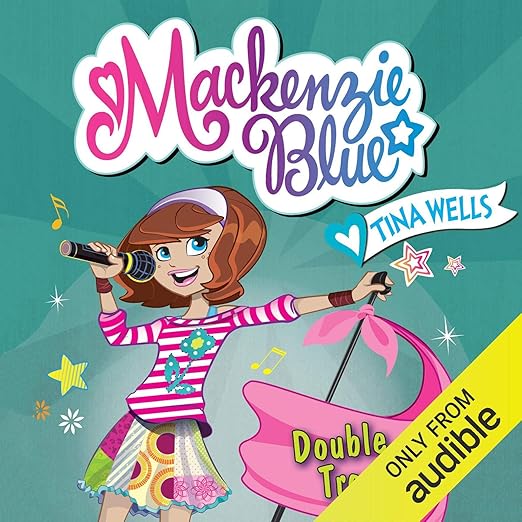
- Narration: Katie Schorr captures Zee's diary-entry voice with the right mix of breathless energy and emotional honesty suited to the middle-grade audience.
- Themes: Friendship versus ambition, performing arts aspirations, middle school identity pressure
- Mood: Warm and slightly frenetic, with the honest emotional register of a twelve-year-old figuring out what she actually wants
- Verdict: A confident fifth installment in the Mackenzie Blue series that handles its central conflict with genuine understanding of how tweens experience competing priorities.
Zee's TV Audition Costs Her Real Friendships
Mackenzie Blue's fifth installment hands Zee Blue her biggest opportunity yet and then immediately makes her miserable about it, which is exactly the right narrative move for a middle-grade series built on the authentic texture of being twelve. Double Trouble is an audiobook that understands what its readers actually worry about, not grand catastrophes but the specific social cost of canceling plans with your best friend for the third time in a row because an audition ran late. Tina Wells has been writing Zee since the first book with an awareness of that emotional frequency, and this volume in the Mackenzie Blue series does not break from that commitment to capturing what early adolescence actually costs in small social transactions.
Zee lands an audition for a TV pilot where she would play an aspiring singer, which is a casting choice that feels both specific and inevitable for a character who has been building toward a performing identity across the series. The conflict is structural rather than dramatic: the more she commits to the auditions, the more she fails the people she loves. No villain exists in this story. No catastrophe arrives. Only the quiet pressure of wanting two things that keep bumping into each other, which is the kind of conflict that kids in the target age range recognize immediately because they live it constantly in the context of school, extracurriculars, and friendship groups that demand their own loyalty tax.
Katie Schorr Voices Zee's Audition Nerves
Katie Schorr handles Zee's voice with the particular energy that middle-grade audiobooks require: present and readable without veering into the exaggerated performance that alienates older listeners in the eight-to-twelve range. One reviewer compared the series favorably to Dork Diaries, and the sonic register is similar in that both aim for a first-person voice that feels like a diary entry read aloud, slightly breathless, emotionally unguarded, and aware of its own absurdity. Schorr is good at that register, and she calibrates the moments of genuine friendship warmth against the moments of self-conscious humiliation with the right amount of tonal contrast to make both feel real.
The music and performance elements that run through this book work particularly well in audio. When Zee is rehearsing, nervous before an audition, or processing the gap between how she sounds in her head and how she sounds in the room, those scenes benefit from being heard rather than read. The audiobook format suits this specific subject in a way that the text-on-page experience does not quite replicate. Schorr brings a kind of embodied understanding of performance anxiety to those sections that gives them a quality the print edition simply cannot match, and it is the specific reason to choose audio for this particular volume in the series.
Book Five Assumes You Know Chloe and Ally
This is book five of the Mackenzie Blue series, and while Wells provides enough context that new listeners can orient themselves without having read the earlier volumes, the emotional weight of Zee's friendship dynamics assumes prior investment. The bonds with Chloe, Ally, and the rest of the group carry history that the book references but does not fully reconstruct. Listeners coming in at book five may find themselves caring about Zee herself while feeling slightly removed from the stakes of her friendships. Starting from book one gives those friendships their proper weight and makes Double Trouble significantly more effective as a fifth installment than as a standalone listen.
The resolution also arrives in a way that some listeners will find slightly accelerated. The final act brings the competing pressures together in a manner that closes the central tension cleanly but does not sit long in the consequences of the choices Zee made along the way. For a series aimed at the upper elementary and middle school range, that efficiency is a reasonable editorial choice. Younger readers in particular often prefer resolutions that restore equilibrium without extended moralizing. Older readers in the target range who have developed a taste for narrative ambiguity may find it slightly tidy, though the ending does not feel dishonest to the characters Zee and her friends have been across the series.
Wells is also careful about how she handles the resolution without making it feel like Zee simply chose correctly all along. The costs of her choices are real, and the people who were affected by her cancellations and absences do not simply forgive her because the audition went well or badly. The friendships in the Mackenzie Blue series have always been one of the more honestly rendered elements of the books, and Double Trouble does not treat the repair of those friendships as automatic. It requires actual acknowledgment and actual change, which is the kind of moral texture that makes the series worth reading across its run rather than just sampling individual installments.
Existing Fans Get the Most From This One
This audiobook suits readers aged nine to thirteen, particularly those navigating the specific tension between personal ambition and social belonging that defines early adolescence. Girls involved in performing arts, whether music, theater, or dance, will find Zee's particular dilemma especially resonant and well-observed. The series as a whole has been embraced by the Dork Diaries readership, and the tonal overlap is genuine enough that a recommendation for one translates reliably to the other. For new listeners to the Mackenzie Blue series, books one through four are the right starting point before this volume. For existing fans, Double Trouble delivers exactly what the series has been building toward in Zee's performance ambitions, with Schorr's narration adding a dimension that makes the audiobook format the ideal way to experience this particular story in the run.
A Few Questions About Double Trouble
Does the audiobook format add anything specific for a story centered on music and performance?
Yes. The rehearsal scenes, audition anxiety, and Zee's internal processing of her own sound work better in audio than on the page because the format makes the performative dimension of the story feel more immediate.
Is Double Trouble a good standalone audiobook or does it end on a cliffhanger?
The central tension resolves cleanly within this volume. It is not a cliffhanger ending, though the series continues and Zee's larger arc across the full run is not complete at the end of book five.







