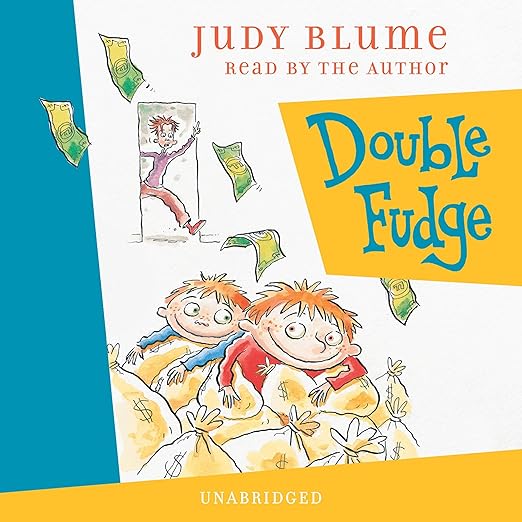
Judy Blume personally narrating this fifth Fudge book is a different kind of craft choice than most self-narrated audiobooks make: this isn't a debut author reading a manuscript for the first time, it's a writer with decades of history in this exact voice and these exact characters, returning to material apparently set aside as finished before deciding otherwise. That history shapes how this audiobook lands more than any single performance choice could.
Two Farley Drexels Give Double Fudge Its Title
Fudge, still going by his real name Farley Drexel when it suits the joke, has discovered money as his latest obsession: printing his own "Fudge Bucks," dressing as a miser for Halloween, and picking out birthday and Christmas presents years ahead of schedule, much to the mortification of older brother Peter, who is starting seventh grade and would very much like his little brother to be less of a public spectacle. Eric B. Gordon's review gives useful context here: Blume got the inspiration for this specific book in 2002, after a run of readers, that reviewer included, assumed Fudge-a-Mania had wrapped the series for good.
The plot complication that gives this entry its shape is a genealogical coincidence: the Hatchers discover long-lost relatives, the Howie Hatchers of Honolulu, Hawaii, including new cousins Flora and Fauna and a four-year-old named Farley Drexel, yes, another one, which the synopsis flags with its own exclamation point. That doubling is baked right into the title itself: Double Fudge works as both a description of the money-obsessed plot and a literal description of there suddenly being two children with the exact same real name running around one extended family.
The printed "Fudge Bucks" detail is the sharpest joke of the bunch precisely because it's so specific: not a vague obsession with money but an actual invented currency, evidence of a small child's very particular, very literal-minded logic applied to a grown-up preoccupation. Peter, thrust into seventh grade and visibly mortified by all of it, supplies most of the exasperation running underneath these particular jokes, the reliable straight man to a little brother who has never once considered that his logic might not be everyone else's.
One Review Finds Jokes for Kid, Teen, or Grandma
Reviewer colm zeroes in on a small, specific beat that says a lot about Blume's instincts as a writer: appreciating how "fudge understood how Peter felt when he swallowed dribble," a callback moment that rewards a listener who already knows the earlier books rather than working as a standalone joke. That kind of internal continuity, characters actually remembering and reacting to earlier events rather than resetting each volume, is easy to skip in a long-running series and the reviews here suggest Blume didn't skip it.
The anonymous four-star review makes the strongest case for this book's cross-generational reach: "whether it's the well-hidden adult humor or how Peter and Fudge's brother relationship changes throughout the series," material aimed at "kid, teen, or grandma" alike sits inside the same chapters without one age group's version crowding out another's. Jess Gustin's review backs that up from the other direction, a fourth grader who "laughed out loud," proof the humor lands with its stated target audience just as directly.
Only Two Ratings Sit Behind the 4.7 Average
Only 2 ratings are counted toward the displayed 4.7 average here, while five full written reviews sit beneath that number, leaving a real gap between how many people rated the book and how many left something to actually read. Eric B. Gordon's review cuts off mid-sentence at "seven years," presumably finishing a thought about how long it took to finally pick this book up after Blume wrote it, but the listing doesn't preserve the rest. That review otherwise makes clear the earlier books got read, plus Otherwise Known as Sheila the Great, between the ages of ten and eleven, before assuming the series had ended with Fudge-a-Mania, which puts this fifth entry's eventual discovery into a real, specific personal timeline rather than a vague general endorsement.
Listening Library published this fifth Fudge entry back on March 27, 2007, yet the visible reviews here stretch from 2011 through 2025, well over a decade of listeners still finding and rating the same recording, which for a chapter book aimed at a specific age range is a meaningfully long tail rather than a title that faded quickly after release.
Blume Brings Her Own Voice to Fudge
Fudge devotees who already worked through the earlier books in the series, up through Fudge-a-Mania, get the most out of this entry specifically because of how much it leans on remembered detail, per colm's review of the dribble callback. Grandparents buying for grandkids, a pattern that shows up directly in mike spain's short review, will find a series built to survive exactly that kind of handoff between generations.
New listeners unfamiliar with Peter and Fudge should still find plenty to enjoy, since the core sibling dynamic, an exasperated older brother managing a chaotic younger one, needs no prior installment to make sense on its own terms. Anyone hoping for a plot that stands apart from the family's earlier adventures should know this one leans specifically on the Hatchers' backstory building across the series rather than introducing a fully self-contained situation.
Parents deciding between a print copy and this audio edition should weigh Blume's own narration as a genuine point in the audiobook's favor rather than a neutral format choice; hearing the author's own comic timing on jokes written decades into a long career carries a different authority than a hired narrator interpreting the material secondhand.
Before You Press Play
- Read by: Judy Blume personally narrates this fifth Fudge entry, bringing decades of authorial history to material once assumed finished for good.
- At its heart: sibling rivalry, family money obsession, long-lost relatives
- Vibe: Warm, chaotic, and comic
- Short version: Fudge devotees who remember the earlier books get the most payoff, though new listeners will still follow the core sibling comedy easily.