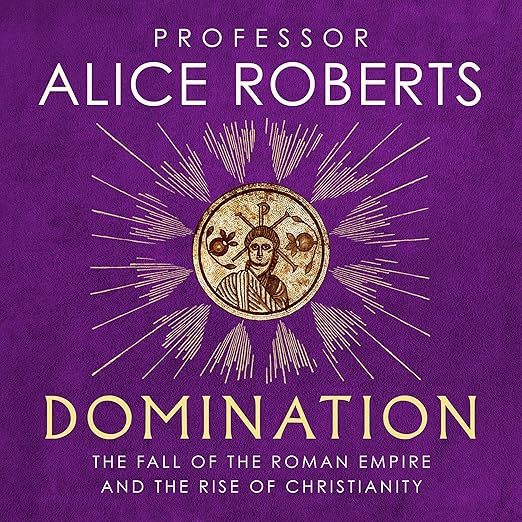
Quick Take
- Voice: Alice Roberts narrating her own work gives the investigation an intimacy and intellectual conviction that a hired voice could not replicate, though the pace is occasionally academic.
- Big ideas: Power and its survival across institutional collapse, the political origins of Christian expansion, archaeology as counter-narrative
- Atmosphere: Investigative and intellectually demanding, rewarding for those willing to sit with complexity
- Worth it?: A genuinely original argument delivered with real archaeological authority, but listeners who need accessible pacing should prepare for a slow first chapter.
I came to Domination with a specific interest: I had been reading around the dissolution of the Western Roman Empire for a project of my own, and Professor Alice Roberts's name kept appearing in recommendation lists alongside more familiar titles. What I did not expect was how thoroughly the book would reframe what I thought I understood about the relationship between imperial power and religious expansion. I finished it on a long train journey, notebook open, finding myself scribbling questions I had not thought to ask before. That is the specific pleasure of a book that is genuinely doing something new with material that seems well-covered.
Roberts's argument, developed through archaeological evidence rather than purely through textual sources, is essentially this: when the Western Roman Empire crumbled, a shadow of its power structure remained, mapping almost perfectly onto its disappearing territories. That shadow was the Catholic Church. And then it continued to spread. The book traces that movement from a secluded valley in south Wales to the shores of Brittany, from the Roman political turmoil of late antiquity to the ancient city of Corinth in the footsteps of Paul, from fourth-century Alexandria to Constantinople. It is ambitious both geographically and argumentatively.
Forensic Instincts Meet a Slow Opening Chapter
What distinguishes Domination from other accounts of Christianity's rise is Roberts's insistence on the physical evidence: the buildings, the material culture, the administrative structures that survived the collapse of one empire and were absorbed into another. She is a professor of anatomy and biological anthropology with a secondary specialization in archaeology, and her forensic instinct for what objects and structures actually tell us about power is the book's strongest asset. The best sections, as one reviewer correctly identifies, come in the middle chapters where she traces the transition from Roman to Christian in specific material contexts.
The journey through south Wales and Brittany in the opening section is where Roberts grounds the larger argument in specific place, and it is also where the book's pacing is slowest. One reviewer described the first chapter as wearisome, citing the depth of detail on Celtic place names and monk-recorded histories. That assessment is fair as a warning, though it somewhat overstates the case. The opening is dense, and the digression through Argentine cultural figures to illustrate something about the persistence of power symbols feels slightly out of place. But readers who persist will find that Roberts earns the density in the chapters that follow.
Roberts's Own Voice, and a Split 4.3 Rating
The decision to have Roberts narrate her own work is interesting and, on balance, the right call. She brings to the audiobook the quality of a lecture delivered by someone who genuinely believes the argument matters, which is an energy that professional narrators often cannot fully replicate when the material is this specialized. The conversational rhythm of her academic prose, which one reviewer described as breezy in a way that was initially irritating before proving enlightening, translates directly to her narration style. You are spending twelve hours and forty-six minutes with someone thinking aloud about a question that has occupied her for years. If that dynamic suits your listening preferences, Domination delivers it fully.
The 4.3 rating across over two hundred reviews reflects a genuine split between listeners who find the pacing and density exactly right and those who expected something more immediately accessible. Both responses are honest.
Politics and Architecture Over Miracle and Theology
Roberts is careful to frame Domination as an investigation rather than a definitive account. She is not writing a complete history of the early church, and she says so. What she is offering is a corrective to narratives that treat Christianity's spread as primarily theological or miraculous, ignoring the gritty administrative, architectural, and political realities of institutional expansion. One reviewer calls this a new approach to viewing Christianity's takeover of the fragmented Roman Empire, focusing on political realities. That framing is exactly right.
Listeners who are seeking reassurance of faith will not find it here, and several reviewers signal as much. Roberts is operating as a scientist and historian, not as an apologist or a debunker. The book is neither hostile to Christianity nor reverential about it. It is interested in power, and how power persists even when the institutions that generate it collapse.
Complexity-Tolerant Readers Earn an Ending That Stays
Domination is for listeners who are genuinely comfortable with historical and archaeological complexity, who want their nonfiction to challenge existing assumptions, and who can tolerate a slow opening in exchange for a genuinely original argument. Ancient and medieval history readers will find it essential. Listeners who are new to the period or who need accessible narrative momentum throughout may find the density difficult to sustain. The middle chapters are worth the patience required to reach them.
It is also worth noting that Roberts's willingness to name what she finds, including conclusions that established church historiography tends to minimize, gives the book an intellectual honesty that is refreshing in a field often shaped by institutional sensitivities. She follows the evidence where it leads. That is not the same as hostility to the subject matter. It is the basic commitment of a working scientist applied to a domain that has not always welcomed scientific scrutiny. Listeners who have spent time in adjacent fields, history of science, comparative religion, Roman archaeology, will recognize and appreciate that commitment even when they disagree with specific conclusions.
Roberts closes the book not with a definitive verdict but with the image of power persisting, mapping itself onto new institutions, finding new languages for the same fundamental human drives. It is an ending that stays with you.