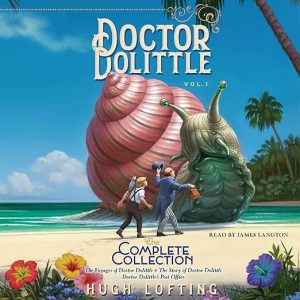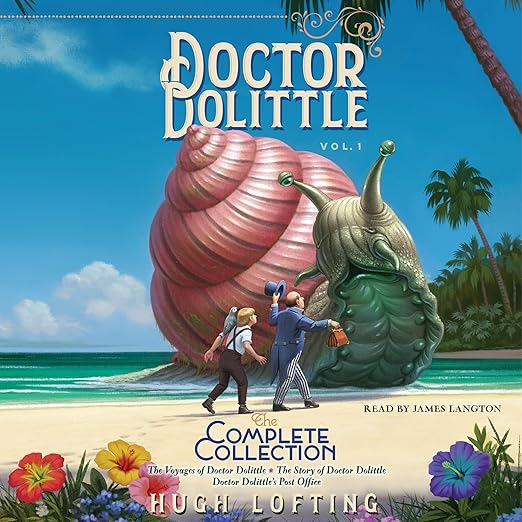
Doctor Dolittle arrived in my listening queue because my nephew would not stop talking about a two-headed animal called the pushmi-pullyu, and I realized with some embarrassment that I had never read the original Hugh Lofting books. This audiobook, the first volume of the complete Doctor Dolittle collection, gave me fifteen hours and twenty minutes of exactly what children's literature is supposed to do: pull you out of the world you know and drop you into one that operates on more generous rules. James Langton narrates all three novels in a way that makes the gentle absurdity feel entirely natural.
The Texts Feel Alive Rather Than Preserved
This volume collects three novels: The Story of Doctor Dolittle, The Voyages of Doctor Dolittle, which won the Newbery Medal, and Doctor Dolittle's Post Office. Together they introduce the good Doctor's core premise, a physician who abandons human patients in favor of animals because his animal-language skills prove far more useful, and then expand it outward into two African adventures and a sea voyage that culminates in an encounter with the Great Glass Sea Snail. Lofting's son worked with the publishers on an update that retains the original charm while adjusting some of the period-specific content that would read poorly to modern audiences. The texts feel alive rather than museum-piece preserved.
For families considering this audiobook, the key thing to know is that the collection is aimed at independent listeners who are just beginning to engage with longer-form fiction on their own, though it works beautifully as a shared experience. Reviewers who grew up with these books have noted that Lofting never condescended to his young readers, and that quality comes through clearly in the audio. The Doctor is portrayed as genuinely eccentric rather than cutely child-friendly, and his world-travel adventures carry real stakes even when they are resolved with characteristic good humor.
Langton Finds Distinct Voices Without Caricature
James Langton is an experienced reader of classic children's literature, and his performance here demonstrates exactly why that experience matters. He finds distinct voices for Polynesia the parrot, the pushmi-pullyu, and Tommy Stubbins without tipping into caricature. The Doctor himself is given a quality of gentle authority, confident about animals, somewhat baffled by humans, that Langton sustains consistently across all three novels. At fifteen hours and twenty minutes, this is a substantial listening commitment, and the consistency of Langton's performance makes it feel far shorter. The pacing is excellent for children who are growing into sustained attention but still need momentum to carry them through longer chapters.
The Great Glass Sea Snail Needs No Illustration
Since this is a compilation of three novels, the tonal register shifts slightly between them. The Story of Doctor Dolittle is the most compact and episodic, functioning almost as a series of linked adventures. The Voyages of Doctor Dolittle is longer and more novelistic, with a proper arc built around the search for Long Arrow and the Newbery Medal-level ambition to match. Doctor Dolittle's Post Office is the most inventive in premise. If a child connects strongly with the first novel but finds the longer middle volume harder to sustain, it is worth encouraging them to push through. The payoff in the voyage sequences is genuine.
A note for parents: some reviewers have pointed to the original Dolittle books as texts that shaped their understanding of biology and natural history. The animal communication premise is whimsical, but Lofting's genuine respect for animal behavior runs underneath it. Readers who went on to study biology have cited these books as an early influence, which tells you something about the depth of imagination at work even in the comedic passages. As a children's audiobook, this collection has more to offer than most of its contemporaries, and the Newbery pedigree is not just decorative.
Hugh Lofting's original illustrations, which accompanied the print editions, are obviously absent from the audiobook format, but their absence matters less than it might seem, because Lofting's prose does its own visual work. The pushmi-pullyu's physical comedy, the Great Glass Sea Snail's improbable scale, and the logistics of a postal service run entirely by birds are all described with enough specificity that a child's imagination has plenty to work with. James Langton helps by pacing through descriptive passages at a speed that allows those images to form rather than rushing past them. One reviewer noted that these books were the first long books they ever read on their own, and that Lofting never wrote down to children. That quality survives completely in audio. The Doctor is not a figure of adult wisdom descending to child-level; he is a person with a specific and unusual expertise, somewhat confused by the world but perfectly calibrated to his animals, and Langton portrays that quality without condescension in either direction.
The 2020 Film Has Almost No Relationship Here
This is an ideal audiobook for children roughly ages seven through eleven, whether listening independently or with family. It works beautifully on road trips or as a bedtime serial over several weeks. Adults who remember the books from childhood will find the revisit surprisingly moving, particularly in the Tommy Stubbins sequences of The Voyages.
Skip if you are looking for a single, focused story with tight plotting. The episodic structure of the first and third novels in particular reflects their serialized origins, and some chapters resolve very quickly. Children who need narrative momentum above all else may find the looser sections hard to follow. The 2020 Robert Downey Jr. film has almost no relationship to these originals, so managing expectations around that connection is worth doing upfront.
Is this audiobook appropriate for children who are just starting to listen independently?
Yes, and that seems to be the design intent. The collection is described as perfect for fans who are beginning to listen on their own, and Langton's narration is clear and expressive without being overwhelming. The stories move at a pace that holds attention without requiring the sustained focus that longer YA novels demand.
Does the audiobook include all three novels in full?
Yes. Volume 1 contains The Story of Doctor Dolittle, The Voyages of Doctor Dolittle, and Doctor Dolittle's Post Office in their updated forms. The texts have been revised in collaboration with Hugh Lofting's son to retain the original charm while updating language that would be problematic for modern readers.
How does James Langton handle the many animal characters in his narration?
Langton gives each animal a distinct but not exaggerated voice, which is exactly right for this material. Polynesia the parrot and the pushmi-pullyu are recognizably different from one another and from the human characters. He does not go for comic caricature, which keeps the animals feeling like genuine personalities rather than punchlines.