In Brief
- Big ideas: animal defense mechanisms, camouflage and active protection, natural world curiosity
- Atmosphere: Brisk, surprising, engineered to spark conversation after the listen ends
- Worth it?: A five-minute early-science audiobook that asks a question children will keep asking after it ends. The narrator is not individually credited in this Animals All Around series release.
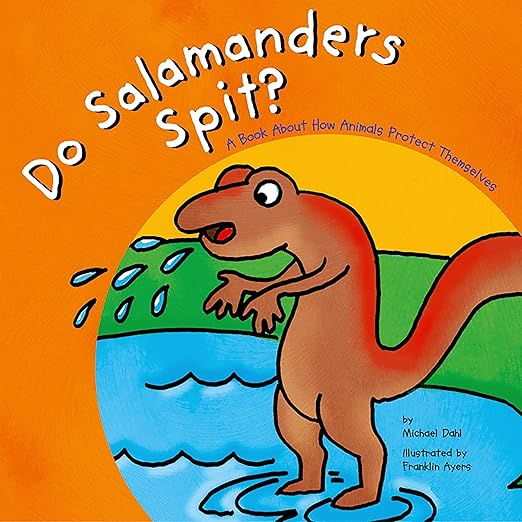
Salamanders, it turns out, have a more sophisticated answer to survival than most children would guess, and the audiobook edition of Do Salamanders Spit? by Michael Dahl uses that curiosity gap as its entry point. This five-minute listen, part of the Animals All Around series, covers animal protection mechanisms across a range of species, from camouflage and hiding to active defense behaviors, including the title question that hooks any child old enough to wonder about it. The narrator credit is not individually listed for this series release, which follows the standard production approach across the Animals All Around format. The focus is on clear factual delivery for young listeners rather than distinctive voice performance, and the series approach is consistent across its titles.
Toxic Skin Secretions Beat Simple Saliva
Where Do Parrots Have Pillows?, another Animals All Around title from Michael Dahl, takes habitat and resting behavior as its subject, Do Salamanders Spit? addresses animal defense, which is a topic with intrinsically higher dramatic stakes for young listeners. Protection mechanisms span the spectacular and the subtle: a salamander's skin toxins, an insect's camouflage, a possum's famous death performance. The five-minute format forces Dahl to select carefully, and the selection in this title is built around contrast. Hiding and fighting represent opposite ends of the defense spectrum, and the book moves between them in a way that gives young children a conceptual framework rather than simply a list of unconnected facts to memorize.
The title question, Do salamanders spit?, is engineered for maximum conversational utility after the listen ends. Children who encounter this audiobook will ask the question again before the day is over, which is the mark of a fact that has landed correctly. The answer, which involves something more interesting than conventional saliva, the toxic skin secretions that make many salamander species actively dangerous to predators, is the kind of biological detail that satisfies because it is both surprising and logical once explained. Dahl's career across this format has been built on finding exactly those moments of surprise-that-becomes-obvious.
The contrast between defensive hiding and active chemical defense also gives young children a way to think about animal adaptation as a spectrum of strategies rather than a single behavior. That implicit framework, built into the content without being explicitly stated, is one of the more valuable things early-science content can do: model analytical thinking without requiring children to articulate it consciously. The five minutes accomplish more conceptual work than the runtime might suggest.
Dinosaur and Shark Fans Get a Gateway Title
The five-minute runtime makes this audiobook one of the most flexible in its age range. It fits in the gap before school drop-off, during a snack break, as a transition between activities, or as the opening of a longer listening session for children who are still building the audio habit. The subject matter, animal self-defense, is perennially popular with children who also love dinosaurs, sharks, or any creature with a compelling survival strategy, which makes it a useful gateway title for children whose interests lean toward the natural world's more dramatic aspects.
The Animals All Around series as a whole is designed to be collected, and Do Salamanders Spit? covers different conceptual ground from the habitat and behavior titles in the same collection. A child who has listened to both the animal homes titles and the defense mechanism titles has begun to build comparative understanding of how animals function in their environments rather than simply accumulating unconnected facts. That cumulative effect is part of what makes the series a better long-term investment than any individual title's brevity might suggest. The titles reinforce and extend each other in ways that become apparent only across multiple listens.
Anonymous Narration Skips Sound Effects and Music
The anonymous narration is functional and age-calibrated but not distinctive. As with other Animals All Around titles, the production emphasis is on clear delivery of factual content rather than atmospheric storytelling or character performance. Parents who have listened to full-production children's audiobooks, with sound effects, music beds, and individually credited voice actors, will notice the more stripped-back approach. The content delivers what the title promises; the production is utilitarian rather than immersive. That is a consistent characteristic of the series rather than a flaw specific to this title.
Defense mechanism topics can occasionally brush against the more unsettling aspects of predator-prey relationships. The book handles this with age-appropriate framing, keeping the focus on what animals do to protect themselves rather than on graphic predation sequences. For children who are curious rather than anxious about nature, the content lands appropriately. For more sensitive listeners, the framing stays mild enough that distress is unlikely, but parents who know their child responds strongly to animal danger themes may want to preview the content.
Building Listening Stamina Five Minutes at a Time
Children aged three to seven with a curiosity about animals, especially those fascinated by creatures with interesting survival strategies, will find this audiobook immediately appealing. It works as a standalone title and as part of a larger Animals All Around collection built across multiple purchases. Caregivers building a listening library for early-science education will find this one of the more engaging entry points in the series given the inherent drama of the defense mechanism topic compared to more static natural history subjects. The five-minute runtime is a genuine asset for the youngest listeners who are building the stamina for longer audio experiences.
Good to Know
Is this audiobook appropriate for children who are nervous about animals or nature content?
The content focuses on animal protection behaviors rather than predation sequences, and the framing stays age-appropriate throughout. Sensitive children should handle it without difficulty. The defense mechanisms described are treated as fascinating adaptations rather than disturbing survival scenarios.
How does this audiobook differ from the other Michael Dahl Animals All Around series titles in terms of subject matter?
Each title in the Animals All Around series addresses a different aspect of animal biology and behavior. Do Salamanders Spit? covers protection mechanisms, while other titles address habitats, food sources, and movement. Together the titles build a comparative picture of the animal world across different biological functions.
At five minutes, is this audiobook long enough to justify purchasing for a child's audio library?
The value argument for the Animals All Around series rests on the collection rather than any single title individually. Titles at this length function as focused, repeatable learning moments rather than extended narratives. Families who build a set of them get cumulative educational value across different biology topics that individual titles do not provide on their own.