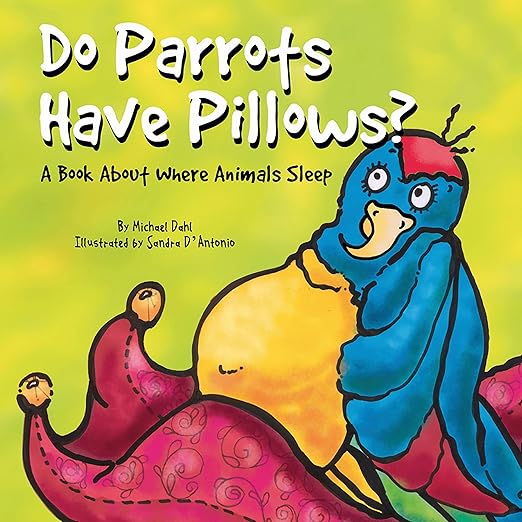
Michael Dahl's Animals All Around audiobook series has a knack for squeezing genuine curiosity into the shortest possible runtime, and Do Parrots Have Pillows? is a fine example of that compact form. This four-minute listen introduces young children to the concept of animal homes and resting places, asking a question that most children would never think to ask on their own. The narrator credit is not listed individually for this title, which is standard production practice across the Animals All Around format, and while that limits what can be said about the specific vocal performance, the series generally maintains a bright, clearly-paced delivery calibrated for young listeners. Dahl is a prolific creator of early-reader science content, and this title sits solidly within his body of work in the genre.
Otters Wrap in Kelp Against the Current
At four minutes, this is not a title where narrative depth or dramatic arc apply. The strength of Do Parrots Have Pillows? lies entirely in its premise: the question itself is engineered to make a child stop and actually wonder. Parrots nest in tree hollows. Horses doze standing up. Otters float on their backs, wrapping themselves in kelp so the current does not carry them away. The framing device of "do animals have things like what we have?" is genuinely effective for the four-to-seven age range because it builds bridges between familiar domestic life and the animal world. For children who are used to their own pillows, the idea that a parrot has a very different relationship with sleep suddenly makes the animal feel real and interesting rather than just something in a picture book.
The Animals All Around series as a whole relies on this strategy of posing a deceptively simple question and then delivering a handful of concrete, specific answers. Do Parrots Have Pillows? sits comfortably within that framework. The writing is direct and factual without talking down to its audience. Dahl has produced dozens of titles in this vein, and the consistency of quality across the series is part of the appeal for caregivers who are building a listening library for young children. Each title works as a standalone, which means there is no required listening order, and a child can jump in at any point without missing context. That flexibility makes the collection practical for families with children at different developmental stages.
The choice to structure the content around a child's own experience, bedtime, pillows, sleep routines, and then expand outward into the animal world is a pedagogical strategy that works across age ranges. Children who are still building language and concept connections benefit from this kind of anchor. The familiar domestically-oriented question serves as an entry point into genuinely unfamiliar natural history territory, and that movement from known to unknown is one of the cleanest things early-science content can do.
Four Minutes That Fit Preschool and Bedtime
The primary argument for this audiobook is its classroom and bedtime versatility. A four-minute runtime means it can slip into the gap between activities at preschool or serve as a pre-nap wind-down at home. The topic, animal sleeping and resting habits, is immediately relatable to young children who have their own bedtime routines, which makes the information stick in a way that more abstract science topics do not. Children come away with two or three specific animal facts they can share with someone else, which is a form of learning that tends to persist.
For parents building a first audio listening habit in young children, titles at this length are also strategically useful. The runtime is short enough that a child who is hesitant about audiobooks can finish it without feeling overwhelmed, and the satisfying structure of question posed and answers delivered gives a clear sense of completion. The Animals All Around series is designed to be collected and revisited, so Do Parrots Have Pillows? also functions as a natural gateway to other titles in the set. Families that start here often find themselves building out the collection title by title as children ask for more of the same format.
Anonymous and Read-Aloud, Built for Classrooms
Because no narrator is individually credited for this title, it is worth noting that the anonymous narration in the Animals All Around series is aimed squarely at an early-listener demographic. The pacing is deliberate, the vocabulary stays age-appropriate, and the delivery is generally warm without being cloying. Parents listening along should expect something closer to a read-aloud performance than a full audio production with sound effects or music. The experience is clean and purposeful rather than theatrical, which suits classroom use particularly well where competing audio stimulation can be a distraction.
The four-minute runtime also means that any listener expecting extended scientific detail will find the content thin by adult standards. That is by design. The goal is a first encounter with a fact, not a complete natural history lesson. For the intended audience of three-to-seven-year-olds, the level of detail is correctly calibrated. Parents who want to extend the learning can use the animal facts as conversation starters after the listen ends, or pair the audiobook with a relevant picture book from the library. The question the book poses, where do animals sleep?, opens a topic that has enough depth to sustain further exploration if a child becomes genuinely curious.
Caregiver and Child Share This Short Listen
This audiobook is built for preschool and early-elementary children who are beginning to develop curiosity about the natural world. It works well for car rides, classroom listening corners, or quiet time at home. Families who already enjoy the Little Blue Truck series or similar early-reader audiobooks will find the Animals All Around format satisfying in the same way, delivering a complete experience at an age-appropriate length. Adults looking for a science title with depth should look elsewhere, but as a shared listening experience between a caregiver and a young child, Do Parrots Have Pillows? does exactly what it sets out to do with economy and a question children will keep asking long after the four minutes are up.
- What it covers: animal habitats, sleep behaviors, early science curiosity
- Feel: Warm, brisk, and classroom-ready
- Our call: A four-minute science question built for preschoolers. The individual narrator is not credited for this Animals All Around series release, which is worth knowing before purchase.
Common Questions
Is Do Parrots Have Pillows? suitable for very young children, like toddlers?
Yes, the content and vocabulary are calibrated for children ages three to seven. The four-minute runtime is short enough to hold toddler attention, and the animal home topic is immediately relatable to children who have their own beds and bedtime routines.
Does this audiobook include sound effects or music, or is it a straightforward narration?
Based on the Animals All Around series format, the production style is a clean read-aloud narration rather than a full audio production with sound effects. The focus is on delivering the animal facts clearly for young listeners without competing audio elements.
Can my child listen to Do Parrots Have Pillows? without having heard other Animals All Around audiobook titles first?
Absolutely. Each book in the series is fully standalone with no required listening order. The question-and-answer format works independently, so children can start here or jump in anywhere in the collection at any point.
How does this audiobook work as an introduction to the longer science audiobooks for kids series format?
The Animals All Around series is among the most consistent of Dahl's early-science work in terms of format and age-calibration. The four-minute length is an ideal starting point for children building an audio listening habit, and the complete-story structure of each title helps very young listeners develop a sense of what an audiobook experience feels like from beginning to end.