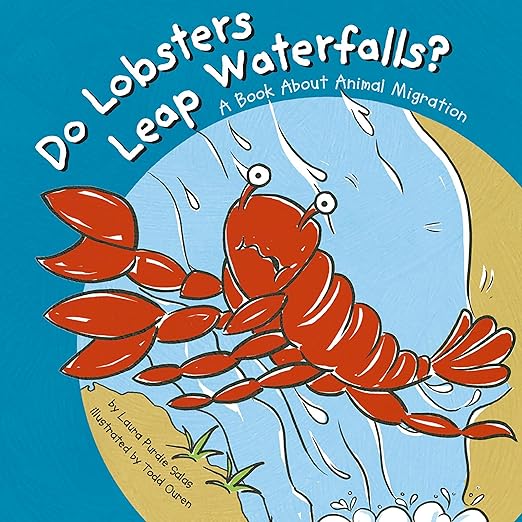
The word lobster appears exactly once in everything this listing offers, and that once is in the title. Laura Purdie Salas asks whether lobsters leap waterfalls, and then the description walks away from the question entirely and substitutes two of its own: "Who walks to the mountains?" and "Who runs across the plains?" At five minutes, this audiobook finishes before most people have made coffee. Judging it by its length would be unfair, but buying it without understanding how short it runs would be worse, because the brevity is the whole design rather than an accident of it.
What you are getting is one entry in the Animals All Around series, put out by Capstone in the spring of 2022, with a runtime shorter than a pop song and a reader credited only as anonymous. Nine people have rated it, collectively landing on 4.7, and not one of them has written a word about it. That combination, warm numbers and total silence, is normal for very short children's audio and still leaves a buyer with almost nothing to go on.
Lobsters Leap Waterfalls, a Question Never Answered
The text works by call and response. Salas poses a question about how something moves, the answer arrives as an animal, and the pattern repeats, accumulating examples until the underlying idea has assembled itself without anyone stating it as a rule. The promise the description makes is to "Move along with migrating animals to find out where they end up when the seasons change", and the phrasing is exact: you move along with them rather than being told about them. For a three-year-old, that difference is the difference between a story and a lecture.
The title is a joke the text is in on. Nothing in the description confirms that lobsters do or do not leap waterfalls, which means the question functions as a hook rather than a thesis, and a child who wants that specific answer has to go looking for it elsewhere. Whether the recording resolves it is something only the listener finds out, and the withheld payoff is either charming or annoying depending on the child. Most of the ones I have read to would demand the answer within about ninety seconds. The joke does real work regardless, because a question nobody has answered yet is the most reliable way to make a small child listen to the next sentence.
Concept books work by accumulation rather than argument, and at this age that is a pedagogical choice rather than a limitation imposed by length. A four-year-old does not need to be told that migration answers a change in season. They need to hear enough examples that the pattern becomes obvious, at which point the abstraction arrives on its own and stays. Salas trusts that process completely. The tradeoff is that a child who wants a reason, who asks why the birds leave rather than where they go, will not find one, and a parent should be ready to supply it.
Five Minutes Fits a School Run or Nap
Question-and-answer prose is the most audio-native writing that exists for this age group. A question read aloud creates a pause a child can fill, and a rhythm built on repeated grammatical shapes gives a four-year-old something to predict and then confirm. Salas is working in a register that survives being spoken in a way that dense informational text does not, and a recording of it turns a solitary reading experience into something a car full of people can do together. That is a real advantage over the printed page rather than a consolation prize.
The practical case is about slot size. Five minutes fits a school run, the gap before a nap, the last stretch of a bath, or the two minutes of a lesson between one activity and the next. Nobody has to commit, nobody has to remember where they stopped, and a teacher introducing a unit on seasonal movement can play the whole thing twice and still have most of the period left. Short-form children's audio is undervalued precisely because it does not look like much on a receipt. Repetition is cheap here too: a child who wants it again gets it again, and nobody loses ten minutes to the request.
An Anonymous Reader Carries a Five-Minute Recording
The credit is the thing to weigh hardest. The reader is listed as anonymous, which at this length is not a minor gap: in a five-minute recording the performance is essentially the entire product, since the writing gives a voice nowhere to hide and no plot to carry it. You cannot look up whoever is reading, cannot check what else they have done, and cannot borrow anyone else's judgment, because none of the nine people who rated this left a comment. Play the sample. At five minutes, the preview is a meaningful proportion of the whole. A recording this short also leaves no room for a listener to acclimate to a voice they dislike.
Two smaller flags. The series name is attached to this title with no position number, so anyone trying to collect Animals All Around in order gets no guidance from the listing itself and has to reconstruct the sequence from the covers. And the description runs to two sentences, which means the title carries the entire sales pitch while the animal in that title never reappears in the copy. For a book aimed at parents scanning quickly, that is a lot of weight resting on a question about crustaceans.
Ages Three to Seven Get a Supplement
This is for households with children roughly between three and seven, and for early-years classrooms that need a self-contained science moment rather than a project. If you are building toward a lesson on seasons, or if your child has started noticing that the birds are gone, the timing writes itself. Parents who already read aloud will find it a useful change of voice, and the price of trying it is five minutes of anyone's afternoon.
Give it a miss if you want depth, a proper explanation of why migration happens, or anything resembling a listening session. Pass as well if an uncredited reader bothers you, because nothing on this page will resolve that. The honest framing is that this is a supplement rather than something you build an evening around, and it has been sized accordingly. Temper expectations too for any child who latches onto the title: the lobster is bait, the subject is movement across seasons, and a curious six-year-old will finish this wanting a second, longer book about exactly the animal that lured them in.
Before You Press Play
- Big ideas: Seasonal migration, how different animals travel, question-and-answer discovery for the very young
- Atmosphere: Brisk and sing-song, one idea delivered cleanly and then finished
- Worth it?: Five minutes that do a single job well, best treated as a classroom or bedtime unit rather than something you sit down with.
Before You Listen
Is five minutes really the full audiobook, or is something missing?
Five minutes is the complete recording. Nothing has been abridged; the book itself is a short read-aloud built on a repeated question-and-answer pattern, and the audio covers all of it. Treat it as a single sitting for a young child rather than as a listening session you plan an afternoon around.
Why is the narrator listed as anonymous, and does that matter?
The listing simply carries no name in the reader credit, which happens with short children's productions. It matters more here than it would on a long title, because at this length the voice is most of what you are buying. Playing the preview before you commit is the only way to judge it.
Does the book actually answer the question in its title?
The description never mentions lobsters again after the cover, so the question works as a hook rather than a stated subject. The declared topic is migrating animals and where they end up when the seasons change, which is broader than any single species and covers walking, running and other kinds of travel.
Can you start the Animals All Around series with this audiobook?
Nothing in the listing suggests otherwise. The series is attached to this title without a position number, and the format is a self-contained concept book rather than a continuing story, so any entry works as a starting point and the order is a matter of interest rather than sequence.