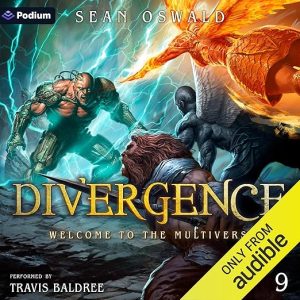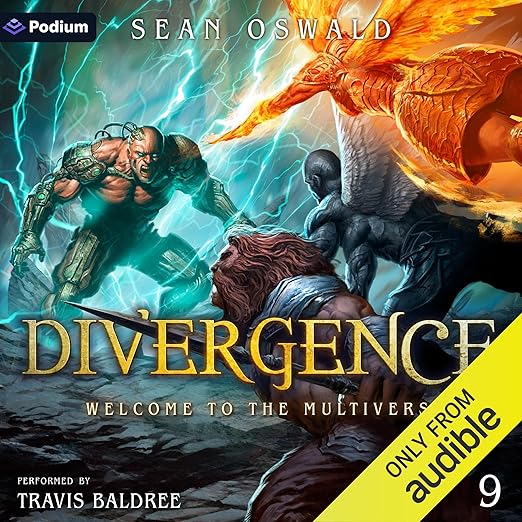
- Narration: Travis Baldree is credited on a Podium production that landed three months after most of the people writing about it had already finished the text
- Themes: Power escalation that costs something, a multiverse widening toward crossover, obligations inherited from eight earlier volumes
- Mood: Propulsive and accumulative, built for people already invested
- Verdict: A satisfying ninth entry for committed series readers, and close to impenetrable as an entry point.
Ninth volumes are where series either tighten or sprawl, and this one has its readers arguing about which way it went. Silas has grown strong enough to become a target, and so has Earth, and so have Earth's allies. Something is loose that wants nothing except destruction. That is close to the entire description Podium Audio attached to a nineteen-hour audiobook, which tells you a great deal about who this release was made for.
What Sean Oswald Delivers
Silas is the whole load-bearing structure by now, and the November 9 five-star response puts a finger on why that holds: the progression and the maturity acquired across the journey. That is the specific pleasure of a long-running series, watching accumulated change rather than a single arc, and the same note credits this installment with keeping the flow intact even with a great deal happening at once across multiple worlds and a steadily widening cast.
Fewer than five hundred characters of copy on a ninth installment is a signal rather than an oversight: the publisher assumes you already own the previous eight, and I do not believe the description was ever meant to help a newcomer. No recap, no premise, no explanation of what the multiverse is or how anybody crosses between its parts. If you landed here through a search rather than through the sequence, this page will not orient you.
Series audio usually trails the text by a quarter, and that is precisely the gap on display. The recording arrived on February 17, 2026. Four of the five written responses went up between November 8 and December 8 of 2025, which is to say they belong to readers rather than to listeners. Only the March 2026 note comes after the recording existed. Podium credits Travis Baldree, and by volume nine the voice attached to a series carries consequences for everyone returning.
Crossover is what longtime readers seem most excited about. Clayton Steinbacher, five stars on November 8, praises the world building and the character building and then goes further, reporting having spotted signs that another of the author's series is being folded in, which would make the multiverse bigger still. Whether that pays off is a future problem for a future book. The anticipation of it is already part of what people are buying here.
Progression is the genre engine, and Oswald keeps feeding it without letting it run free. Growing stronger is the premise line, and the book turns strength into a liability immediately: the more Silas can do, the more attention he draws, and the more obligations pile up around him. That is a smarter version of the power fantasy than the subgenre usually bothers with, because it prices the escalation rather than simply enjoying it.
Scale is the other selling point and the other risk. Threats in this installment operate at several levels simultaneously, and the one demanding attention first has no motive beyond raw destruction, which takes negotiation off the table completely. A recording of nearly twenty hours gives that structure the room it needs to breathe. Nobody is going to accuse this book of feeling rushed at the sentence level, whatever they conclude about the plotting.
Where Sean Oswald Loses Some Ground
Cierra Hardy filed four stars on December 8 with a complaint that is really a request: the books should be longer, with more detail or more depth given to threads carried over from earlier volumes. That same note concedes the difficulty of doing so once a series keeps expanding in scope. It is the only rating below five anybody has posted, and it asks for more of what it likes rather than less of anything.
Brittany Barton, writing in March 2026, wants the exact opposite. That five-star response is relieved the story sped up considerably, calls the acceleration extremely welcome after so long inside the series, and hopes the rapid progress continues so the whole enterprise does not collapse under its own weight. Two readers, two opposed prescriptions, three months apart. A one-to-one split is not a consensus about pacing, and quoting either as the verdict means quoting half an argument.
Counters on this page cannot be trusted. The listing reports one rating and a 4.7 average, and a single whole-star vote cannot come to 4.7; it can be a three, a four or a five and nothing else. Meanwhile five written responses sit underneath, each carrying its own star rating. Whatever that counter is measuring, it is not the ratings a buyer can see with their own eyes.
Latecomers arriving without the previous eight books should understand what the thin copy conceals. This is not a standalone with series flavoring. Obligations accrued in earlier volumes drive the plot, the horrors Silas has been shown happened somewhere else, and the payoff of watching a character mature exists only if you watched it happen. A recording this long is a lot of time to spend inferring context you were supposed to bring with you.
Who Should Pick Up Divergence
Committed readers eight books deep are the entire audience, and the November 29 five-star response speaks for them plainly: another excellent addition, and eager to see where the author takes the main character next. That is the register of the whole pool. Nobody here is evaluating a novel. Everybody is checking in on a serial they committed to years ago, which is a fundamentally different transaction.
Anyone shopping for self-contained science fiction should pass without hesitation. The bare Science Fiction tag on the listing undersells how far inside a specific subgenre this lands, where power escalation, world-hopping and cumulative growth are the point rather than the backdrop. The book makes no concession whatsoever to a listener who wants a beginning, a middle and an end inside one volume.
Divergence is a strong installment by the only standard that applies to a ninth book: the people who stayed are still glad they stayed, and the single reservation on record asks for more pages rather than fewer. Arrive with the previous eight and this will land hard. Without them you will spend the whole recording listening to consequences that have no visible causes.
Common Questions
How long is the Divergence audiobook?
Nineteen hours and forty-one minutes, which puts it among the longer entries you will meet in this corner of science fiction. That length is doing real work, since the installment runs several threats in parallel rather than resolving one. Expect roughly two weeks of commuting time, or a determined pair of weekends.
Is Divergence the last book in the series?
No. The series field lists it as number nine with no closing marker, and the response pool talks openly about where the author takes the main character next and about moving toward an end game rather than reaching one. Treat this as a late-middle installment rather than a finale.
What kind of science fiction is this audiobook?
Multiverse progression fiction rather than the hard or literary varieties. The engine is a protagonist growing steadily more powerful, worlds connecting to other worlds, and a cast that keeps widening across installments. The single Science Fiction tag on the listing does not communicate any of that, which is why newcomers keep arriving unprepared.