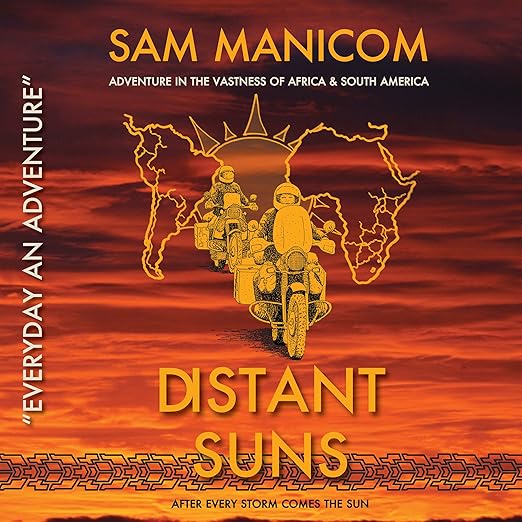
Sam Manicom's writing has always had a particular quality that most travel literature lacks: the ability to make you smell the place. His prose on Southern Africa captures dust and diesel and the specific quality of light in regions that most of his readers will never visit. Distant Suns, his third motorcycle travel audiobook, narrated as always by Manicom himself, sends him and his companion Birgit through Kenya, across Southern Africa, through South and Central America, and eventually home after three years on the road. At 13 hours and 11 minutes, it is his most expansive book, and the addition of Birgit gives the narrative a human dynamic that the earlier solo volumes could not access.
How Distant Suns Holds Up
What separates Manicom's travel writing from the adventure-memoir genre's average output is a refusal to make himself larger than the experience. His acute observations about human behavior in the places he passes through, the specific texture of hospitality in different cultures, the social grammar of rural Africa versus the urban chaos of South American cities, the way danger and generosity often arrive from the same direction, feel like the observations of someone who learned to pay attention rather than someone performing attentiveness for a reader. Manicom narrating his own work amplifies this quality. His voice has the unhurried authority of experience; he has been to these places, felt the fear in these moments, and the telling carries that knowledge in every sentence.
One reviewer wrote that Manicom does a great job bringing you along for the travel experience, and specifically noted that even non-motorcycle enthusiasts would find the book engaging. That assessment is accurate. The motorcycle is infrastructure in Manicom's writing, not fetish. It is the vehicle, literal and narrative, that makes the access possible, but the actual subject of Distant Suns is consistently the people and places encountered along the route, not the mechanical specifics of two-wheeled adventure travel. That choice broadens the audiobook's appeal significantly beyond the overlanding community.
Why Distant Suns Works as an Audiobook
The relationship between Sam and Birgit gives this third book its distinctive texture. Previous volumes tracked a solo journey in which Manicom's only company was his own developing understanding of the world through which he moved. Birgit arrives as someone who had been riding for only 600 miles when they began this journey in Kenya, a remarkable fact given what follows. Manicom is honest about what traveling with a partner actually costs: the stress of group decision-making even in a group of two, the negotiations around risk tolerance, the specific vulnerability of watching someone you care about navigating situations that could go badly wrong. Reviews note that the two saved each other's lives on occasion, and the audiobook earns those moments by earning the relationship first.
The geographical range in Distant Suns is also broader than the previous books. Moving from the savanna corridors of East Africa to the high-altitude roads of South America in a single narrative requires Manicom to shift his observational register significantly, and he manages both environments with the same quality of attention. His descriptions of the Andes and of Central American politics carry the same specificity as his African passages, never defaulting to the generic landscape prose that afflicts lesser travel writing.
Weak Spots in Distant Suns
While the book works as a standalone, Manicom designed the Birgit element as a continuation of her introduction in Under Asian Skies. Listeners who begin with Distant Suns will understand the relationship, but those who have read the previous book will bring more emotional context to the dynamic between Sam and Birgit, and certain scenes will land with greater weight. The audiobook is the third in a series, and though it stands independently, the full resonance of certain passages rewards prior familiarity with Manicom's earlier volumes.
The pacing reflects the reality of long-distance overland travel: not every section is high drama. Manicom includes the logistical realities, border crossings, mechanical problems, stretches of monotonous terrain, alongside the moments of wonder and danger. Listeners who want constant incident may find the honest middle sections slow. Those who understand that the texture of real travel includes stretches of boredom will find these passages add rather than detract from the book's authenticity.
Paul Theroux's observation about staying out of touch and becoming a stranger in a strange land, which Manicom invokes in the context of Distant Suns, captures something essential about his project across the trilogy. What Theroux describes as a leap of faith, Manicom has spent three books documenting in practice: the specific texture of what it feels like to be a stranger repeatedly, in different geographies, with different companions, and how that accumulated strangeness changes you in ways only visible in retrospect. The audiobook rewards sustained listening partly because Manicom's development as a narrator of his own experience is itself a subtle subject running beneath the surface of the adventure content. By the third book, the voice narrating the events has been shaped by everything the previous two books contained, and that depth is audible even to listeners who begin the series here. Birgit's presence amplifies this effect by giving Manicom a witness whose perspective on him he has to account for, and the accountability makes the self-observation sharper.
The Right Listener for Distant Suns
Adventure travel enthusiasts, particularly those with interest in Africa or motorcycle overland routes, will find this one of the best audiobooks in the genre. Listeners interested in travel partnership dynamics and what it actually means to share an extreme journey with someone will find Manicom's treatment of his relationship with Birgit unusually honest. Readers who appreciate travel writing that centers people and cultures over personal heroics will respond to Manicom's observational intelligence. Those seeking a fast-paced dramatic audiobook with consistent narrative tension should look elsewhere. The pleasures here are slower and more considered.
Good to Know
Can I listen to the Distant Suns audiobook without having read Sam Manicom's previous books?
Yes, the audiobook stands on its own as a travel narrative. However, Birgit was introduced in Under Asian Skies, and listeners who know her from that book will bring more emotional context to their partnership and to certain key scenes in Distant Suns.
Does this audiobook work for people who are not interested in motorcycles?
Consistently yes, as multiple reviewers confirm. Manicom uses the motorcycle as access to people and places, not as the primary subject. The actual content is travel observation, cultural encounter, and relationship dynamics. Motorcycle knowledge is not required to enjoy the book.
How does Sam Manicom's self-narration affect the listening experience of this audiobook?
It is a significant asset. Manicom's voice carries the specific authority of experience. He lived through what he is describing, and his narration reflects that. The pacing and emotional weight of key scenes feel calibrated by memory rather than by performance.