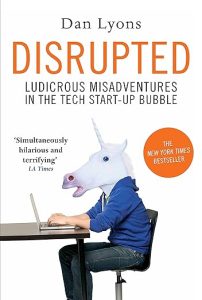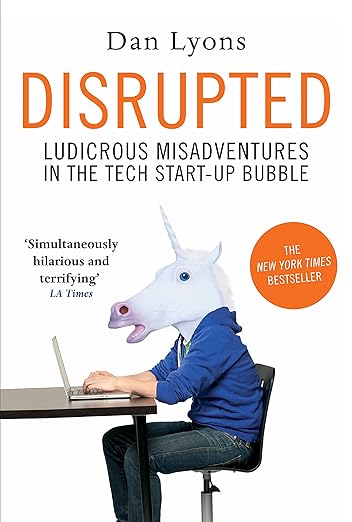
Tech journalism spent most of the 2010s constructing the mythology of the startup world rather than examining it critically, which is part of what makes Dan Lyons's audiobook account so pointed. Disrupted, narrated by Lyons himself, is the memoir of a fifty-year-old journalist who lost his senior position at Newsweek and decided to take a marketing role at a Boston startup flush with $100 million in venture capital. Lyons had spent 25 years as a leading tech journalist and was also the anonymous blogger behind Fake Steve Jobs, a satirical persona built on skewering tech industry self-seriousness. That background turns out to be exactly the right preparation for the situation he walked into.
The company Lyons joined made the world a better place, in its own estimation, by selling email marketing software. The culture he encountered there was a precise blend of frat house and corporate cult: shower pods that became hook-up locations, Nerf gun fights during working hours, and executives who communicated primarily through cryptic jargon-filled emails while being almost never physically present. Lyons arrived in a cohort of predominantly twenty-something coworkers and found himself old enough to be most of their fathers. His portraits of the startup ecosystem are drawn with a journalist's precision: the devilish angel investors who trade in aspirational language and quarterly momentum, the venture capitalists chasing whatever trend has the right vocabulary, and the particular subspecies he calls the wantrepreneur, which is distinct from an entrepreneur in ways the book specifies with some care. What keeps the memoir from becoming pure polemic is Lyons's candor about his own participation. He felt the seductive pull of the stock options, bought into the mission language temporarily, and chronicles his own susceptibility as clearly as he documents the company's dysfunction.
The book's sharpest contribution to public conversation was its documentation of ageism in tech hiring. The systematic preference for younger workers, and the particular discomfort that Lyons's presence created for a culture designed around a specific demographic, remains the most uncomfortable and most durable section of the book. He renders it without sentimentality. The question it raises about what happens to experienced professionals displaced by structural industry shifts has aged into greater urgency since publication. HubSpot executives disputed some of Lyons's characterizations publicly after the book appeared, and listeners who want a fuller picture may want to read those responses alongside this account. Lyons addresses the dispute in subsequent interviews.
Lyons Narrates at a Brisk Nine Hours
Lyons as narrator is the correct choice for this material. He reads with the cadence of someone who wrote the book to be spoken aloud: the sentences are sharp and punchy in a way that rewards listening rather than simply reading. The portraits he draws are funnier when delivered in his slightly weary register than they might be on the page. His timing with comic deflation, the pause before a reveal, the deadpan after an absurdity, is the timing of a working journalist who has been telling these stories at dinner parties for years. At 9 hours and 17 minutes the pacing is brisk. The book does not linger in any single disaster long enough to become repetitive, which suits the material well. The 4.5 rating across over 3,300 reviews, a notably strong number for a nonfiction title with a defined antagonist, suggests this account resonated even among readers who work in the industry it describes.
Startup Culture's Loyalty Rituals, Aging Well
The broader argument about startup culture, its ritual language, its relationship to actual business results, and the specific kind of loyalty it demands, has aged remarkably well. Lyons published this in 2016 and the behaviors he describes were not unique to HubSpot; they were diagnostic of an entire sector during a specific period of funding abundance. Listeners who joined or are considering joining a venture-backed startup will find the portrait familiar regardless of which company is on their badge. The satirical edge is sharpest in the chapters on internal communications and company culture events, where the gap between stated values and actual practice is most visible.
The book that Disrupted most resembles in spirit is not a tech memoir at all but Barbara Ehrenreich's Nickel and Dimed, where an observer with a different class position takes an entry-level job specifically to report on what they find. Lyons did not go undercover in quite that way, but his journalist's training gave him the same instinct to document what he observed rather than simply participate in it. The result is a book that functions simultaneously as personal narrative, industry exposé, and generational story about what happens when the economic assumptions of one professional era collide with the expectations of another. His portraits of the specific rituals through which startup culture manufactures loyalty, the acronyms that replace policy, the orange foam balls that get handed out as symbols of the team, the carefully managed messaging about the company's world-improving mission, are documented with enough specific detail that they could only come from someone who was there. That specificity is what keeps the book alive years after its initial publication moment.
Essential for Anyone Over Forty in Tech
Essential listening for anyone who works in, reports on, or is considering joining a venture-backed startup, particularly anyone over forty weighing the culture gap. Also for readers who have enjoyed Barbara Ehrenreich's workplace undercover journalism and want a tech-industry equivalent. Skip if you are looking for a management book with prescriptive takeaways. Disrupted is diagnostic rather than remedial, and it will make you laugh considerably more than it will make you a better operator. Lyons is not here to fix Silicon Valley. He is here to describe it accurately, and he does.
Before You Listen
Does the audiobook of Disrupted include any updated material since the original publication?
The core content is the original text. Lyons has spoken about the book's aftermath in subsequent interviews and on podcasts, but the audiobook itself does not include an extended epilogue addressing HubSpot's public response to his account.
Is this audiobook appropriate for listeners who are not familiar with the tech industry?
Yes. Lyons writes for a general audience and explains the startup world's vocabulary and culture clearly enough that no prior knowledge of tech companies or venture capital is needed to follow the story.
Is there other audiobook coverage of tech industry culture that pairs well with Disrupted?
John Carreyrou's Bad Blood covers fraudulent startup culture at Theranos and shares the same forensic curiosity about the gap between tech mythology and reality. Brad Stone's The Everything Store profiles Amazon's internal culture with more ambivalence. Disrupted occupies a more personal, comic register than either.