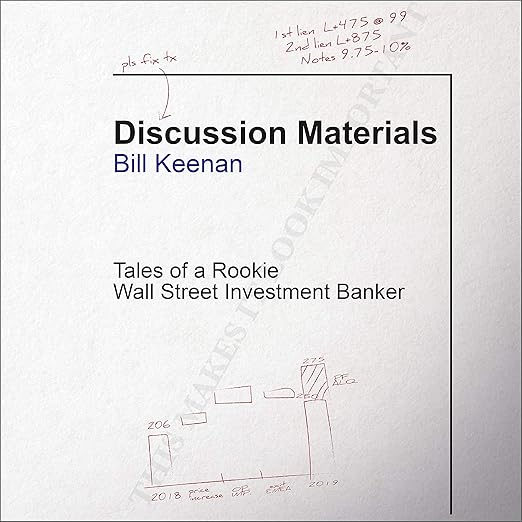
Bill Keenan's desk on the 44th floor of 60 Wall Street is where Discussion Materials spends most of its nine hours, and the audiobook, narrated by Roger Wayne, makes that cubicle feel completely real. Keenan joined Deutsche Bank's investment banking division after graduating from Columbia Business School, and the memoir covers his first two years as an associate: the PowerPoint decks, the BlackBerry anxiety, the floating bar charts that had to be precisely the correct shade of orange, and the despotic superiors for whom the distinction between a correctly left-aligned number and a slightly off-center one was, apparently, not minor. This is the world Keenan documents, and the audiobook's greatest accomplishment is making it simultaneously absurd and recognizable.
Reviewer McMurrab called it "screamingly funny" and then added that it is also "a palatable education in what on earth investment banking actually means," a combination that is considerably harder to achieve than either element alone. Keenan does not write about deals in the abstract. He writes about what it is like to be the most junior person in a room where everyone has a hierarchy to protect and a reputation to maintain, and where the junior banker's job is to make everyone above them look competent regardless of what actually happened. The PowerPoint obsessions, the Seamless dinner orders, the outsourcing relationships that allow work to get done at a scale one person could not sustain alone: all of it is described with the specificity of someone who lived it, and the specificity is what makes the comedy work. The climactic story about achieving the perfect $25.00 Seamless order from Hwa Yuan Szechuan, matching the bank's maximum meal allowance exactly including tax and tip, is the kind of detail that only makes sense once you understand the ecosystem that produced it, and Keenan constructs that understanding carefully before the payoff arrives.
The book accumulates rather than escalates. There is no single crisis or dramatic turning point; it is a portrait of competence developing under absurd conditions, and the emotional arc is quiet. Reviewer Leon described it as "a real masterpiece" where Keenan has a "special talent for articulating the most mundane activities," and that talent is real. The mundane is the point. Investment banking at the junior level, this memoir argues, is mostly about producing documents under conditions of low-grade terror, occasionally understanding what the documents mean, and slowly learning to navigate a social and professional ecosystem that operates by rules that are never fully explained to the people most subject to them.
Wayne Delivers Dry Comedy With a Straight Face
Roger Wayne's narration is well-suited to this material. He understands that Keenan's comedy is dry and that it requires a certain flatness to land. A narrator who reached for the jokes would undercut them. Wayne delivers the bureaucratic absurdity with a straight face, and the humor emerges from the accumulation of specific detail rather than from any particular emphasis or timing trick. That restraint is harder than it looks and it pays off across nine hours. There are no sequences where Wayne seems to be performing a character rather than delivering a memoir; the voice stays consistent with Keenan's own first-person register throughout.
The audiobook format suits a memoir like this well. Keenan's writing has the rhythm of someone who tells stories aloud, with the asides, the self-deprecating corrections, and the moments of apparent digression that turn out to be load-bearing. Roger Wayne delivers those rhythms cleanly. Listener Z described the book as "hilarious" while also noting it conveys "the soul-crushing misery that befall junior bankers," and that double register of comedy and genuine sympathy is what gives the audiobook staying power past the initial humor. The nine-hour runtime rarely feels long because each anecdote builds the institutional picture rather than merely adding another funny incident to a list.
No Epiphany Waits at the Two-Year Mark
Listeners without any prior exposure to investment banking terminology will get most of the humor and all of the human story, but some of the professional texture will be opaque without context. Keenan explains enough to make the narrative followable, but the specific prestige anxiety around deal types, client relationships, and bank hierarchy is more resonant for listeners who have worked in finance or adjacent industries. That is not a barrier so much as a gradient: the book works for outsiders but rewards insider knowledge.
The memoir ends at what feels like the right point, the two-year mark at Deutsche Bank with Keenan having accumulated enough competence and institutional knowledge to function with something approaching confidence, but it does not deliver a conventional redemption or epiphany. If you are looking for a clear argument about whether Wall Street is worth it, or a transformation narrative where the protagonist emerges from the experience with hard-won wisdom, this is not quite that book. It is more honest than that: it describes what happened, what it felt like, and leaves the interpretation mostly to the listener, which is an unusual quality in a genre that typically delivers conclusions with its anecdotes.
Liar's Poker Fans Get a Warmer Wall Street
This audiobook is for anyone curious about what the junior analyst experience in investment banking actually looks like from inside the cubicle, without the dramatization of film or the abstract distance of industry reporting. Finance professionals who have worked at the associate level will find much that is familiar and funny for exactly that reason. Readers who enjoyed books like Liar's Poker or Young Money will find this a warmer, less cynical addition to the genre. Those who need a conventional career narrative arc or a strong redemptive conclusion may find the memoir's quiet, accumulative structure unsatisfying, but listeners who appreciate observation over argument will find nine hours go quickly.
Quick Take
- Read by: Roger Wayne handles the dry comedy of Bill Keenan's Wall Street memoir with good timing; the deadpan delivery suits the material's humor without reaching for laughs.
- At its heart: Junior banker survival, corporate absurdity, the gap between prestige and meaning
- Vibe: Wry and observational, with a slow-building warmth underneath the institutional satire
- Short version: Discussion Materials earns its Wall Street memoir shelf space by being genuinely funny about genuinely unfunny working conditions, and Roger Wayne's narration is the right vehicle for it.
Does this audiobook require prior knowledge of investment banking to follow?
No. Keenan explains enough of the professional context to make the narrative accessible to outsiders. Listeners with finance backgrounds will get additional texture from the insider details, but the human story and the humor land without that background.
Is Discussion Materials more comedy or serious Wall Street analysis?
It is primarily a comedy memoir that happens to be accurately observed. The humor comes from specific institutional detail rather than exaggeration. There is real professional insight in the book, but it is delivered through a wry, observational lens rather than as a formal analysis of the industry.
How does Roger Wayne's narration handle the comedy in this audiobook?
Wayne plays it straight, which is exactly right for Keenan's dry humor. He does not reach for laughs or emphasize punch lines; he delivers the bureaucratic detail with a flat affect and lets the absurdity accumulate. Listeners who appreciate deadpan comedy will find his approach effective.