The Short Version
- Narrator: Gary Middleton narrates with the tone of a knowledgeable guide who wants you excited rather than lectured - steady, warm, and well-paced.
- Subjects: Natural heritage, outdoor adventure, American geography and folklore
- Tone: Curious and open-air, like planning a trip with someone who has already been everywhere
- Bottom line: A solid audio introduction to the national parks system for listeners who want orientation and inspiration rather than detailed trip-planning resources.
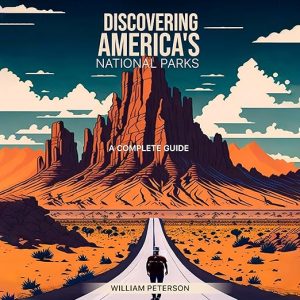
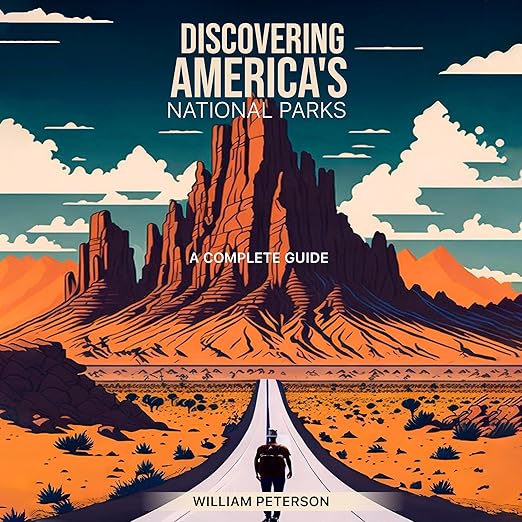
National parks have a way of staying perpetually on the list - the kind of destination that accumulates intention but rarely converts it into a booked flight. William Peterson's Discovering America's National Parks audiobook landed in my queue when I was doing exactly what most people do before finally going somewhere: researching the place instead of visiting it. Across four hours and thirty-nine minutes, the book makes a genuine case that the parks system spanning more than 84 million acres contains enough variety, strangeness, and sheer scale to occupy a lifetime of travel decisions.
Peterson opens with a fact that resets the expectations of listeners who think they know this terrain: one of the national parks houses the longest-known cave system in the entire world. Another features structures that once stood at the 1933 Chicago World's Fair. Several have local folklore involving creatures that range from the plausible to the genuinely strange. The opening reframe - come for the famous parks, stay for the ones you've never heard of - is an effective hook, and Peterson sustains it throughout. This is not a book about Yellowstone and the Grand Canyon in the expected way. It is a book about the breadth of what the designation "national park" actually contains.
Is Discovering America's National Parks Worth Your Time?
Peterson has a clear affection for the material that surfaces in how he handles individual parks. He doesn't just list facts; he chooses the angle on each park that makes it memorable. A park that might receive three dry sentences in a reference book gets a scene - the specific wildlife encounter, the geological curiosity, the historical event that makes the place matter beyond its topography. The result is a book that functions more like a sampler of the parks system than a comprehensive reference, which is exactly what an audio format calls for.
One reviewer noted that the book is best understood as inspiration and orientation rather than trip-planning. That is accurate and worth knowing before you press play. Peterson provides enough information about each park to make you want to visit, to help you understand what kind of experience awaits, and occasionally to upend your assumptions about what parks look like - but not enough to plan logistics, book permits, or choose a specific trail. For that work, you will need park-specific resources. But as a starting point for deciding where to direct that further research, the book is genuinely useful.
The Best Parts of Discovering America's National Parks
Gary Middleton narrates with a quality that suits travel content particularly well: genuine enthusiasm without promotional excess. The risk with travel narration is that it tips into advertisement - everything is spectacular, every location is unforgettable. Middleton's tone is warmer and more grounded than that. He sounds like someone who has been to these places and wants to tell you what they're actually like, not sell them to you. For a book that spans everything from volcano rims to underground cave systems to the Louisiana bayou, the tonal consistency Middleton maintains across very different landscapes is itself a modest achievement.
The four-hour-and-thirty-nine-minute runtime is well-matched to the book's intent. A longer treatment would risk becoming encyclopedic in a way that the audio format handles poorly; a shorter one wouldn't have space for the range of parks that makes Peterson's argument about breadth land. As a listening experience for a road trip to a park, or an evening of armchair travel, the pacing is close to ideal.
Before You Commit to Discovering America's National Parks
A review worth noting flags that the title uses "America" in the strictly US sense - parks in Canada, Mexico, or South America are not included, despite the geographic ambiguity of the title. This is a US national parks book, covering the system administered by the National Park Service. International listeners or those hoping for a broader continental scope should calibrate their expectations accordingly.
The book also covers legends and folklore alongside documented facts, which gives it a slightly different texture than a purely factual reference. The "swamp monsters" and "white walkers" mentioned in the synopsis are popular folklore elements associated with specific parks, presented in the spirit of travel curiosity rather than credulous paranormal writing. Peterson handles this material with appropriate lightness - these are the stories the parks have accumulated, and they make the parks more interesting without the book pretending they are true.
The broader value of this approach is that it repositions national parks as cultural objects as much as natural ones. Each park has accumulated not just geological history but human history - of the Indigenous peoples who lived in these landscapes for millennia before the designation existed, of the conservation battles that protected some areas while others were lost, of the stories that communities have built around specific places. Peterson doesn't develop any of this in depth, but the folklore passages gesture toward it in ways that listeners curious about those histories can follow up independently.
Should You Listen to Discovering America's National Parks?
This audiobook works best for listeners who want to broaden their sense of what the national parks system contains beyond its most famous landmarks, and who want the kind of enthusiastic orientation that motivates rather than overwhelms. Teachers looking for a classroom resource will find it accessible enough for most age levels. Travelers beginning to plan a parks trip will find it helpful for narrowing choices before moving to more detailed research. Skip if you want logistical detail - trailheads, permit systems, seasonal conditions, accommodation near the parks. That information isn't here, and that's fine, because that's not what the book set out to provide.