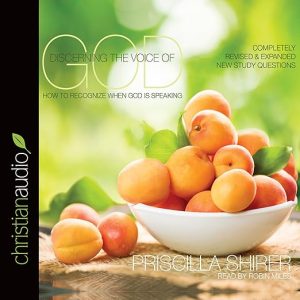
Spiritual nonfiction presents a particular challenge for the audiobook format: the content is inherently reflective, built for lingering and returning to key passages, and yet audio drives you forward at a fixed pace. Priscilla Shirer's Discerning the Voice of God is one of those books that manages to work against that tendency, partly because Shirer writes with a directness and warmth that pulls you into its argument rather than demanding you pause and annotate. Robin Miles's narration makes this audiobook feel like a conversation rather than a lecture, and for a book organized around the idea that God speaks in ways ordinary people can recognize, that conversational quality is exactly right.
I came to this audiobook with some prior familiarity with Shirer's work, though I am not the target reader in the strictest sense. Shirer writes from within an evangelical Christian framework, and she is direct about that. She is not writing for the skeptically curious or for listeners still weighing whether they believe at all. She is writing for people who accept the premise that God speaks and who want practical guidance on recognizing that voice more clearly. If that describes you, this revised edition, which includes updated content and new reflection questions, delivers precisely what it promises.
First, the Big Picture
The central argument of the audiobook rests on a reassuring claim: that hearing from God is not a capacity reserved for biblical figures or spiritually elite believers, but a natural dimension of a relationship with a God who, as Shirer puts it, 'loved you enough to die for you and loves you enough to talk to you.' She builds this case patiently, drawing on examples ranging from the burning bush to accounts from well-known contemporary Christians. The effect is cumulative, and it works. By the midpoint, even listeners who approach this kind of material with mild skepticism will find the framework internally consistent and the teaching well-organized.
Shirer is a gifted communicator, and that gift comes through strongly in audio. She knows how to plant a claim and then loop back to it with added weight, building conviction through repetition and variation rather than through argument. This is a preacher's technique, not an academic one, and it is worth naming. If you are expecting theological rigor or engagement with counterarguments, this book will disappoint you. If you are expecting accessible, faith-affirming practical instruction, it delivers that with skill.
What Makes Discerning the Voice of God Worth Hearing
Robin Miles is one of the finest narrators working in religious and inspirational nonfiction, and her performance here is measured and deeply attentive to Shirer's rhythms. Miles understands when Shirer's sentences build to a moment of emphasis and she meets those moments without overselling them. She reads with the quality of someone who takes the material seriously, not devotionally in a sentimental way, but with the care of an interpreter who respects both the text and the listener. For a book that asks its audience to slow down and listen more carefully, having a narrator who models that quality of attentiveness is more than a nice coincidence.
The reflection questions added to this revised edition are woven naturally into the audiobook structure. They function as genuine invitations to pause, which is something that books of this type sometimes fail to do. Shirer frames them not as exercises but as extensions of the conversation, and Miles delivers them with the same unhurried quality she brings to the main text. Listeners who find audiobooks a useful format for devotional reading, particularly during commutes or morning routines that otherwise resist quiet reflection, will find this edition works well in those contexts.
A Few Reservations
A few things worth flagging honestly. The book's structure is looser than the best systematic theology. Shirer circles back to the same core ideas multiple times across sections, which works in an oral teaching context but can feel slightly repetitive in concentrated audiobook listening sessions. This is not a flaw so much as a feature of the preacher's compositional style. Listeners used to linear argument-building may find the rhythm unusual at first.
The Scripture framework is Protestant evangelical throughout. you will find no substantial engagement with Catholic or Orthodox traditions around discernment, which have their own rich literature on the subject. Shirer's intended audience is clearly within her tradition, and if you come from outside it, some of the assumed premises may require active translation into your own theological framework. That translation is possible, but it is work the book does not do for you.
The audiobook format suits this material in a particular way. Devotional reading often benefits from a voice that creates pace and rhythm, preventing the reader from either racing ahead or getting lost in single passages. Miles establishes that rhythm from the first chapter and maintains it throughout all seven hours, which is precisely long enough to feel substantial without wearing out its welcome. Listeners who use audiobooks as part of a morning or evening devotional practice will find this edition an especially good fit for that use.
Should You Listen to Discerning the Voice of God?
This audiobook will land best with evangelical Christian listeners who already believe in the possibility of direct communication from God and want practical, encouraging guidance on developing that sensitivity. It is well-suited to Bible study groups, devotional listening routines, and listeners who have appreciated Shirer's other teaching work. Robin Miles's narration makes it particularly effective in audio. Listeners outside Shirer's faith tradition, or those looking for a more analytically rigorous engagement with questions of spiritual discernment, will likely want to look elsewhere. But for its intended audience, it is warmly and professionally done.
Questions Listeners Ask
Do I need prior knowledge of Priscilla Shirer's work to get value from this audiobook?
No prior knowledge is required. Shirer writes accessibly and introduces her framework from the ground up. Listeners new to her teaching will find the audiobook self-contained and welcoming.
How does this audiobook handle the reflection questions in the revised edition?
Robin Miles incorporates them naturally into the flow of the narration, reading them with the same unhurried quality as the main text. They function as invitations to pause rather than interruptions, and they work well in audio even without the ability to write responses.
Is this audiobook suitable for listeners who are skeptical about the premise of hearing from God?
Not primarily. Shirer writes within and for an evangelical Christian framework, and the book assumes that direct communication from God is possible. Skeptical listeners will find little engagement with alternative viewpoints or counterarguments.
How does the audiobook format compare to reading the print version of this book?
For this type of devotional nonfiction, audio has a specific advantage: Robin Miles's delivery naturally paces the material and prevents the kind of rushed reading that can flatten Shirer's cumulative teaching technique. The reflection questions work slightly less well in audio if you want to stop and journal, but the overall experience is well-suited to the format.