Before You Press Play
- Narration: Wayne Dyer's self-narration is essential to this experience, his unhurried warmth and lived familiarity with the Tao giving each chapter a meditative quality no third-party reader could replicate.
- Themes: Ancient Taoist philosophy adapted for daily modern practice, with emphasis on peace, balance, and natural living across 81 discrete verses.
- Mood: Meditative, slow-burning, and deeply personal, best absorbed one chapter at a time over weeks or months rather than in linear sittings.
- Verdict: One of the most accessible and genuinely useful audiobook editions of Taoist philosophy, strengthened considerably by the bonus lectures and meditations included in this enhanced release.
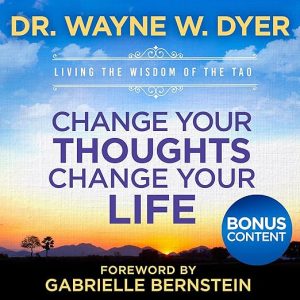
Late on a quiet evening, with the week finally settling into stillness, I pressed play on Wayne Dyer's self-narrated audiobook edition of Change Your Thoughts - Change Your Life and found myself unexpectedly held in place for the next two hours. This is a book about the Tao Te Ching, Lao-tzu's ancient text of 81 verses, rendered through Dyer's decades of study, personal practice, and an earnest desire to translate 2,500-year-old wisdom into something a modern listener can actually use. The enhanced edition released after Dyer's passing adds layers that make the audiobook experience genuinely distinct from the print version: three live lectures, four meditations, and a heartfelt introduction from Gabrielle Bernstein reflecting on his legacy.
The Review
Dyer's approach to the Tao is neither scholarly translation nor casual self-help grafting. He worked from ten separate translations of the text, assembling his own composite verses, and then spent several pages with each one unpacking its implications for contemporary life. The rhythm of the book is deliberate: verse, reflection, and then a closing section called 'Do the Tao Now' that offers a practical exercise or intention for the day. This structure, which might feel repetitive on the page, works particularly well in audio. Dyer's narration gives each chapter a meditative quality. His voice is warm, unhurried, and carries the credibility of someone who has spent years living inside this material rather than summarizing it from the outside.
The bonus meditations including the 'Morning Ah,' the 'Evening OM,' the 'Change Your Thoughts Meditation,' and the 'Divine Love Meditation' are not afterthoughts. They are interwoven into the listening experience in a way that invites repetition rather than linear consumption. Several listeners have noted spending a full year moving through this book one verse at a time, and the format actively encourages that pace. Lin Yutang, who was nominated for a Nobel Prize, called the Tao Te Ching the one book above all others in Oriental literature that every serious reader should encounter. Dyer's version makes that encounter accessible without cheapening the source.
Reviewer Al Stone, who studied ten translations himself before finding this book, describes Dyer's process admiringly: cobbling together composite verses from multiple sources and then offering pages of reflection on each. That layered approach distinguishes this from a simple paraphrase. It is an interpretation built from genuine engagement, and the depth of that engagement shows throughout the thirteen-hour listening experience.
The Best Parts of Change Your Thoughts - Change Your Life
The self-narrated audiobook format is essential here. Dyer's live lectures, three of them included as bonus tracks, reveal the gap between author-read prose and an author actually speaking from experience. In the lectures, his pacing loosens, his humor surfaces, and his personal relationship with the Tao becomes tangible in a way that even the main text cannot fully convey. Bernstein's introduction is brief but genuine, grounding the material in the context of Dyer's influence on a generation of spiritual seekers without becoming hagiographic.
This edition also rewards listeners who already know Dyer's work. The enhanced material functions as a kind of retrospective, a chance to hear him in different modes across a single listening experience. For newcomers, the core 81 chapters stand entirely on their own. Each is short enough to absorb in a single sitting, concrete enough to prompt reflection, and structured so that practical application follows immediately from the philosophical framing. That combination is rarer in spiritual nonfiction than it should be. Reviewers consistently note that the book rewards slow reading, and the audio format supports that pace naturally. Playing one or two chapters a day and sitting with the 'Do the Tao Now' prompt before moving on mirrors the contemplative practice the book is actually teaching.
The Caveats
Listeners expecting a conventional self-help audiobook, the kind that builds toward a single framework and delivers it in the final chapters, will need to adjust their expectations. The Tao Te Ching does not build toward a conclusion. Each verse is complete in itself, and Dyer honors that structure rather than imposing a narrative arc. This makes the book genuinely non-linear in a way that most audio content is not. The experience is closer to a daily practice than a listening event, and the meditations reinforce that orientation.
The pacing may also feel slow to listeners accustomed to information-dense nonfiction. Dyer's narration lingers, and some chapters circle the same insight from multiple angles before landing. That deliberateness is the point, since the Tao rewards patience, but it is worth knowing before you settle in. The audio quality of the bonus tracks is occasionally uneven, as live lecture recordings tend to be, though never to the point of distraction.
Listeners who approach this as secular philosophy rather than spiritual instruction will find the material holds up. Dyer draws on Taoist principles without requiring any particular religious affiliation, and his practical applications are grounded enough to work independent of the metaphysical framing. The 'Do the Tao Now' sections are often surprisingly concrete for a book rooted in ancient wisdom traditions. Reviewer Denise Becknell describes taking a full year with the text, finding it 'something to savor and re-read over and over,' which is an honest description of what this kind of listening experience asks for and what it gives back in return.
Who Wayne W. Dyer Is Writing For
This audiobook is well suited for listeners who want a contemplative daily companion rather than a goal-oriented read. If you have been curious about the Tao Te Ching but found direct translations difficult to connect with, Dyer provides one of the most accessible entry points available in the English-language audio catalog. Fans of his earlier work will find this among his most disciplined and personal projects. The enhanced edition adds genuine value over the original release, particularly for listeners who respond to guided meditation as a complement to reading. Plan your listening accordingly. This is a months-long companion, not an afternoon listen, and the audiobook format is perfectly suited to that kind of extended engagement.
Do I need to know the Tao Te Ching to get value from this audiobook?
No prior knowledge is required. Dyer provides his own composite verse for each of the 81 chapters alongside his commentary, so the audiobook functions as a complete introduction to the text and its practical applications.
What does the enhanced audiobook edition add compared to the standard version?
The enhanced edition includes three live lectures by Dyer on how he personally lived the Tao, four guided meditations (Morning Ah, Evening OM, Change Your Thoughts, and Divine Love), and an introduction by Gabrielle Bernstein reflecting on his legacy.
How long does it take to finish this audiobook?
The runtime is approximately 13 hours and 33 minutes including bonus material, but most listeners recommend treating it as a daily reader and spending several months moving through the 81 chapters rather than listening straight through.
Is this audiobook suitable for secular listeners or is it primarily religious content?
Dyer's approach is broadly philosophical rather than devotional. He draws on Taoist principles without requiring any specific religious framework, and the practical applications work well for secular listeners interested in mindfulness and intentional living.