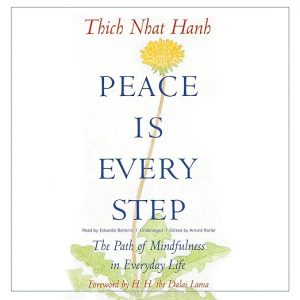
I first encountered Peace Is Every Step during a period when I was doing everything at full speed and resenting all of it. A friend described it as a book you could listen to on a commute and actually feel different by the time you arrived. I was skeptical, most books making that claim deliver a series of productivity hacks dressed in contemplative language. Thich Nhat Hanh is doing something categorically different. This is not a self-improvement program. It is closer to a sustained invitation to inhabit your own life.
Edoardo Ballerini's narration is a genuine asset. He has the skill, which many narrators of contemplative literature lack, of reading slowly without sounding hollow. His voice does not perform serenity, it simply arrives there. The effect, over three and a half hours, is surprisingly cumulative. I found myself physically slowing down around the hour mark, which is a response I have had to almost no other audiobook.
Hanh's central argument is quietly radical: that peace is not a destination but a quality available in each moment, accessible through the simple act of conscious breath and aware attention. He does not argue for retreat from the world. He argues for full presence within it, at the kitchen sink, in traffic, during a phone call. The ringing telephone, he writes, can be a bell calling you back to yourself. Red lights are opportunities rather than interruptions. This reframing is either profound or frustrating depending on your temperament, and Hanh is wise enough to know that.
The book is structured in short chapters, some barely a page in the original print edition, which makes it ideal for audio listening in fragments. Hanh moves between personal meditation, practical exercises, anecdotes from his years as a peace activist, and gentle commentary on social and environmental injustice. The range is wider than most mindfulness books, which tend toward the purely personal. His concern for what he calls pollution and injustice in the outer world sits alongside his concern for inner peace without contradiction.
The Best Parts of Peace Is Every Step
One reviewer described some of Hanh's teachings as the most deceptively simple they had ever encountered, the point being that the apparent simplicity conceals genuine depth. That observation holds in audio form more than in print, because Ballerini's pacing forces you to sit with each idea rather than skim toward the next. The conscious breathing exercises are particularly effective when heard; following them aloud in real time produces the immediate effect Hanh describes, which is unusual for instructions that look straightforward on a page.
At three and a half hours, this is a short listen, but reviewers in multiple languages consistently describe finishing it and immediately wanting to begin again. That re-listen impulse is a reliable signal that the content has a density that surface brevity conceals. The book was written in 1991 and edited by Arnold Kotler; the audiobook edition retains that original clarity without updating or diluting it.
Before You Commit to Peace Is Every Step
Listeners who need measurable behavioral frameworks, systems, habits, timed practices, will find Hanh's approach frustratingly impressionistic. He is not teaching a technique in the sense that cognitive behavioral tools are techniques. He is describing a way of being, and the gap between description and practice is left for the listener to close. For some, that gap is generative. For others, it is a limitation that makes the book feel incomplete as a practical guide.
The spiritual framework is Buddhist but not exclusionary, Hanh consistently addresses listeners of all backgrounds, and the book has found audiences across religious traditions and among secular readers. Still, listeners who are uncomfortable with any spiritual framing should know that Hanh does not strip that framing out in the service of secular accessibility. The book is what it is.
Should You Listen to Peace Is Every Step?
This audiobook is well-suited for anyone experiencing the particular exhaustion of modern busyness, the sense of being productive but not present. It is also an effective introduction to Hanh's broader body of work for listeners unfamiliar with Buddhist practice. Skip it if you need clinical anxiety management tools or structured behavioral interventions; this is contemplative guidance, not therapy. Pair it with longer Hanh works like The Art of Living for a fuller picture of his thinking.
At only 3.5 hours, is this audiobook substantive enough to justify the time?
Multiple reviewers across languages describe finishing it and immediately wanting to start over, which suggests the content has more density than its length implies. The short chapters make it well-suited for re-listening, and Ballerini's narration rewards a slower pace than most audiobooks encourage.
How does Edoardo Ballerini's narration compare to Hanh narrating his own work?
Hanh has narrated some of his own recordings in other editions. Ballerini brings a professional stillness and warmth that serves the material without the slight pacing irregularities that self-narration sometimes introduces. Both approaches are valid; this edition is polished and consistent.