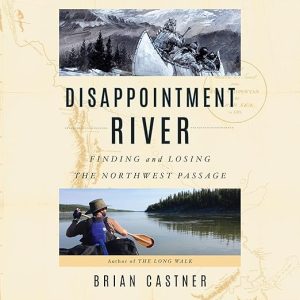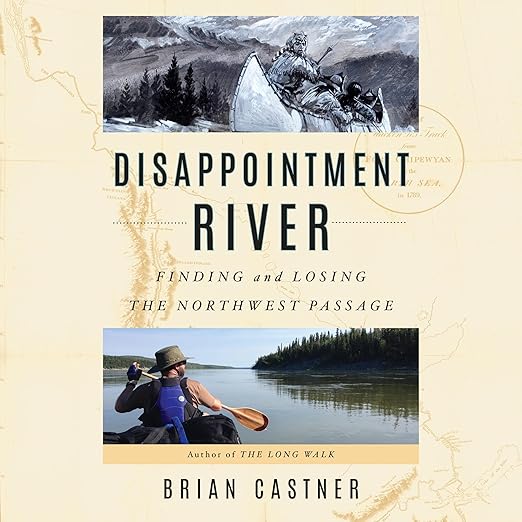
I started Disappointment River on a rainy afternoon and finished it three days later having thought about it more than expected in the hours between sessions. Brian Castner sets himself an unenviable structural challenge: tell two stories simultaneously, one of Alexander Mackenzie's 1789 voyage down the river that would bear his name, and one of Castner's own canoe journey retracing that route in 2016. Dual historical narratives fail constantly in literary nonfiction, usually because one timeline is more compelling than the other and the alternation feels like interruption rather than enrichment. Castner avoids that failure, though it takes about fifty pages to understand how.
Mackenzie's voyage is the frame that most readers come for. In 1789, fourteen years before Lewis and Clark, he set off with a crew of voyageurs and Chipewyan guides to find a navigable route to the Pacific that would open trade routes to Asia. What he found instead was the Arctic Ocean, a discovery he regarded as catastrophic failure. The river he named Disappointment. He died thinking he had accomplished nothing. He was, as Castner shows across twelve hours of close narrative attention, completely wrong.
First, the Big Picture
Castner is not content to simply retell Mackenzie's story. He is interested in what it feels like to move through the same geography 227 years later, and what the river and the communities along it reveal about what we have done to the North in the intervening two centuries. The 2016 journey confronts tar sands extraction, thawing permafrost, remote indigenous villages navigating the pressure of a modernity they did not choose, and the spectral possibility of an Arctic Ocean that could become a major commercial shipping route. Reviewers who came expecting pure adventure and found themselves equally engaged by the contemporary geopolitics capture exactly what Castner is attempting.
The Chipewyan guides who accompanied Mackenzie are recovered with more specificity than most historical adventure narratives would bother with. Castner is attentive to the fact that the people who made Mackenzie's journey possible were not background figures in a European explorer's story. They had their own interests, their own knowledge of the land, and their own understanding of what was being asked of them. That attention to indigenous perspective in the historical narrative connects meaningfully to Castner's encounters with the descendants of those same communities along the modern river.
Why Listen to Disappointment River
Castner narrating his own book matters more than it might seem. The dual timeline structure requires a voice that can inhabit 1789 Mackenzie and 2016 Castner with equal conviction, and a professional narrator would have to work harder to maintain that credibility across both. Castner's voice carries the exhaustion and wonder of the physical journey and the genuine intellectual engagement with Mackenzie's journals simultaneously. Several listeners describe the book as one they found difficult to step away from, and the narration is a significant part of why.
The twelve-hour runtime is genuinely earned here. This is not a book that could have been shorter without losing something real. The historical material requires enough density to give Mackenzie's psychology its weight, and the contemporary journey needs enough breath to accumulate its own emotional effect. The convergence at the end, where both timelines arrive at the Arctic Ocean, earns its meaning because Castner has given us enough of both journeys to understand what arriving means for each of them.
A Few Reservations
The pacing of the historical sections can be demanding. Mackenzie's journals, which Castner draws on extensively, were written in a functional ledger style that prioritizes documentation over narrative flow. Castner renders this with fidelity, which means the historical chapters have a different texture than the contemporary ones. Listeners who are less patient with eighteenth-century expedition record-keeping may find those sections slower than they'd like before the accumulating historical context starts to generate its own momentum.
The climate and environmental material is woven throughout rather than gathered in dedicated sections, which means the book's engagement with what is happening to the Canadian North registers gradually rather than as a set-piece argument. Some listeners expecting a cleaner environmental thesis may not notice the coherence of what Castner is actually building until they reach the Arctic Ocean and the pieces resolve. That's intentional, and it's worth trusting the structure.
Who Should Pick Up Disappointment River
Readers who responded to books like Rinella's American Buffalo or Wade Davis's The Serpent and the Rainbow, works that use physical journeys to anchor larger historical and cultural arguments, will find Castner working at a comparable level. Armchair travelers who have followed the great Arctic and subarctic exploration narratives will find Mackenzie's story given its proper weight. Listeners interested in the intersection of climate change, indigenous rights, and resource extraction in the Canadian North will find the contemporary material more substantive than most adventure narratives provide. Those who want a faster-paced survival adventure without the historical density should look elsewhere. This is a book for readers willing to move at the speed of a river rather than a rapids.
Key Details
- Voice: Brian Castner reading his own dual narrative gives the book a coherence it might otherwise lack, moving between 1789 and 2016 with a voice that belongs equally to both timelines.
- Big ideas: exploration and failure, indigenous displacement and climate change, the distance between historical myth and lived reality
- Atmosphere: Rigorous and immersive, with an elegiac undercurrent
- Worth it?: A genuinely ambitious dual narrative that succeeds both as adventure memoir and as historical reckoning with what we have done to the Far North.
A Few Questions About Disappointment River
How does Castner handle the alternation between 1789 and 2016? Does it disrupt the momentum of either story?
It takes about fifty pages to establish the rhythm, but once both timelines are underway the switching becomes a source of contrast and enrichment rather than interruption. Castner is careful to ensure each timeline has enough accumulated context before he cuts away from it.
How much historical knowledge of Mackenzie or the Canadian fur trade is needed to appreciate the book?
None going in. Castner builds everything the listener needs from scratch. One reviewer described having known nothing about Mackenzie before starting and leaving with him occupying a significant space in their historical imagination, which is about the right expectation to set.
Is the climate change and environmental content persuasive or does it feel grafted onto the adventure narrative?
It's woven throughout rather than argued as a thesis, which makes it feel integrated rather than added. The contemporary journey's encounters with tar sands operations, thawing permafrost, and changing indigenous communities develop organically from what Castner observes along the river.