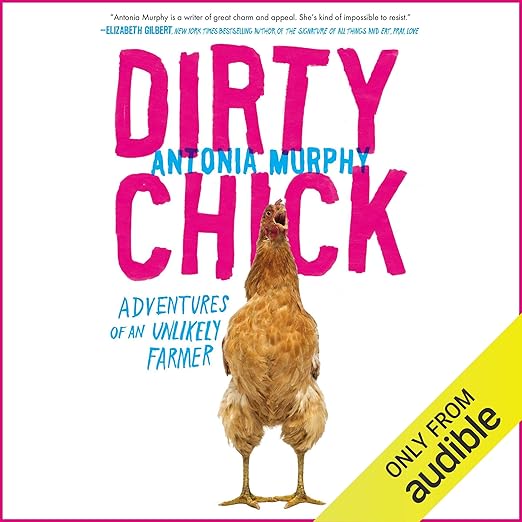
- Read by: Antonia Murphy narrates her own story with dry, self-aware comic timing that makes the farm disasters land exactly as hard as they should.
- At its heart: Urban-to-rural displacement, accidental animal husbandry, parenthood under pressure
- Vibe: Chaotic and warm, with real tenderness underneath the manure
- Short version: A funny, honest memoir about trading city life for a New Zealand farm, and learning, slowly and messily, that neither farming nor family goes according to plan.
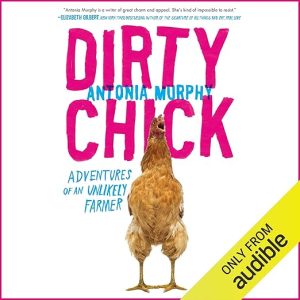
Purua, New Zealand sits somewhere between a pastoral fantasy and a working farmer's worst nightmare, and it was into that exact contradiction that Antonia Murphy and her family moved when their oldest son's rare genetic diagnosis prompted a search for slower, more supported living. This audiobook had been on my list for months before I finally pressed play on a long afternoon drive, and within the first ten minutes I was laughing loudly enough to confuse the other cars around me. Murphy narrates her own memoir, and the combination of material and voice is something you can't manufacture in a studio with a hired reader.
Murphy enters her year in New Zealand as a self-described liberal urban cliche, a woman whose interactions with the animal kingdom had rarely extended past dinner. She and her husband Peter buy into the myth of farming as peaceful, fulfilling, and harmonious with nature. What the myth failed to include: cows prone to bowel ailments, goat mating involving quantities of urine no city-dweller could anticipate, and roosters whose character the book describes with a frankness that stops just short of unprintable. They also, within the first month, managed to execute the chickens, lose a cat to apparent disgust, and watch their cow Lucky escape almost daily.
Where This One Lands
The book is Antonia's account of that first year, and its organizing structure is episodic rather than propulsive. Chapters circle around a creature, an incident, or a particular lesson learned the hard way. A reader arriving with Chris Tellis's description in mind, that Murphy chronicles her slow evolution from dilettante animal lover to sage farmer with hysterically funny results, will not be disappointed. What distinguishes the book from pure farm farce is the emotional texture running underneath the comedy. The reason the Murphys moved to New Zealand in the first place, their son's rare, mysterious genetic condition, is woven through the narrative in ways that complicate the comedy without overwhelming it.
Murphy is precise about the pleasures alongside the disasters. She discovers homemade wine that she claims does not cause hangovers. She makes cheese, cat hair incidents notwithstanding. She raises a baby lamb that is addictively cute until it grows into a sheep, which is a sentence that rewards hearing aloud in Murphy's own voice because the timing is hers in a way it could not belong to anyone else. The specificity of these details is what keeps the book from being a generic fish-out-of-water narrative. Murphy notices things and writes them exactly.
What Makes Dirty Chick Worth Hearing
Murphy's self-narration is the central reason to choose the audio version. Her dry San Francisco wit applied to New Zealand farm life has a very particular texture that a hired narrator would approximate but not replicate. She knows which moments to underplay, which disasters to relay at full deadpan, and when to let warmth into her voice without tipping into sentiment. Reviewer Damean Posner noted that despite the endless disasters, the book made him want to move to the country and own animals. That response is only possible because Murphy conveys genuine affection for the life she stumbled into, even while cataloging its humiliations.
Listener L-M heard Murphy on KUOW/NPR, bought the book immediately, and read the whole thing in three hours. That speed of engagement speaks to the narrative pull of Murphy's voice, which in audio is both more immediate and more sustainable than in print. The pacing of the seven-hour runtime gives each animal and incident more space than a read would, and the breathing room suits the material. Farm life is not efficient, and a memoir about farm life benefits from a format that can hold its own against that rhythm.
What Gives Us Pause
Listeners who expect sustained narrative momentum may find the episodic structure loose. The book is not building toward a climactic event; it is accumulating a year's worth of experience and asking the listener to hold the arc of the whole thing in mind while enjoying the individual incidents. That is a legitimate structural choice and one that suits memoir more than it suits fiction, but it helps to know in advance that chapters arrive as dispatches rather than acts.
The medical subplot involving Murphy's son surfaces at intervals rather than dominating. It provides the emotional ground for the whole relocation, and when it returns, usually at moments of particular difficulty, it recontextualizes the comedy without canceling it. Murphy handles these moments with care and without instrumentalizing her son's condition as dramatic scaffolding. Anyone who picks this up expecting pure farm farce may be surprised by those moments; they are worth the surprise.
Murphy also writes about the specific texture of rural New Zealand community in ways that give the book a dimension beyond the farm comedy. The neighbors who show up with advice, the farmers who treat the Murphys' disasters with tolerant amusement, and the particular social rhythms of a place where most residents keep private farms all form a backdrop that Murphy observes with the attentive eye of a journalist who has accidentally become a participant. Her background in urban San Francisco gives her a reporter's instinct for what is strange and what needs explaining, and she applies it to her own life with a self-awareness that stops the book from ever tipping into smugness about the life she found.
Should You Listen to Dirty Chick?
This audiobook rewards listeners who enjoy memoir with a strong comic sensibility and no requirement for resolved outcomes. Self-narrated books will find Murphy's performance a genuine asset. Anyone who has ever romanticized rural living, and particularly anyone who has acted on that romanticism and been humbled by it, will find the book bracingly familiar. Listeners who prefer tight narrative arcs or consistent tonal drama may find the episodic warmth unsatisfying. The New Zealand setting and community texture are specific and vivid; attention to detail is repaid throughout.
Good to Know
Does Antonia Murphy's self-narration enhance this audiobook experience?
Significantly. Her dry comic timing and the slight emotional shifts in her voice when describing her son's medical moments are things a hired narrator could not replicate. The material belongs to her and the performance makes that unmistakable.
Is the audiobook episodic or does it follow a single narrative arc?
Largely episodic. Structured around the calendar year and individual animals or incidents rather than a single propulsive story. Listeners who prefer chapter-by-chapter momentum may find the pace loose, but those who enjoy essay-style memoir will feel at home.