In Brief
- Narration: Mark Podolsky self-narrates, which gives the material the authority of a practitioner speaking from experience rather than a narrator reading someone else's argument. His enthusiasm for the system he describes is audible throughout.
- Themes: Business systemization, passive income through land, working on the business not in it
- Mood: Ambitious and pragmatic
- Verdict: A focused sequel that delivers on its promise to take land investors from freelancer-with-land to actual CEO, best followed after the first Dirt Rich volume.
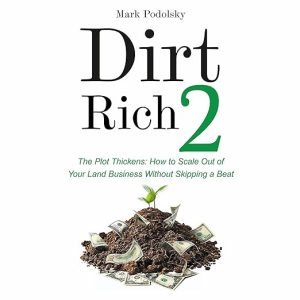
Mark Podolsky built his land investing business down to two hours a month of his own time. The Dirt Rich audiobook, second in his series, is his argument that this is not a personal quirk or a lucky outcome. It is a replicable system, and this second volume is dedicated entirely to explaining how to build it. That specificity sets this apart from much of the passive income genre, where the gap between aspiration and operational detail tends to be wide. Podolsky does not spend significant time on the appeal of financial freedom; he assumes you already want it and gets directly to the architecture of making it happen.
Self-narrating this material was the right call. Podolsky has spent years mentoring land investors, and the experience shows not just in what he says but in how he says it. A professional narrator reading this content would produce something more polished but less convincing. What you want from a business methodology audiobook narrated by its author is the sense that this person has actually done what they are describing, has seen where students get stuck, and knows which parts of the system require the most emphasis. Podolsky delivers that throughout the 4 hours and 52 minutes of this recording. The pacing is direct without being rushed, and he brings enough energy to the material to make a sequencing conversation about automation and delegation feel genuinely interesting rather than procedural.
Highly Paid Freelancer Versus Actual Business Owner
The framing Podolsky uses throughout is the distinction between being a highly paid freelancer and actually owning a business. The first Dirt Rich volume taught the land investing fundamentals: finding deals, pricing, and selling on terms. This second installment assumes you have that foundation and addresses the more difficult problem of extracting yourself from the day-to-day operations so the business can function without your constant presence. The mindset section, which opens the book, is more than motivational boilerplate. It is a diagnostic. Podolsky is specific about the behaviors and beliefs that keep successful land investors trapped as highly paid employees of their own operations, and the clarity with which he names those patterns gives the subsequent systems discussion its practical grounding.
Podolsky Assumes You Already Have the Basics
A reviewer with direct coaching experience from Podolsky described him as someone who inspires you to dream really big while remaining sincere and encouraging. That combination of ambition plus operational specificity is what makes the audiobook work. Another reviewer who had read the first volume called this a strong follow-up for those looking to take their land flipping business to the next level. The sequel framing is accurate: this is not a standalone business book. It is a continuation that builds directly on the groundwork of the first volume, and listeners who come to it without that foundation will find the middle sections particularly opaque. The automation and delegation chapters assume you already have a functioning land business that you are trying to scale rather than a prospective investor starting from zero.
The systems Podolsky describes are specific to the land investing niche: the team structures, the technology, the outsourcing approach, and the delegation frameworks are all calibrated for businesses that operate in this particular market. The principles are generalizable in broad strokes, but the implementation details will be most useful to listeners who are already in the land investing world and recognize the specific operational problems Podolsky is solving. At under five hours, this is a business audiobook that respects its reader's time. The content density is high throughout, and the absence of filler reflects someone who has taught these concepts repeatedly and knows exactly which parts require elaboration and which do not.
Mapping the Moves Between One State and Another
This is the second book in the Dirt Rich series, and the material builds directly on the first volume. Listeners who have not read or listened to the original should start there. This sequel is pitched at investors who already have the foundation in place and are ready to build the operational layer on top of it. The business model being discussed is specific to raw land investing: buying and selling undeveloped land parcels, often via seller financing. Listeners from other real estate niches will find some of the structural advice applicable but the specific systems and market references less directly transferable. The passive income framework Podolsky advocates is compelling in theory but requires significant upfront work, team building, and capital. The two-hours-per-month outcome is the end state of a process that takes years to build.
The sequencing of the Dirt Rich series reflects a broader philosophy about how business education should work. Too many entrepreneurship books describe end states: the passive income lifestyle, the location-independent business, the fully staffed operation that runs without the founder. Podolsky does something more useful. He describes the transition: the specific moves, mindset shifts, and system installations that get you from one state to the other. That focus on the gap between where most land investors are and where they want to be is what gives this audiobook its practical density. It is not a vision board; it is a change protocol for a specific type of business at a specific stage of development.
Land Investors Ready to Stop Being the Bottleneck
Land investors who have worked through the first Dirt Rich volume and feel ready to stop being the bottleneck in their own business will find this the most directly applicable resource in this niche. The ideal listener has an active land business that is generating revenue but consuming more personal time than they want to sustain. Entrepreneurs from adjacent fields, including other real estate niches and service businesses, will find the systemization and delegation framework useful as a parallel, even if the land-specific examples do not translate directly. Complete newcomers to land investing should start with the first volume before approaching this one, which assumes significant context and existing operational experience.