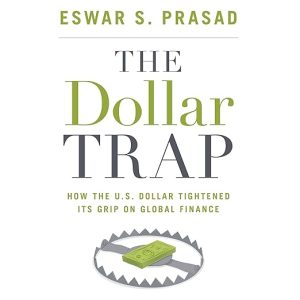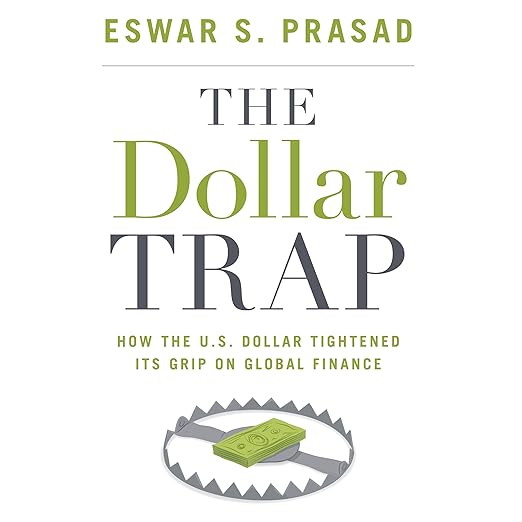
Quick Take
- Narration: Dennis Holland reads Prasad’s dense economic argument with steady, measured clarity, he keeps the material from becoming a lecture without dumbing it down.
- Themes: dollar hegemony, global monetary instability, China-US financial interdependence
- Mood: Sobering and intellectually dense, rewarding for patient listeners
- Verdict: Essential listening for anyone trying to understand why the dollar remains dominant despite every reason it should not be.
I came to The Dollar Trap during one of those stretches when the financial news felt particularly dizzying, headlines about currency wars, Federal Reserve taper tantrums, and breathless predictions about the yuan dethroning the dollar. I queued it up on a long train ride back from Paris and finished it over three subsequent evenings. By the end, I understood something I had only half-grasped before: the dollar’s dominance is not a sign of American strength so much as a consequence of a system that no one has yet figured out how to escape.
Eswar Prasad is a Cornell economist and former head of the IMF’s China division, and his authority on this subject is evident from the first chapter. What distinguishes this book from the currency-crisis panic literature, and Prasad himself contrasts his conclusions with books like James Rickards’s Currency Wars, is that he refuses to write a disaster narrative. His argument is essentially paradoxical: the 2008 financial crisis, which should have shaken confidence in the dollar, actually reinforced the dollar’s centrality, because when global investors panicked, they fled into US Treasury securities. The trap is that there is no good exit.
Our Take on The Dollar Trap
Prasad marshals this central paradox with precision. Foreign nations have accumulated such vast reserves of dollar-denominated assets that a dollar crash would devastate them as much as it would the United States. China holds trillions in US government securities and has every incentive to keep the system stable even as its own leaders publicly call for a post-dollar world. This is the intellectual core of the book, and Prasad develops it carefully, chapter by chapter, without the breathless urgency that characterizes most popular economics writing. One reviewer noted the book is repetitive, and that is a fair point, Prasad does circle back to his key contentions more than once. But each return adds a new layer of context, whether it is the role of the IMF, the politics of currency intervention, or the limitations of proposed alternatives like the SDR or a gold standard.
Why Listen to The Dollar Trap
The audiobook format works better here than you might expect for a 12-hour economics text. Dennis Holland’s narration is composed and authoritative without being monotonous, he handles the technical vocabulary of international finance without stumbling, which matters in a book that regularly moves between concepts like carry trades, sterilized intervention, and capital account liberalization. Holland does not try to inject drama that the text does not contain; he trusts the argument to carry its own weight. Reviewer Julian Berengaut, writing at the book’s release, called it thoughtful and very well-written, noting how strange it is that emerging markets with faster growth and healthier financial systems find themselves subject to the monetary decisions of a country they are effectively financing. That strangeness is exactly what Prasad unpacks over the course of the book.
What to Watch For in The Dollar Trap
Two weaknesses are worth flagging. First, the book was published in 2014, which means some of the specific policy discussions, particularly around the taper tantrum and emerging market vulnerabilities of that era, feel dated. The underlying argument about structural dollar dependence remains valid, but listeners should be prepared to mentally update the examples. Second, as one reviewer pointed out, Prasad spends relatively little time on alternative systems like gold or bitcoin, which he largely dismisses. If you are specifically interested in those arguments, you will need to look elsewhere. The book is also, by its own acknowledgment, more descriptive than predictive, Prasad explains why things are the way they are but is careful not to offer timelines or collapse scenarios.
Who Should Listen to The Dollar Trap
Listeners who will get the most from this audiobook are those with at least some grounding in macroeconomics or international finance, not necessarily academic, but enough to be comfortable with terms like reserve currency, current account deficit, and monetary policy transmission. Complete beginners may find the density punishing. For those listeners, a primer on Bretton Woods and the petrodollar system would be useful preparation. For everyone else, policy-minded readers, investors who want to understand sovereign debt dynamics, anyone following the slow-motion debate about de-dollarization, this is one of the more rigorous treatments available in audio form. Avoid it if you want a clear prediction or a simple answer, because Prasad’s honest conclusion is that the system is fragile, flawed, and likely to persist anyway.
Frequently Asked Questions
Does The Dollar Trap predict a dollar collapse?
No. Prasad’s central argument is the opposite, that despite its structural flaws, the dollar will remain the dominant reserve currency for the foreseeable future because no viable alternative exists and too many nations are too deeply invested in the current system to allow a controlled transition away from it.
How does this audiobook compare to James Rickards’s Currency Wars?
Prasad himself addresses Rickards as a contrasting view. Where Rickards leans toward a crisis narrative and advocates for gold, Prasad is more skeptical of alternatives and focuses on explaining the existing system’s self-reinforcing logic. Reviewer Samuel Clemens called Currency Wars the perfect companion piece for the contrary view.
Is the 2014 publication date a problem for listeners today?
For the specific policy examples and market dynamics of the early 2010s, yes, some sections feel dated. But the structural argument about dollar dependence and the China-US financial relationship remains relevant and largely unchanged in its essentials.
Does Dennis Holland’s narration handle the economic terminology well?
Yes. Holland reads with steady authority and does not stumble over technical vocabulary. For a dense 12-hour economics text, his measured pace is appropriate, he keeps the material intelligible without oversimplifying Prasad’s careful distinctions.