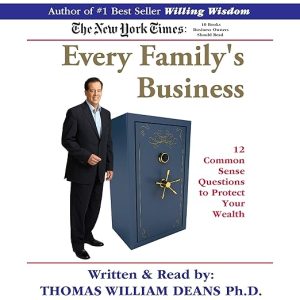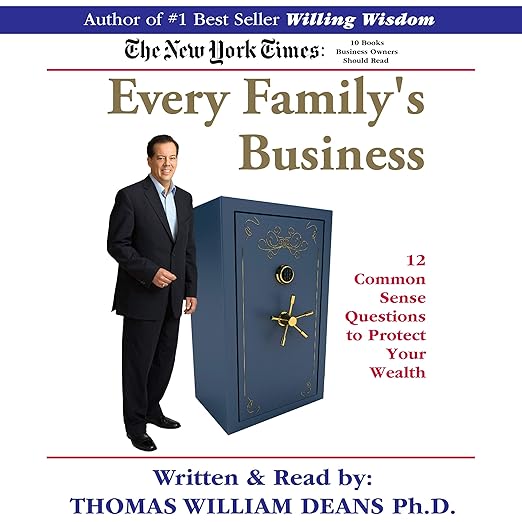
Quick Take
- Narration: Dr. Thomas Deans narrates his own work, which lends the material an authority and personal conviction that a hired narrator could not replicate, the delivery is measured and direct, suited to the boardroom-style subject matter.
- Themes: Family business succession, wealth preservation, the dangers of gifting a business to heirs
- Mood: Practical and quietly urgent, like a candid conversation with a trusted advisor
- Verdict: Essential listening for anyone tangled in the question of what happens to a family business, and honest enough to challenge the answers you thought you already had.
I came to this one on a quiet Tuesday afternoon, having just spent a long phone call with a friend whose parents were in the middle of a painful succession dispute. The call left me thinking about all the things families never say out loud until they are forced to. That was the headspace I brought to Thomas William Deans’s audiobook, and it turned out to be exactly the right one.
Every Family’s Business has been circulating since 2008 and has sold over a million copies, which is a staggering number for a book that deals with what most people consider a niche problem. The reason for that reach becomes clear quickly: the core argument is not really niche at all. It is about money, legacy, and the stories families tell themselves about what they owe each other.
Our Take on Every Family’s Business
Deans’s central provocation is genuinely unsettling if you have grown up around a family enterprise. He argues that gifting a business to the next generation is, more often than not, a terrible idea, financially, relationally, and strategically. That is a hard message to deliver to audiences who have spent decades assuming the handoff is both inevitable and noble. What makes the book work is that Deans is not speaking from theory. He navigates three businesses over a hundred years within his own family, culminating in more than a hundred million dollars in transactions, and the candor with which he shares that history gives his contrarian position real weight.
The twelve questions he structures the book around are not trivia. They force business owners and their families to confront whether selling to an outside buyer might actually be the kindest thing they could do for everyone involved, including the child they were planning to hand the reins to. Readers on Audible have called these questions transformative in a practical, immediate sense, one reviewer mentioned using them with all their financial planning clients.
Why Listen to Every Family’s Business
The audiobook format suits this material well. Deans narrates it himself, and while his delivery is not theatrical, it has the steady, unflappable quality of someone who has already survived the arguments he is describing. The fictional-story framing that some print readers appreciated translates naturally to audio, making the twelve questions feel like scenes from a life rather than items on a checklist. At just over four hours, it is also a format that respects your time, you could finish it across two commutes and walk away with a clearer framework for a conversation most families delay for decades.
The series context matters here too. This is the first book in the Family Wealth Transition Trilogy, meaning Deans has more to say beyond these twelve questions. But this volume stands completely on its own and does not require a sequel to be useful. The advice is self-contained and actionable without being simplistic.
What to Watch For in Every Family’s Business
The book’s greatest strength, its conviction, is also something to hold critically. Deans argues forcefully that selling outside the family is often the right move, but his own experience, however instructive, represents a specific kind of family business operating at a specific scale. Listeners running a small regional bakery or a two-person trades operation may find that the framework needs some translation to fit their reality. The emotional complexity of letting go is addressed, but the practical mechanics of different sale structures get less attention than the philosophical case for selling.
A reviewer who gave the book four stars noted that as a third-generation business owner, the perspective still needed to be heard, which is honest about both the value and the limits of a single framework. That is not a reason to skip it; it is a reason to engage with it actively rather than accept it wholesale.
Who Should Listen to Every Family’s Business
This audiobook is built for business owners who are within a decade or two of transition, adult children of business owners who sense the expectation of inheritance coming toward them, and financial advisors or estate planners who want to equip clients with better questions before the hard conversations begin. It is less suited to someone looking for a technical guide to business valuation or transaction structuring, those books exist, and this is not one of them. What Deans offers is the emotional and strategic framing that makes those technical conversations possible in the first place.
Frequently Asked Questions
Do I need to own a large business for this audiobook to be relevant?
Not necessarily. Deans’s own examples involve significant sums, but the twelve questions he poses apply to businesses of many sizes. The framework is most directly useful if you are involved in a family business with at least two potential successors and some meaningful asset value to protect.
Is this audiobook useful for the next generation, or only for the current business owner?
Both, which is part of its value. Deans addresses the children and spouses in a family business system, not just the founder. Several reviewers noted that it reframed the dynamic from both sides of the succession conversation.
Does Dr. Deans narrating his own book work well in audio format?
Yes, with the caveat that his delivery is measured rather than dramatic. The personal authority he brings to the material more than compensates for any lack of vocal range. It sounds like a mentor talking, which matches the book’s tone exactly.
Is Every Family’s Business part of a series, and do I need to listen to the others?
It is the first book in the Family Wealth Transition Trilogy, but it functions as a fully standalone listen. The twelve questions and the core argument are complete within this volume alone.