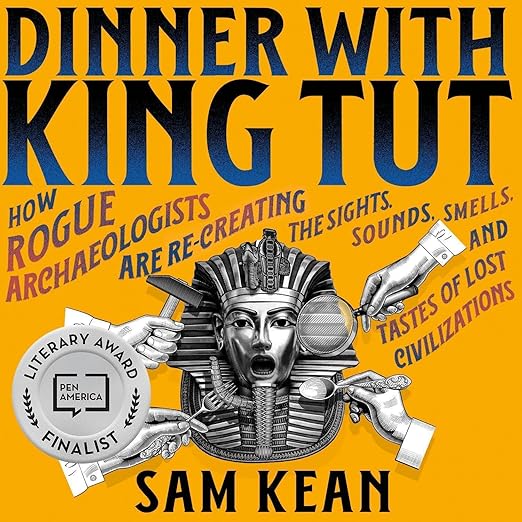
Sam Kean has spent his career finding the door at the back of the museum, the one marked staff only, where history gets its hands dirty. Dinner with King Tut is his best attempt yet to drag the listener through that door. This audiobook runs fifteen hours and fifty-three minutes and argues that everything we think we know about the past is incomplete because it is almost entirely visual. We know what the pyramids looked like. We do not know what Egyptian sourdough tasted like, or what the air smelled like the morning a medieval catapult was fired, or what the crowd sounded like at an Aztec ballgame where the losers might not be going home.
Kean has found his ideal subject in experimental archaeology. The field is populated by researchers who build their own mummies, knap obsidian blades, launch actual boats onto open seas, and otherwise refuse to let historical knowledge remain theoretical. These are not reenactors performing for an audience. They are scientists trying to close the sensory gap between then and now. Kean joins them in the field, which means the book has the energy of participatory journalism rather than archival scholarship. He fires the catapult. He attempts ancient surgery. He builds a Roman-style road. The first-person research persona is genuinely useful here rather than a stylistic affectation, because the book's thesis is about embodied experience, and Kean's bodily presence in the research validates that thesis.
The novelistic interludes are another structural innovation. Kean intersperses chapters of narrative nonfiction about experimental archaeology with shorter fictional scenes that place named historical individuals in the precise sensory moment being studied. A chapter about Roman fish sauce gets a fictional sidebar set at a Roman dinner table. These interludes work with varying success. Some are sharp and evocative, others interrupt the momentum of the main argument. But the ambition behind them is real and the execution is more often strong than not.
Shetterly Slows Down for the Denser Chapters
Derek Shetterly is exactly the right narrator for Kean's register. Kean's prose runs warm and informal. He writes like a very well-read friend who cannot stop telling you about the thing he just discovered, and a wrong narrator can make that approach feel insufferably casual or hectoring. Shetterly finds the enthusiastic-without-being-exhausting middle ground. His delivery on the comic moments, and Kean writes comic moments with real precision, lands without overselling the joke. On the denser archaeological passages, Shetterly slows to match the weight of the material rather than pushing through at the same pace as the narrative sections.
Longtime Kean readers have called this maybe his best book, and the specific praise is worth unpacking. Kean's previous work in chemistry and atmospheric science applied his accessible style to subjects where the sensory translation is harder. Dinner with King Tut benefits from a subject that is inherently more participatory. You can experience food and sound and smell in ways that are harder to translate from the periodic table, and the structure here alternates scholarly argument with visceral narrative in ways that keep both in productive conversation throughout the fifteen-hour runtime.
Fictional Interludes Are a Matter of Taste
The runtime is genuine and the book covers a very wide geographical and temporal range. From Polynesian islands to Arctic ice floes, from Egyptian bread to Viking swords to Aztec ballgames, this is an ambitious sweep that occasionally costs the book some depth. The sensory archaeology of any particular culture or period deserves more space than Kean can give it in a structure consciously designed to move quickly and broadly. Specialists in any one area covered here may find their field treated more superficially than they would like, and that is a genuine limitation rather than a minor quibble.
The fictional interludes are a matter of taste. Some listeners will find them exactly the right palate-cleanser between analytical chapters. Others will find the gear-shift between nonfiction and fiction slightly disorienting, particularly in audio where the transition may not always be clearly signaled. This is a structural note rather than a serious criticism, but it is worth knowing before committing sixteen hours. Listeners who want purely nonfiction narrative without fictional reconstruction may find their immersion occasionally broken by these passages.
General Curiosity Is the Only Requirement
Kean's general audience is perfectly positioned for this audiobook. It assumes curiosity and patience but not specialist knowledge. History enthusiasts who have grown slightly tired of the same visual-monument focus in popular history will find something genuinely refreshing here. Derek Shetterly's narration is a significant asset for nearly sixteen hours of material. Listeners who have bounced off Kean's more science-focused previous books should give this one a try. The subject matter is more broadly accessible and the narrative register is somewhat looser and more adventure-driven. Skip it if you prefer narrow-focus deep dives over wide-ranging archaeological surveys that cover many cultures in sequence. What Kean offers in exchange for that breadth is a sense of historical experience as something alive and recoverable rather than sealed behind glass. The best passages in the audiobook make you feel that distance between past and present as a gap that human ingenuity can genuinely close, at least partially. The experimental archaeologists Kean profiles are motivated by the same curiosity that makes readers pick up popular history in the first place. Shetterly's narration captures their enthusiasm in a way that makes the sixteen hours feel collaborative rather than instructional.
- Voice: Derek Shetterly matches Sam Kean's enthusiastic, irreverent tone without tipping into performance, making nearly sixteen hours feel like a well-paced lecture from someone genuinely delighted by their material.
- Big ideas: Experimental archaeology as lived history, sensory experience across time, the gap between what we know and what we can feel
- Atmosphere: Curious, kinetic, and occasionally gonzo
- Worth it?: Sam Kean's best book to date according to longtime readers, and one of the most inventive approaches to popular history in recent audiobook publishing.
A Few Questions About Dinner with King Tut
Is the Dinner with King Tut audiobook worth the nearly sixteen-hour runtime, or does it feel padded?
Reviewers consistently describe it as tightly paced despite the length. Kean's structure alternates between participatory field research, historical argument, and novelistic interludes in ways that prevent any single register from becoming exhausting. Most longtime readers call it his best work.
How does Derek Shetterly's narration handle the tonal range between academic analysis and comic observation?
Shetterly is well matched to Kean's range. He delivers comic observations without overselling the humor and adjusts his pace for the denser archaeological passages. Listeners who know Kean's prose style will find Shetterly a strong and appropriately calibrated voice for this particular material.
Does this audiobook include supplemental materials like maps or reference charts?
No supplemental materials are noted as accompanying this audiobook. The text is self-contained and the experimental archaeology sections are described in enough narrative detail to follow without visual support throughout the runtime.