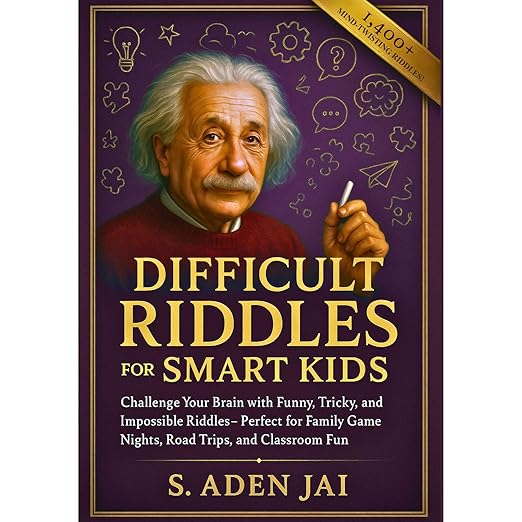
Courtney gave this one star and titled the review AI Slop. The complaint is specific: the first riddle admits many possible answers, the second was too easy to guess, the third made no sense at all, and after three attempts Courtney declined to reach the other 1,397. That figure is the arithmetic of a book advertising over 1,400 riddles, performed by a reader who quit at three. This audiobook is read by Virtual Voice, which is to say by a synthetic narrator. So anyone sharing Courtney's suspicion would be hearing a machine read aloud what they believe a machine wrote, which is either the modern condition or a reason to spend the money somewhere else.
Virtual Voice is the whole of the credit, and for this format that line weighs far more than it would on a novel. A riddle runs on timing: the setup, the pause, the reveal. A human reader shapes that pause and lets a child's guess land inside it. Synthetic narration proceeds at whatever cadence the model produces, and nothing on this page suggests anyone shaped the gap between question and answer. In a book whose entire function is to stop and wait, the shaping of that gap is not a minor production question. Any parent planning to use this on a long road trip should audition it before committing six hours of it to a back seat.
Fourteen hundred riddles is the number the description keeps returning to, and the runtime is six hours and five minutes. Divide one into the other and each riddle gets a little over fifteen seconds, answer included. That is a plausible pace for reading a one-line question aloud and supplying the solution, and an impossible one for playing a riddle with a child, which involves stopping, arguing, guessing wrong, and going again. On paper this arithmetic never comes up, since you move at your own speed. In audio it becomes the central usability question, and a family working through this at the dinner table will spend more time on the pause button than on the file.
A Layout Is Not Something You Can Hear
This listing's series field reads SUPER INTERESTING FACTS FOR CURIOUS KIDS, which is not the title of this book, appears nowhere in the description, and carries no volume number. Whether that points to a companion line by the same author or a copy-paste from a different product, this listing offers no explanation and a buyer cannot work it out. The publisher field reads Independently Published. What passes for a description here is really a sales sheet, carrying headings like Ideal Gift For and Why Kids (and Parents) Love This Book, bullet categories running from wordplay to space to holidays, and a closing paragraph that repeats the pitch it opened with. Nothing here was written for a reader, only at one.
Samson A. gives it five stars and explains why with unusual clarity: the riddles are funny, the variety is broad, the questions are grouped nicely, and the layout is clear and easy to read. Three of those four observations survive the move into audio. The fourth cannot. A layout is not something anyone can hear, and a reader praising the organization of a page is describing a book meant to be looked at. That is a print response attached to an audio edition, and it happens to be the most enthusiastic entry on this listing. Whether the grouping helps at all when you cannot see it is something nobody here has tested.
One Silent Voter Identified by Simple Arithmetic
Four people wrote here while five votes were counted, which for once produces clean arithmetic. Five whole-star votes averaging exactly 4.0 have to total twenty points. The visible grades are a five, a one, and two more fives, which comes to sixteen. So the one person who graded without commenting gave it a four, exactly and unambiguously. It is the rare case where a silent voter can be identified precisely, and the answer turns out to be mildly positive: somebody got through this book, liked it well enough, and did not feel strongly enough to write a sentence about it. Possibly the most accurate verdict a riddle collection can earn.
Riddles need answers, and both of the calmer positive reviewers make a point of confirming they exist. Yair Aizenman notes that if one does not get every riddle, answers are provided. LiletR goes further and gets practical about it: the book has answers and explanations at the end, which makes it even better. At the end is where the trouble begins for a listener. Skipping to the back of a printed book takes a second. Locating a single answer at the end of a six-hour recording, then returning to your place, takes considerably longer and will not survive a car full of children. This is the most consequential structural fact about the audio edition and nobody has flagged it.
A Riddle Sheet Read by a Machine
Families are the target, and the description names the occasions directly: family game nights, classrooms, long road trips, rainy days. LiletR was planning to use it at a Christmas party, which is precisely the intended purpose and a decent sign the material works in a group. But notice who is speaking. Not one of these four responses comes from a child, and the categories the description advertises, from logic and math puzzles to science, space and history, are pitched across a band wide enough that smart kids covers more or less everyone. The title promises difficulty. LiletR reports being surprised by how challenging it turned out to be, which suggests the promise is at least partly kept.
Buyers looking for a shared activity with the screens off will find raw material here, and three of the four responses are warm about it. The variety is real, the answers exist, and a six-hour file holds a great many prompts for a long drive. Anyone who cares about provenance should read Courtney's review before purchasing, because the accusation is stated plainly and a synthetic narrator credit does nothing to weaken it. Anyone buying for a particular child should note that no one here reports how it went with one. And anyone expecting the polish of a produced children's audiobook should adjust expectations: an independently published riddle sheet read by a machine is what this listing actually describes. Ask for the sample first, and time how long the file waits after each question before it answers.
The Short Version
- At its heart: Wordplay, logic puzzles, family game nights, screen-free entertainment.
- Vibe: Light, brisk, mechanical.
- Short version: Plenty of raw material for a long drive, though a synthetic reading and an answer key parked at the end work against the format.