- Performance: Hamilton McLeod sustains controlled, journalistic authority across a genuinely long runtime.
- What it covers: Post-colonial dictatorship, Western complicity, resource wealth
- Feel: Grim, meticulously researched, narratively propulsive
- Our call: A serious, well-told comparative history worth the nineteen-hour commitment it asks for.
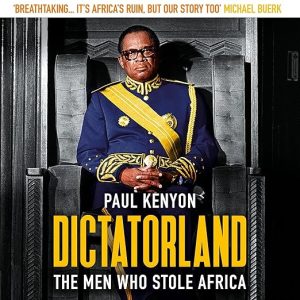
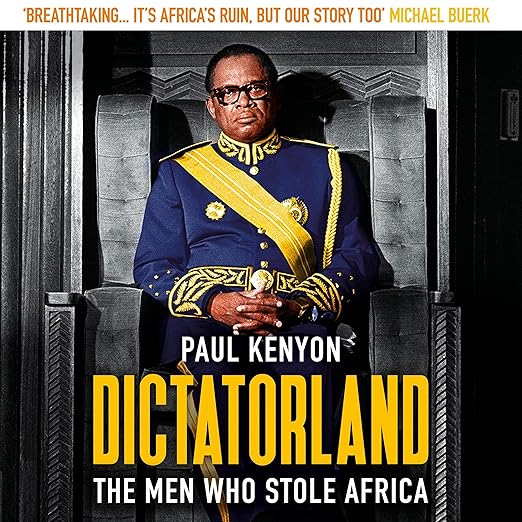
A thirty-five-story basilica rises from the Ivory Coast jungle in one of this audiobook's most jarring images: what does it cost a country when a single ruler builds something like that while his own people go hungry? That's roughly the animating question behind Dictatorland, Paul Kenyon's account of the dictators who rose across Africa in the decades after independence, men who consolidated staggering personal wealth from cocoa, oil, diamonds, and gold while their citizens lived in dire poverty. A Financial Times Book of the Year, Dictatorland spans Ivory Coast, Eritrea, Equatorial Guinea, Libya, and several more countries across a single, ambitious nineteen-hour account.
Four Dictators, Four Different Shades of Excess
Kenyon's real subject, running underneath every individual profile, is Western complicity: the chocolate, oil, and mineral markets that made these dictatorships not just possible but profitable for outside interests willing to look away. The basilica from the opening belongs to Ivory Coast's post-independence leader, and it's the kind of image Kenyon returns to throughout, staggering, almost absurd individual excess built directly on resources the country's own people never saw the benefit of.
Libya gets one of the book's most vivid individual portraits: an army officer who authored his own book of political philosophy, The Green Book, and ran the country from a tent, surrounded by a female honor guard, more like a family business than a modern state. Equatorial Guinea's profile is darker still, a leader convinced Hitler represented some kind of salvation for Africa, waging what Kenyon documents as sustained terror against his own population. The book doesn't flatten these figures into a single type; each profile has its own specific, well-researched shape.
Eritrea's profile stands apart from the others in tone. Rather than a single flamboyant dictator indulging personal excess, Kenyon documents a leader who sealed the country off almost entirely from the outside world, maintaining a permanent state of war readiness and conscripting every adult into national service indefinitely. It's the bleakest chapter in the book precisely because it lacks the almost operatic excess of the Libya or Ivory Coast material; the control is total and the visible spectacle is minimal, which Kenyon frames as its own particular kind of horror.
Interviews and Archival Research Build a Seven-Country Roster
The historical photography reviewers mention isn't incidental production value; Kenyon conducted in-person interviews across multiple countries, and the resulting texture, real testimony layered onto archival research, is part of why reviewers consistently describe the book as more narratively alive than a typical academic history of the same material. That reporting-plus-archive combination is a meaningful part of what makes the book read as more than a straightforward academic survey.
Congo, Zimbabwe, and Nigeria round out the seven-country roster alongside the four profiles more heavily featured in the official synopsis, and one reviewer specifically credits Kenyon with covering many African countries struggling after gaining independence in the 1960s as a connected group rather than isolated case studies. That connective framing, treating seven separate national histories as variations on one underlying pattern of resource extraction and Western complicity, is what elevates the book above a simple anthology of dictator profiles.
The book's reception among readers specifically credits its narrative propulsion; one reviewer calls Kenyon's approach a 'breathtaking narrative' despite covering dense, multi-country political history spanning more than a century. That combination, genuine narrative drive applied to serious historical research, is rarer than it should be in this specific subgenre of political history.
McLeod Sustains Authority Across Nineteen Hours
Narrator Hamilton McLeod brings an investigative-journalism register to the material, controlled authority sustained across a genuinely long runtime without losing tension. That's a real skill in audio history writing at this length; a narrator who can't sustain authority over nineteen-plus hours turns dense historical material into background noise rather than a book a listener stays engaged with.
Reviewers consistently praise the research underneath the narrative: in-person interviews and historical photography that back up what could otherwise read as sensationalized material. One reviewer called the book 'fast-paced' despite its length and subject matter, a genuine achievement for narrative history covering seven distinct countries across roughly a century of political change.
At 4.6 from 738 ratings, the reception holds up well for a nineteen-hour commitment in a genre, serious political history, where listener attrition across long runtimes is common; that retention says something real about how well Kenyon sustains momentum across the full length.
Published in 2018, Aged into Recent History
Published in 2018, some of the book's more contemporary material has aged into recent history rather than current events; readers should treat the most recent chapters as a snapshot of that specific moment rather than an up-to-date account of every country's present situation. The core historical narrative, colonial withdrawal through the consolidation of dictatorial power, holds up regardless.
At over nineteen hours, this is a serious time commitment, closer to several dense history books than a single afternoon's listen. The seven-country scope means depth on any single nation is necessarily proportional to the whole; readers wanting an exhaustive single-country history should look for a dedicated title on that specific country rather than expecting this comparative survey to go as deep as a focused biography would on any one dictator.
Hochschild's Congo, and a Coined Word's Argument
One reviewer specifically praised the book's chronological ambition, tracing a journey worth taking from the European Scramble for Africa in the late nineteenth century through the early twenty-first century's contemporary aftermath. That's a genuinely wide historical aperture for a single audiobook: colonial partition, the independence wave of the 1960s, and the decades of consolidated dictatorial rule that followed all get room to develop rather than being compressed into a rushed introductory chapter.
Comparisons to Adam Hochschild's King Leopold's Ghost are apt but only partial; Hochschild's book stays within a single Congo-focused case study across one colonial period, while Kenyon works across seven separate national histories and multiple eras of Western involvement, trading some of that single-story depth for comparative breadth across the wider continent.
The book's own title, Dictatorland, compresses its whole argument into a single coined word: not simply a land that happened to produce dictators, but a specific kind of territory shaped and sustained by the economic relationships surrounding it. That's a small but telling choice, framing dictatorship less as an individual moral failing of any one ruler and more as a structural condition Western markets helped manufacture and maintain.
Skip It If Nineteen-Plus Hours Feels Too Long
Readers of narrative history who appreciated books tracing how resource wealth and Western economic interests shaped the developing world, in the tradition of King Leopold's Ghost, will find familiar territory handled with real narrative skill here. The comparative structure, seven countries under one analytical lens, rewards readers specifically interested in patterns across post-colonial African governance rather than a single national story.
Skip it if nineteen-plus hours feels like too large a commitment for a single audiobook, or if you're looking for a purely academic, footnote-heavy treatment rather than Kenyon's narrative-driven, journalistic approach; this prioritizes readable momentum over exhaustive scholarly apparatus.