De Ocampo's Greg Is Never Quite Right
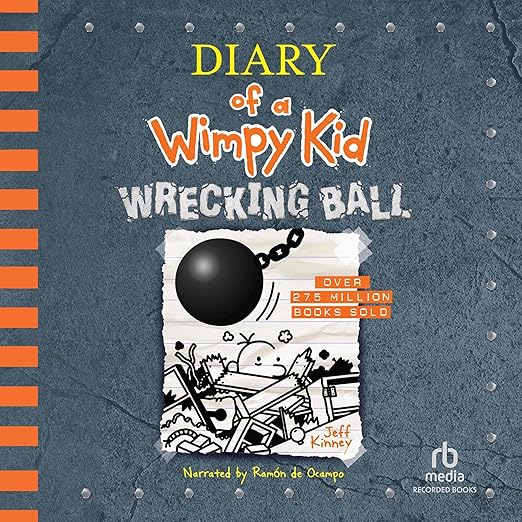
Greg Heffley has survived middle school social politics, a viral cheese touch, summer camp, a cross-country road trip, and more than one Rodrick-related catastrophe. Now, in Wrecking Ball, Book 14 of Jeff Kinney's Diary of a Wimpy Kid series, he faces what might be his greatest domestic adversary yet: a home renovation project. This audiobook adaptation narrated by Ramón de Ocampo arrives with the confidence of a series that knows exactly what it is and delivers it consistently. The premise is deceptively simple. An unexpected inheritance gives the Heffley family the means to upgrade their house, and everything that follows is a precise catalog of how quickly a good idea becomes a very expensive, very chaotic one. De Ocampo's narration has been essential to the audio experience of this series across multiple entries, and his work here is no different.
De Ocampo captures Greg's voice as a very specific kind of narrator: a thirteen-year-old who is never entirely wrong but also never quite right, who misreads situations just plausibly enough that you understand exactly how he got there. That quality of plausible wrongness is what has always made Greg a durable comic protagonist rather than a mere catastrophe generator, and de Ocampo understands it at the level of phrasing and pause. The one-hour-fifty-one-minute runtime is well-suited to young listeners, and the chapter structure makes it natural to listen in school-run or bedtime sessions without losing the thread between stops.
An Inheritance That Becomes the Engine
What Kinney does consistently well across this series, and what this installment demonstrates again, is the mechanics of family embarrassment at scale. The renovation conceit is smart because it gives every family member a role in the unfolding disaster. Greg's tendency to catastrophize is given fresh material, his mother's optimism is deployed against a backdrop of increasingly structural chaos, and Rodrick exists to make everything incrementally worse in the specific ways only a sibling can manage. The inheritance that sets the plot in motion is a classic Kinney device: an apparently fortunate event that becomes the engine of everything going wrong, which is the structural signature of the series.
For the audiobook specifically, de Ocampo's ability to differentiate family members without tipping into caricature keeps the domestic chaos legible across extended listening. The Wimpy Kid books are illustrated, and the audio format requires the narration to carry the jokes that would otherwise land visually on the page. De Ocampo has developed a real facility for this over the course of the series. He understands the comic timing that Kinney's sentences require, the particular rhythm of a punchline that arrives a beat after you expect it and lands harder for the delay. Young listeners familiar with the series will settle into this audiobook within the first ten minutes. The series-wide context also gives Wrecking Ball added texture for longtime readers. By Book 14, Greg has accumulated a consistent history of survival through no particular virtue of his own, and that accumulated track record makes each new disaster funnier in retrospect than it might be in isolation.
A Genuine Undertow of Family Fragility
The central tension of whether the family will stay in their home or be forced to move is the most emotionally resonant thread this entry offers, and it is handled with more sincerity than the series sometimes allows itself. Kinney is careful not to overplay it, but there is a genuine undertow of family fragility beneath the renovation comedy that gives the resolution an earned quality rather than an arbitrary one. Younger listeners may not register it consciously, but it is there, and it is the thing that keeps the Wimpy Kid series from being purely disposable entertainment across fourteen books.
The premise also gives the book an interesting class commentary angle. The inheritance and renovation plot requires Greg to navigate the social currency of home improvement in a middle-school context, which is a more specific observation about contemporary suburban life than the series usually attempts. De Ocampo delivers these moments with the same deadpan consistency he applies to the broader comedy, which is exactly right. He does not editorialize; he lets Kinney's observations land at their natural weight.
For parents who have been reading the Wimpy Kid books aloud or sharing them with children since the early installments, the fourteen-book arc has an unexpectedly rich cumulative texture. Greg's long-running domestic misadventures function less like a single novel's plot and more like an ongoing document of a specific kind of American suburban childhood, and Wrecking Ball contributes to that document a chapter on the anxiety of domestic impermanence that resonates differently for adults than for children.
Breezy but Slight Without a Child Passenger
This is an audiobook for children aged eight through twelve, particularly those who have already encountered Greg Heffley in print or audio. It works as an entry point too, since the series' premise is self-evident within a few minutes, but the cumulative pleasure of following Greg across books is real, and a first-time listener will get considerably more from it with some prior context. Parents looking for a listen that genuinely works in the car or at bedtime will find this reliable. Adult listeners without a child passenger may find it breezy but slight. Established fans of the series who have been collecting every entry will find this a completely satisfying addition.
How long is the Diary of a Wimpy Kid: Wrecking Ball audiobook, and is it a good length for young listeners?
The audiobook runs one hour and fifty-one minutes, which is well-matched to the attention spans and listening habits of its target age group. It divides naturally into short sessions and works well for car journeys, bedtime, or after-school listening.
Does Ramón de Ocampo's narration work well for the Wrecking Ball audiobook?
De Ocampo has narrated multiple Wimpy Kid entries and is very well suited to Greg's voice, delivering Kinney's dry, slightly aggrieved kid logic with precise comic timing. Listeners familiar with his earlier work in the series will find complete consistency here.
Is Wrecking Ball one of the stronger books in the Diary of a Wimpy Kid audiobook series?
It is a solid, dependable entry rather than one of the series' peaks. The renovation premise gives Kinney fresh comic material, and there is a genuine emotional thread about whether the family might be forced to move that adds more weight than usual. It is not the place to start the series, but it will not disappoint established fans.