At a Glance
- Read by: Ramon de Ocampo has become the definitive audio voice for Greg Heffley, and his deadpan comic timing on the party-disaster sequences is exactly what book 20 needs.
- At its heart: Birthday ambition vs. reality, family embarrassment, middle-school social anxiety
- Vibe: Breezy and comedic, perfect for short listening sessions with kids aged 8-12
- Short version: Book 20 is unmistakably Wimpy Kid in form and execution, and listeners already invested in Greg's world will laugh at exactly the moments Kinney intends.
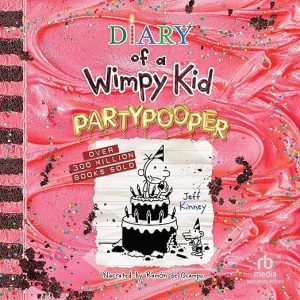
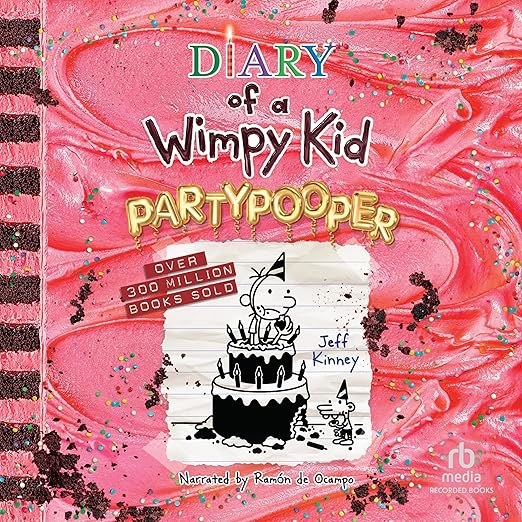
Greg Heffley's 20th audiobook outing, Diary of a Wimpy Kid: Partypooper by Jeff Kinney, narrated by Ramon de Ocampo, does exactly what this series has always done: it takes the gap between what Greg imagines and what actually happens and mines that gap for sustained, unforced comedy. The premise this time is a birthday party Greg plans for himself, a perfectly chosen setup because it lets Kinney stack three different failure modes simultaneously, the guest list that spirals out of control, the decorations that don't come together, and the surprises that backfire in ways Greg couldn't have anticipated. Twenty books in, the core mechanism still functions because de Ocampo has spent years calibrating his delivery to Greg's specific brand of self-defeating optimism.
At just under 2 hours, this is one of the shorter installments in the series. That brevity is a feature for its target audience. Children aged 8 to 12 can finish it in a single afternoon session, and the episodic structure means the humor hits in short, regular bursts rather than building toward a climactic payoff. It's a format Jeff Kinney has refined over two decades, and it still works reliably.
Three Failure Modes Stacked at One Party
Ramon de Ocampo has become so identified with Greg Heffley that it's difficult to imagine the series with another narrator. His delivery carries the self-importance of a middle schooler who is absolutely convinced of his own reasonableness while making every wrong call, and that tonal tension between Greg's narration and the events he's describing is the engine of the comedy. The party disaster sequences benefit particularly from de Ocampo's timing. He knows when to let a moment land flat, which is frequently the right call with Kinney's humor, which often works through understatement and Greg's obliviousness to his own role in each catastrophe.
What Partypooper delivers that marks it as a genuine series installment rather than a placeholder is the integration of family dynamics. The family fiascos the synopsis flags are not just background noise but active complications that escalate Greg's already-doomed party plans. The little-sister Brianna subplot, consistent across the series, continues to provide a counterweight to Greg's schemes, and de Ocampo handles the register shift between Greg's humorless narration of Brianna's chaos and the actual comedy of her behavior with practiced ease. The cake disaster sequence, in particular, earns its payoff because de Ocampo has spent the prior passages building the deadpan tension that makes it land.
De Ocampo Lets the Cake Disaster Land Flat
One reviewer notes that her oldest granddaughter started the series in elementary school and is now 21, while the younger grandchildren are now discovering it. That multigenerational continuity is worth noting. The Wimpy Kid series has an unusual ability to maintain its audience across re-reads and re-listens because the comedy doesn't date. The audiobook format serves that quality well because de Ocampo's performance adds a dimension of comic delivery that silent reading doesn't provide. For younger children who are still developing reading stamina, the audio version is a natural entry point.
Another reviewer mentions her 9-year-old returned to it for repeat listening. That's the benchmark for a children's audiobook: not just that a child finishes it, but that they come back to it. At under 2 hours, it doesn't require a large time investment to revisit, which lowers the barrier to returning on a second or third listen. De Ocampo's timing rewards this: the comedy is there whether you're hearing the punchlines for the first time or the fifth.
Seven Ratings, All from the Existing Fan Base
Two structural notes for new series entrants: the Wimpy Kid audiobooks work as series components rather than fully self-contained stories. While Partypooper doesn't require reading the previous 19 books to follow its plot, the humor and character dynamics are richer with prior series familiarity. Characters like Rowley and Rodrick carry weight that's accumulated across years of installments, and de Ocampo's vocal characterizations draw on a performance history that rewards series listeners.
The rating here is based on 7 ratings, all 5 stars, which reflects the loyalty of the existing fan base rather than a broad sampling of new readers. New listeners without prior Wimpy Kid affinity may not find it as immediately satisfying as readers who are already invested in Greg's world and willing to follow him through another ill-conceived plan.
What Kinney consistently understands, and what de Ocampo's narration reinforces, is that the Wimpy Kid books work because they never ask the reader to laugh at Greg from outside his perspective. We're always inside Greg's point of view, which means we get to observe his rationalizations in real time. The party's collapse doesn't happen despite Greg's planning; it happens partly because of it. That internal consistency is what makes the series' humor feel generous rather than mean-spirited, even when Greg is making objectively bad decisions at every turn.
Start Earlier Rather Than at Book 20
Children aged 8 to 12 who are already in the Wimpy Kid series are the natural primary audience. Parents looking for a sub-2-hour audiobook that holds younger listeners' attention reliably will find this a proven option. Adults who grew up with the series and want a light, nostalgic listen will find de Ocampo's performance makes the experience feel fresh. New listeners without prior Wimpy Kid familiarity should consider starting with the earlier books rather than jumping in at book 20, since the comedy's full effect depends on caring about Greg's established patterns of self-sabotage.