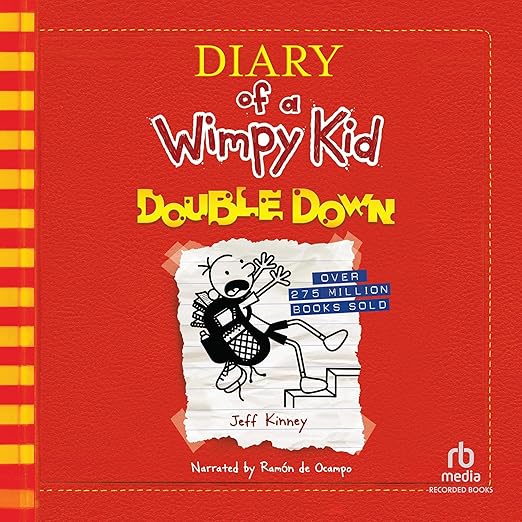
Greg Heffley's filmmaking ambitions in Diary of a Wimpy Kid: Double Down (Book 11) by Jeff Kinney, narrated by Ramón de Ocampo, follow a pattern that any fan of this audiobook series will recognize immediately: Greg identifies a path to wealth and fame, enlists Rowley in a scheme that ignores every practical obstacle, and discovers that reality has opinions about his plans. What makes the eleventh entry in the series still work as well as it does is Kinney's reliable understanding of exactly how far to let Greg's self-regard inflate before the inevitable deflation, and the timing of that puncture is as sharp here as it was in the earliest volumes.
Greg's Video Camera Sparks a Doomed Movie Plan
The setup is characteristically strong. Greg finds an old video camera in the basement, which is exactly the kind of domestic discovery that Kinney uses to great effect throughout the series: small, mundane, and immediately transformed by Greg's imagination into a vehicle for a grand plan. The scary movie idea taps into something genuine about middle school creative ambition, where the gap between the vision and the execution is not just large but spectacularly, comedically large. Kinney's genius has always been in the specificity of middle school social dynamics, and Double Down does not disappoint in that regard. The pressures Greg faces from his mother to broaden his horizons provide the external engine for the plot, but the internal engine, Greg's unshakeable conviction in his own underappreciated genius, is what actually powers the comedy.
Reviewers note that this is a series that makes children want to read, which is perhaps the most meaningful thing you can say about any book aimed at the middle grade audience. The audiobook format adds a particular layer to that claim. Parents who listen alongside their children will find the experience holds up from both sides: the material is genuinely funny at any age, and de Ocampo's performance is calibrated to land the jokes for a listening audience rather than simply reading aloud the text. That distinction matters more than it might seem for comedy, where timing is everything and a flat reading can defuse what should be a sharp moment.
Ramón de Ocampo Nails Greg's Self-Justifying Complaints
Ramón de Ocampo's narration is one of the consistent pleasures of this series in audio form. He has Greg's particular brand of self-justifying complaint down to a precise science, giving the character enough genuine likability that the audience roots for him even while clearly seeing that he is wrong about nearly everything. The 1 hour and 58 minutes runtime is ideal for a single-session listening experience, short enough for younger listeners to complete without losing the thread, long enough to feel like a complete story. At that length, it works particularly well for car journeys with children or as a bedtime listen. The runtime being under two hours also makes it a low-commitment audiobook for adults curious about the series who want to understand what the fuss is about.
Escalating Failures Keep the Filmmaking Plot Sharp
The tension between Greg's creative aspirations and the practical reality of making a movie with no real resources or skill is the book's richest comic vein. Kinney escalates the chaos of the filmmaking project with the discipline of someone who knows exactly how complicated things need to get before the payoff lands. The relationship between Greg and Rowley is particularly well-drawn here: Rowley's loyalty is unwavering in ways that continuously misfire, and that dynamic produces some of the book's best comedy. New listeners picking this up without prior series experience will find it accessible; the character dynamics are consistent enough across books that jumping in at eleven is not disorienting. Series veterans will find the familiar rhythms comforting, which is exactly what a reliable long-running children's series should deliver.
Jeff Kinney's structural approach to comedy is worth noting as one of the series' underappreciated strengths. Each book sets up a central Greg-scheme and then complicates it through a series of escalating failures that are always just plausible enough to avoid feeling like pure slapstick. In Double Down, the filmmaking premise allows Kinney to satirize not just middle school ambition but the entire concept of creative self-assessment, where the gap between what a beginner believes their work is and what it actually is becomes its own comedic engine. Ramón de Ocampo's years with this material mean he understands exactly where the beats are and exactly how to honor them in audio, which elevates what could be routine reading into something that sounds genuinely performed.
New Listeners Find a Comfortable Entry Point
This audiobook is an obvious choice for children aged 8 to 13 who are already fans of the series, and the under-two-hour runtime makes it practical for parents looking for a shared listening experience that won't tax young attention spans. New listeners to the series will find it a comfortable entry point, though the full rewards of the character work accumulate across books. Adults who enjoyed the earlier volumes will find this one equally satisfying. Teachers and librarians looking for read-aloud material that genuinely captures the interest of reluctant readers have strong evidence from reviewers that the Wimpy Kid audiobooks deliver on that front in ways that few middle grade series match. If the only concern is whether this particular installment lives up to the series standard, the answer is straightforwardly yes.
In Brief
- Read by: Ramón de Ocampo captures Greg Heffley's aggrieved, delusional optimism with practiced ease, having mastered the character's voice across the series.
- At its heart: Middle school ambition, creative disaster, best-friendship under pressure
- Vibe: Gleefully chaotic, with the warm familiarity of a series that knows exactly what it is
- Short version: Book 11 delivers exactly what Wimpy Kid fans arrive for, and de Ocampo's narration makes the filmmaking misadventure a genuine pleasure to listen to.
Can you start the Diary of a Wimpy Kid audiobook series at Book 11, or should you begin from the beginning?
Double Down works as a standalone listen because each book tells a self-contained story with Greg and Rowley. There is no plot continuity that requires prior knowledge. That said, the series is most rewarding when read or listened to in order because the character dynamics and running jokes deepen over time. If a child is new to the series and this is their entry point, they will enjoy it without feeling lost.
Is the audiobook version different from reading the print book, given the illustrations in Wimpy Kid?
The print books include Jeff Kinney's distinctive handwritten-style illustrations alongside the diary text, and those visuals are not present in the audio version. Ramón de Ocampo compensates with expressive narration, and most of the humor translates well to audio. However, some jokes that rely on visual gags or the specific formatting of the diary will land differently without the pictures. The audiobook is a genuinely enjoyable experience, but pairing it with access to the illustrated print version gives the full Wimpy Kid experience.
How long is the Diary of a Wimpy Kid: Double Down audiobook, and is it appropriate for a single listening session?
The runtime is 1 hour and 58 minutes, which makes it one of the shorter audiobooks in the series and very practical for a single-session listen. It is well-suited to car journeys, a quiet afternoon, or a bedtime read-along. The pacing is brisk enough to hold a child's attention for the full duration without breaks.