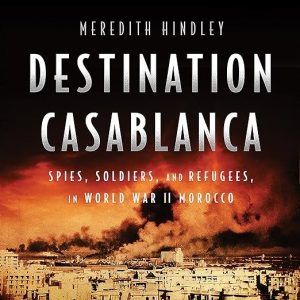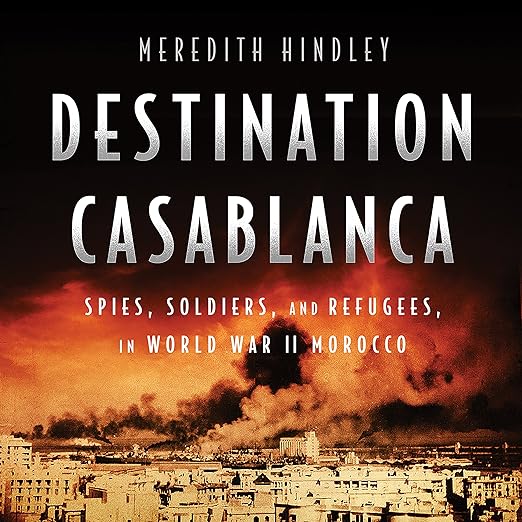
How did a Moroccan port city become one of the most contested pieces of real estate in the Second World War? Destination Casablanca answers that question across seventeen and a half hours, and Meredith Hindley builds her case methodically: from Vichy French colonial outpost, to magnet for Jewish refugees desperate for exit visas, to the site of a 33,000-soldier American amphibious landing in November 1942, to the location where Roosevelt and Churchill demanded Germany's unconditional surrender. Matthew Waterson narrates this audiobook, and the material asks a lot of him, spy intrigue, refugee testimony, and military history all sharing the same narrative space.
We Know the Allies Win, Yet It's Tense
Reviewer Jehoshephat's assessment doubles as a good description of the book's tonal balancing act: 'a suspenseful page-turner even though we know how it all came out,' complete with the dry parenthetical '(Spoiler alert: the Allies win.)' That kind of self-aware humor about narrative nonfiction's built-in lack of suspense is rare, and it signals a writer confident enough in her material's texture, the specific people, the specific compromises, the specific near-misses, that she does not need artificial tension. The same reviewer credits Hindley with 'full command of the history of the operation and of the people involved,' crediting the pacing and thoroughness for never lagging across a genuinely long book.
Reviewer Dave DeWitt offers a more mixed take, structuring his review around the book's three clear movements, background, battles, and aftermath, while cautioning that the background section demands real patience before the Allied operation itself gets underway. That is a fair structural note about a seventeen-hour history: Hindley is building an enormous cast, refugees, resistance fighters, Vichy officials, Nazi agents, before the invasion narrative can pay off, and listeners used to history books that open in the middle of the action may need to adjust expectations for a slower, more deliberately layered opening.
The Casablanca Conference itself, held in January 1943 just months after the American landing the book opens with, gets treated as a genuine turning point rather than a footnote: this is where Roosevelt and Churchill hammered out the unconditional surrender policy that would shape the rest of the war's diplomacy, and Hindley's decision to build toward that meeting as a structural climax gives the book's sprawling early chapters a clear destination worth the patience Dave DeWitt flagged.
The refugee material deserves particular attention, since it is easy for a Casablanca-focused history to treat refugees as background texture to a spy story rather than as the book's own real human stakes. Hindley documents the actual bureaucratic maze desperate families navigated, forged papers, bribed officials, transit visas that expired before exit visas ever arrived, and that granular, procedural detail does more to convey the era's desperation than a purely emotional account could, since it shows readers exactly how much depended on paperwork most of them will never have had to think twice about.
Waterson Balances Spies, Refugees and Battle Scenes
What makes this more than a straightforward military history is how much space Hindley gives to Casablanca's refugee crisis and its espionage culture alongside the combat narrative, shopkeepers, celebrities, former French Foreign Legionnaires, and disgruntled bureaucrats all recruited into a real resistance network well before American troops ever arrived. Reviewer Ken Jarin calls it 'one of the best books' he has ever read and states plainly that 'Anyone traveling to Morocco should read this book before going,' a strong endorsement of how thoroughly Hindley grounds the political history in a real, still-visitable place rather than treating Casablanca as an abstract wartime location.
Waterson's narration is well suited to exactly this kind of tonal range; he has a track record with dense, multilayered nonfiction that shifts between registers, and here that means moving credibly between spy-thriller pacing, refugee testimony that demands genuine gravity, and straightforward military history without losing the connective tissue between them. Seventeen hours is a serious commitment, but the alternation between these registers keeps the momentum Jehoshephat praised intact rather than letting any single thread, the diplomacy, the danger, the human cost, dominate so long that listener attention flags.
Operation Torch Waits Behind a Patient Opening
Dave DeWitt's patience warning deserves real weight for anyone deciding whether to commit to the full seventeen and a half hours. The background section, establishing Casablanca's transformation from travel destination to strategic target after France's surrender, takes real time to set up before Operation Torch and the invasion narrative proper begin, and listeners hoping to jump straight into wartime action may find the opening slower than expected. This is deliberate scene-setting rather than padding, but it is worth knowing going in.
This is also unambiguously popular history rather than a breezy narrative thriller despite Jehoshephat's page-turner comparison; Hindley works from real archival research and juggles a large cast of historical figures, agents, diplomats, and refugees whose names recur across many hours, so listeners who prefer a tighter cast or a single clear protagonist may find the sprawl occasionally difficult to track purely by ear, without a physical index or map to consult the way a print reader could.
Listeners who know the city mainly through the 1942 film should be prepared for how little the two overlap in substance; Hindley's Casablanca is a real, functioning wartime port city full of competing intelligence services and desperate refugees navigating actual visa bureaucracy, not a single smoky cafe with a piano player, and the book uses the film mostly as a cultural hook to explain why Casablanca became so instantly legible to American audiences rather than as a subject of sustained analysis in its own right.
Durable Interest Across Two Hundred Fifty-Three Ratings
The 4.4 rating across 253 ratings is worth noting as a genuinely healthy sample size for a popular history title this specific, suggesting sustained interest well beyond a single publication-week spike. That kind of durable audience is typical of history audiobooks that find a second life among travelers, WWII enthusiasts, and listeners who discover the book years after Hindley's own research first appeared, rather than titles that sell mainly on initial marketing push.
History buffs interested in World War II's North African theater, espionage history, or the refugee crisis that unfolded alongside the war's more familiar battle narratives will find real depth here, along with anyone who has seen the classic 1942 film Casablanca and wants the real history behind its rushed, drama-driven release. Travelers planning a trip to Morocco, per Ken Jarin's specific recommendation, get an unusually rich layer of context most standard guidebooks never touch.
A fast-moving, tightly focused single narrative is not what this book offers, so listeners expecting that should brace for the patient background-building Dave DeWitt flagged, and anyone unwilling to commit the better part of eighteen hours to one book should consider whether this specific slice of World War II history justifies that length for them personally before diving in.
Does this audiobook cover the movie Casablanca as well as the real history?
The film is referenced as a cultural touchstone rushed into release in 1942 to capitalize on real events, but the book's actual focus is the true wartime history of the city, not a study of the film itself.
Is this audiobook mostly about military battles or does it cover other topics?
It covers battles, but spends comparable time on Jewish refugees seeking exit visas, resistance networks of ordinary citizens, and Allied diplomacy, so it is broader than a pure combat history.
How slow is the opening of this Destination Casablanca audiobook?
One reviewer specifically flagged the background section as demanding patience before the invasion narrative begins, so listeners wanting immediate action should expect a deliberately layered setup first.
Is 17 hours a lot for a World War II history audiobook?
It is on the longer side for the genre, reflecting the book's large cast of historical figures and multiple intertwined storylines, so it suits listeners planning a sustained, multi-session commitment rather than a single sitting.