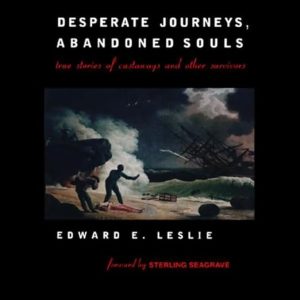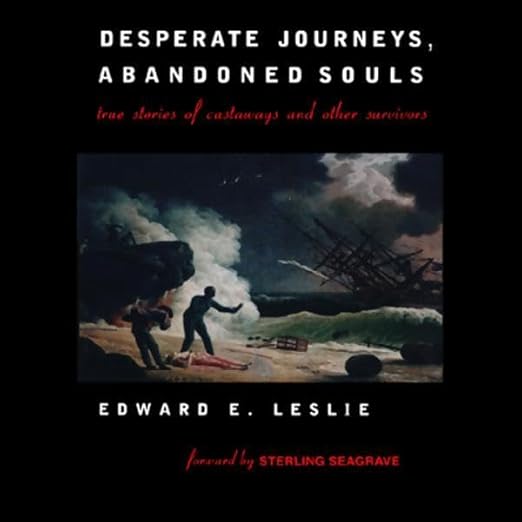
Edward E. Leslie's Desperate Journeys, Abandoned Souls audiobook arrives with a kind of literary pedigree that few survival collections can claim. The accounts gathered here range from the 1500s to the present and include not just the shipwrecks and desertions that form the genre's backbone but the moral and psychological territory that most survival narratives skirt: the decisions made under extremity that reveal what people actually are rather than what they believe themselves to be.
Reviewer Jewelred Beatler put it precisely: "it surprises me how often one of the stories in this book springs to mind in response to events in life large or small. It's amazing to me what people can survive." That quality, the way the accounts become a kind of reference library for thinking about human endurance, is what separates this from the adventure-anthology genre. Leslie is doing something closer to moral philosophy through case study than simple chronicle.
First, the Big Picture
The range is genuinely extraordinary. Shipwrecks on Ascension Island and Patagonia sit alongside an account by Antoine de Saint-Exupery on his experience after a plane crash in the Libyan desert. Maroonings in corners of the globe that most listeners will not have thought of since geography class appear alongside accounts that shaped literature: the echoes of Robinson Crusoe and The Swiss Family Robinson are everywhere in the early chapters, not as derivative borrowings but as the originals from which those fictional constructions were assembled. Leslie's point, implicit but consistent, is that the true accounts are stranger and more demanding than any novelist invented.
The moral dimension is what gives the anthology its depth. Leslie is interested in how isolation and extremity strip away social performance and reveal character, sometimes admirably and sometimes not. Several accounts involve violence, cannibalism, and the breakdown of the ethical frameworks that sustain communities under normal circumstances. These are not sensationalized but analyzed, which is both the book's intellectual strength and its emotional demand on the listener. This is survival literature in the register of Joseph Conrad rather than the survival memoir genre; Leslie reads these stories as evidence about human nature rather than as celebrations of individual triumph.
The Saint-Exupery account deserves particular mention. The author of The Little Prince writing about his own near-death experience in the Sahara brings a literary consciousness to the subject that most of the other accounts, relayed through incomplete historical records or survivor testimony, cannot match. Leslie's decision to include it alongside the earlier historical accounts lifts the anthology into a discussion of how extremity and isolation have shaped literature as well as history, and that dimension makes the book considerably richer than a straight survival chronicle.
The Best Parts of Desperate Journeys, Abandoned Souls
Patrick Cullen's narration across more than twenty-one hours is a considerable achievement. The anthology moves through centuries and cultures, through first-person accounts and third-person historical reconstruction, and Cullen modulates appropriately without losing the common thread. The Saint-Exupery section in particular benefits from a narrator who understands that this material is literary as well as documentary; Cullen gives it the register it deserves. Reviewer Angela, who found the book "fascinating and well-written," noted that it is "a huge book" and suggested the author could have eliminated the last section. That is a fair structural critique, and listeners who feel the anthology's energy dissipating toward the end may want to treat it as a collection to revisit rather than a linear argument to complete in sequence.
A Few Reservations
This is not a book about triumph. Some of the people in these accounts do not survive. Some survive physically but not morally. The accounts involving starvation, dehydration, and violence against other survivors are handled without flinching, and listeners who are drawn to survival narratives for the inspirational arc should know that Leslie is more interested in the full complexity of extremity than in the redemptive version.
The historical range also means some accounts are more fully documented than others. The earliest entries from the 1500s and 1600s rely on incomplete or partial sources, and Leslie is appropriately careful about the limits of what can be known. That scholarly honesty is admirable, but it occasionally creates a different reading experience than the more recent accounts, where survivor testimony is more direct and the psychological detail is richer. The transition between these modes of narration, historical reconstruction versus direct testimony, is something Cullen navigates well in audio but that listeners should be prepared for as a feature of the anthology's structure.
Who Should Listen to Desperate Journeys, Abandoned Souls
This audiobook is for readers drawn to narrative history at the edge of human endurance, listeners who want their survival reading to carry genuine intellectual and moral weight rather than inspirational packaging, and anyone who has read accounts like those in Alive or In the Heart of the Sea and wants a wider anthology of the same serious register. Reviewer Marion Hughes found it excellent for teenagers as well, which speaks to how the moral clarity of extreme situations can function as a kind of ethical education for readers at any stage.
Skip it if you need your survival narratives to resolve happily, or if twenty-one hours of harrowing human extremity will leave you with more anxiety than perspective. Leslie's collection is one of the more demanding listens in the genre, and it rewards listeners who are willing to let the accounts unsettle them. At its best, which is often, this is the kind of audiobook that genuinely changes how you think about what people are capable of under pressure.
Before You Listen
At over twenty-one hours, is this audiobook best consumed in sequence or can sections stand alone?
Individual accounts are self-contained enough to read out of sequence, and reviewer Angela specifically suggested skipping the final section as weaker than the middle. The anthology structure means you can return to specific accounts or periods rather than needing to maintain linear narrative continuity.
Does this audiobook include the literary and cultural influence of these survival accounts on fiction like Robinson Crusoe?
Yes, and this is one of Leslie's central interests. He traces how actual maroonings and castaway experiences fed into literary tradition, which gives the anthology a dimension beyond pure historical chronicle. The relationship between documented survival and fictional elaboration runs throughout the collection.
How does Patrick Cullen's narration handle the tonal variety across centuries and survival situations in the audiobook?
Cullen modulates well across the anthology's range, from historical reconstruction to first-person accounts including Saint-Exupery's literary desert narrative. The twenty-one-plus hours never feel monotone because Cullen adjusts register appropriately, though the sheer length requires listener stamina regardless of how good the performance is.