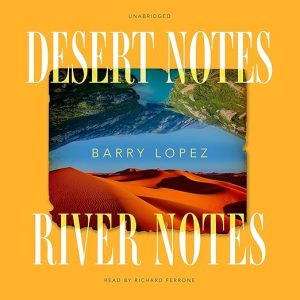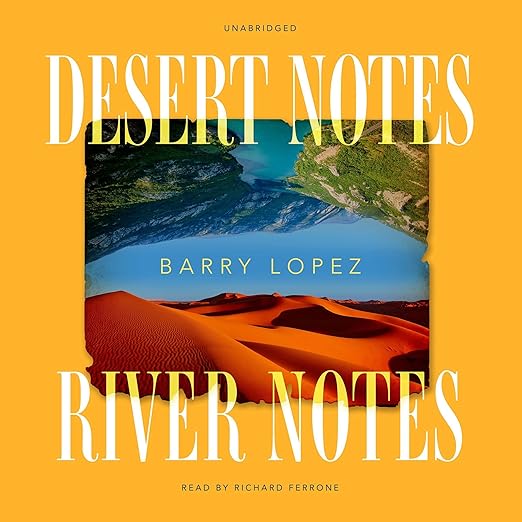
I came to Barry Lopez's Desert Notes and River Notes on a long drive through flat country, which turned out to be exactly the right setting. The landscape outside was unspectacular and enormous, and Lopez's voice inside the car was making the desert feel like a place you had to actively learn to see. I had to stop twice to sit with something he had written about silence, which is not a thing I often do with audiobooks.
These are two short works, originally published separately in the 1970s, collected here into a four-hour and twenty-two minute listen. They are not travel writing in any recognizable sense. Lopez is not describing locations or journeys in the way that genre implies. He is doing something closer to phenomenological field work: recording the specific textures of perception that a desert or a river creates in the person paying careful attention to them. The result is a series of linked vignettes, some approaching prose poetry, some closer to short fiction, some operating in a register that is difficult to name.
The Review
The reviewer who called this confusing and extremely hard to comprehend because of Lopez's interesting views of life and all the metaphors was being honest about a real quality of the text. Lopez is not interested in accessibility as a primary value. He is interested in accuracy, in finding the precise language for what a hot spring in a desert does to the person who discovers it, or what the thoughts of herons might be if herons thought, and that commitment to precision sometimes produces sentences that need to be heard more than once to register fully.
The reviewer who read it slowly and thoughtfully over several months, a piece at a time, and found it impossible to read in a hurry because it is too deep, is also describing something true. These are short texts, but they are dense with intention. At four hours and twenty-two minutes, the listening time is brief, but the reading rate at which they want to be received is much slower than average prose.
Richard Ferrone's narration is the right choice for this material. His voice is unhurried without being solemn, and he allows the more elliptical passages to settle rather than pushing through them. The quality of attention in his reading matches what Lopez is asking of the reader: a willingness to slow down and listen to what the landscape is doing rather than what you are doing in it.
The professor of poetry who recommended this book to one reviewer, who then read Lopez's entire canon, represents the lineage this book belongs to. It has more in common with writers like Annie Dillard or Gary Snyder than with conventional nature memoir. Readers who have found Pilgrim at Tinker Creek or Desert Solitaire meaningful will understand immediately what Lopez is attempting here.
Things to Know Before Starting Desert Notes and River Notes
The two sections have distinct sensibilities. Desert Notes is more austere and disorienting, the desert as a space that dissolves conventional frameworks for understanding. River Notes is warmer and more narrative in places, with specific vignettes like the meditation on herons that several reviewers cited as particularly memorable. If the desert section leaves you uncertain, stay with it through to the river, which may provide a more accessible entry point into Lopez's way of seeing.
One reviewer found that the ideas contained within have deepened and ripened in meaning over years of returning to them. That articulates something real about Lopez's method: he is writing about processes that operate at timescales much longer than a single reading, and the book tends to echo rather than conclude. That is not a flaw in the structure; it is the structure.
Who It's For
This is for readers drawn to literary nature writing, prose poetry, and the philosophical tradition of attending carefully to nonhuman landscapes. Listeners who want forward momentum, narrative arc, or conventional travel description will find this frustrating and possibly opaque. Those who have found Desert Solitaire, Pilgrim at Tinker Creek, or the essays of Gary Snyder worth the effort will find Lopez in similar territory, with his own particular preoccupations around silence, identity, and what it means to be present in a wild place. At under five hours, the commitment is modest even if the rate of reception needs to be slower than the clock suggests.
Are Desert Notes and River Notes fictional or nonfiction?
They occupy a deliberate middle ground. The publisher describes them as fiction, and Lopez himself worked in a lyrical, first-person mode that draws from both imaginative writing and close observation of actual landscapes. They are not factual travel accounts, nor are they conventional short stories. The genre designation matters less than understanding that Lopez is doing something that requires a different kind of reading attention than either pure fiction or conventional nature writing.
Is this appropriate as driving or commute listening, or does it require focused attention?
One reviewer listened during long drives and found it riveting; another read it slowly over several months a piece at a time. The honest answer is that Lopez's prose works best when you can stop and let a particular image or idea settle, which is difficult during active driving. Quiet, focused listening, a walk, a long train journey, an evening at home, will return more than high-distraction commute listening.
How does Richard Ferrone's narration handle the more elliptical, prose-poem passages in Desert Notes?
Ferrone reads the more difficult passages without hurrying to resolve them. His pacing is deliberately patient, which allows Lopez's stranger sentences to exist as they are rather than being softened by momentum. For the meditative quality these texts are reaching for, his approach is well-suited, though listeners who prefer narrators who drive through difficult material may find his measured delivery occasionally testing.