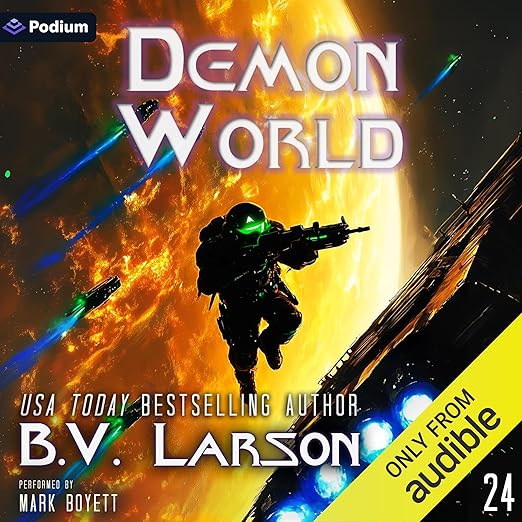
Key Details
- Performance: Mark Boyett is the established voice of James McGill across the Undying Mercenaries series, bringing the character's hard-edged Southern charm and moral ambiguity to life with practiced ease.
- What it covers: Immunity and its cost, the ethics of invasion, loyalty in a universe built on hierarchy
- Feel: Fast-moving military SF with a philosophical undertow that surfaces in the best moments
- Our call: A late-series entry that introduces genuinely interesting moral complexity without losing the action density that built the series' following.
By book twenty-four of a series, you know what you are signing up for. The Undying Mercenaries franchise, B.V. Larson's long-running military science fiction sequence following James McGill of Legion Varus, has run long enough that new entries function almost like seasons of a television show: familiar characters, familiar rhythms, but each volume expected to introduce a new threat credibly while servicing the ongoing mythology. I have followed McGill across a substantial portion of this series, and I came to Demon World with the particular pleasure of returning to a character I know well. The fact that this book surprised me is genuinely to Larson's credit.
The premise is elegantly constructed. Legion Varus lands on Kepler-62 expecting a routine investigation into silent colonies. What they find is not death but transformation: colonists altered by microscopic invaders the unit calls Demons, turned into coordinated killing machines whose efficiency is terrifying precisely because it represents improvement. And then comes the real complication, Centurion James McGill is immune. Completely, mysteriously, immune. In a universe where immunity to something this devastating is never coincidental, that creates a very specific kind of narrative pressure.
A Closer Look at Demon World
The moral question Larson builds into Demon World, what if the invaders are right?, is one of the more interesting propositions the series has attempted. The Demon parasites do not merely control their hosts; they upgrade them. The efficiency they create is real. This is not a straightforward alien-invasion narrative where the enemy is unambiguously monstrous. McGill has to navigate the possibility that something that looks like evil from the outside might have logic to it, while also fighting that same something to prevent humanity from becoming a species-level resource. Larson does not fully resolve this tension, which is the honest choice.
McGill himself remains one of the genre's more entertaining protagonists, larger than life by any realistic measure, driven by appetites that would be reprehensible in a person you knew, and yet somehow relatable in the way that characters who do not apologize for what they are tend to be. The family drama that one reviewer mentioned runs in parallel to the galactic-scale threat, grounding the book in interpersonal stakes even when the action is at its most operatic.
What Works
Mark Boyett has been with this series long enough that his McGill is fully inhabited rather than performed. The Southern-fried bluntness, the moments of unexpected reflection, the particular register Boyett finds for McGill's dark humor in the face of existential threat, these are the product of accumulated character knowledge that a new narrator could not replicate. Fourteen hours is an efficient runtime for this kind of military SF, and Boyett keeps the pacing honest throughout.
Long-running series veterans will find the narrative threads around the Galactic hierarchy and McGill's immunity well-integrated. Larson is a disciplined writer in this series, he does not lose the plot even at book twenty-four, which is an achievement in itself.
What to Watch For in Demon World
One reviewer raised a legitimate structural complaint: the Galactic patrons who might have information about the Demon problem are never consulted, which feels like a missed opportunity given the established hierarchy. It is not a fatal flaw, but it is the kind of thing long-term readers notice when the rules of the world seem to be bent for plot convenience.
Demon World is emphatically not a starting point for the series. At entry twenty-four, the accumulated mythology, the character relationships, and the significance of McGill's immunity all depend on context built across two dozen previous books. New listeners should start at the first Undying Mercenaries title if the premise appeals to them.
Who B.V. Larson Is Writing For
Existing Undying Mercenaries fans who want a book with more than the usual moral texture, where the enemy's logic is worth examining rather than simply defeated, will find this among the stronger recent entries. Military SF listeners who like their action inflected with questions about power, hierarchy, and what improvement actually costs will find the Demon premise particularly engaging. New listeners need to start at book one of the series.