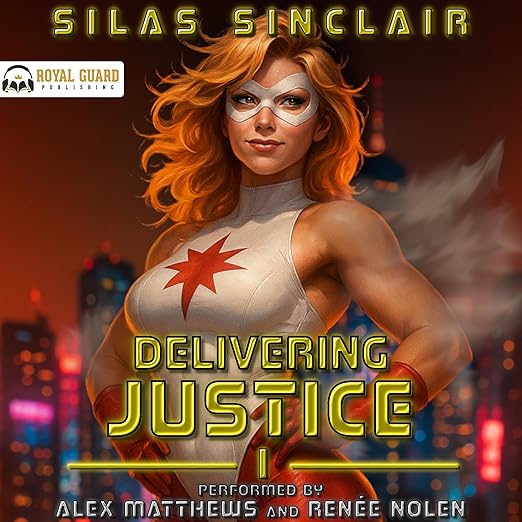
- Voice: Alex Matthews handles Arthur Ward's arc from burnt-out to empowered with credible pacing, tracking the character's emotional shift without losing the grounded quality the story requires.
- Big ideas: Male empowerment in a female-dominant superhero world, slow-burn harem romance, identity under pressure and transformation
- Atmosphere: Action-driven and world-building-heavy, with a slow romantic simmer and a protagonist who takes time to root for
- Worth it?: A confident series opener that builds its world and protagonist carefully rather than rushing to deliver on its premise. For the right subgenre audience, that patience is exactly what the first book should provide.
In a publishing landscape where the superhero genre has fragmented into a dozen subgenres, each with its own dedicated readership, Delivering Justice occupies a specific and clearly delineated space: it is a superhero story with a male protagonist in a world where superheroines are the norm, with elements of harem romance built slowly into the action-adventure framework. If you know what that combination is promising, Silas Sinclair largely delivers on it. If you do not know that specific subgenre well, the book is still a competent and entertaining superhero origin story with unusual worldbuilding premises that are more interesting than they first appear.
Arthur Ward is a burnt-out delivery driver in Neo Elysium, a neon metropolis where superpowered women are a normal feature of the landscape and honey is inexplicably the most popular pizza topping. He has scars and a background he is not eager to discuss, and he wants nothing more than to be left alone. The inciting incident that disrupts this is a collision with both a rookie hero and a mad scientist that leaves him drenched in a volatile chemical compound that should have killed him. Instead it transforms him, making him the first male Empowered in a world where that has apparently never happened before. The premise is well-constructed: Arthur's powers are unstable and evolving, which keeps the action sequences interesting because the rules keep changing, and the social situation of being the only male Empowered in a world of superpowered women provides the book's most consistently interesting dramatic tension.
How Delivering Justice: A Men's Superhero Adventure Holds Up
The Neo Elysium setting does more than serve as a backdrop for action sequences. Sinclair has thought through what a world where superpowered women are the norm would actually look like in terms of social structures, power dynamics, and the specific complications that would arise when a man suddenly appears in that space with comparable abilities. The chemical instability of Arthur's powers, with skin hardening to iron under pressure and frost pouring from him under heat, is a good physical metaphor for a character who is fundamentally in a destabilized state in every dimension. One reviewer described the world-building and character development as fantastic as expected, noting that the realism of damage and psychological issues in the story made the characters more appealing than clean superhero fantasy typically allows. Another described finding the characters layered and the plot line tantalizing, specifically noting the curveballs thrown before the ending that make book two feel genuinely necessary rather than optional.
Why Delivering Justice: A Men's Superhero Adventure Works as an Audiobook
It would be dishonest to review this book without addressing its harem romance framework directly, both because it is central to what the book is doing and because readers who are specifically looking for this subgenre need to know how it is handled. One reviewer who came specifically for this noted that Sinclair is not rushing the romantic development, describing it as a good slow build that takes time for the reader to get a genuine impression of everyone before committing. That pacing is deliberate and, for the subgenre, notable. Harem fiction that rushes the relationship development tends to feel mechanical. Sinclair's approach, taking the time to establish Solaris as a specific character with guilt and protectiveness rather than as a placeholder, suggests a writer interested in making the eventual romantic payoff feel earned. The same reviewer noted that this is not the book to pick up if you expect things to move fast in the harem department, which is useful guidance for managing expectations going in.
Weak Spots in Delivering Justice: A Men's Superhero Adventure
Alex Matthews faces the specific challenge of narrating a protagonist who begins the book deliberately low-energy and checked-out, and who the story requires to become something genuinely different by its end. The early sections require a kind of flat affect that could easily feel like a dull performance rather than a character choice, and Matthews navigates this well, calibrating Arthur's emotional remoteness without making the listen tedious. As Arthur's transformation both physical and psychological accelerates, the narration adjusts accordingly. One reviewer noted that they initially began to dislike the protagonist before the story switched around and made them cheer for him, which is a description of a specific narrative arc that the narrator needs to track and convey accurately. Matthews delivers that shift credibly. The ten-hour runtime moves at a pace that reviewers described as smooth and engaging, which for genre fiction is the appropriate goal.
Delivering Justice is the first entry in what is clearly planned as a series, and it does the work of establishing a world and protagonist that justify the investment in subsequent volumes. For readers in the specific audience this book is written for, that is exactly what they need from an opening chapter. The worldbuilding is interesting, the protagonist is sympathetic after some work, and the questions left open by the ending are genuinely interesting rather than merely cliff-hanging for its own sake.
The Right Listener for Delivering Justice: A Men's Superhero Adventure
Listen if you enjoy LitRPG or superhero fiction with a male protagonist in an unusual setting, are comfortable with a harem romance structure that is paced slowly and deliberately, and want a series opener that builds a world as carefully as it builds an arc. Skip it if you want a standalone story or if the harem romance framework is not something you engage with as a genre convention.
Questions Listeners Ask
Is Delivering Justice a standalone story or does it require reading the subsequent books to feel complete?
The first book provides its own complete arc for Arthur's transformation and initial establishment in Neo Elysium. Questions are left open and romantic developments are deliberately paced for continuation, but the book does not end on a hard cliff-hanger that leaves the story incomplete.
How explicit is the romantic content in this book?
The romantic content is present but deliberately restrained in the first book. Reviewers consistently noted that Sinclair is building slowly rather than delivering on the harem premise immediately, which is a genre-specific choice that some readers will appreciate and others will find frustrating depending on their expectations.
Is the superhero world of Neo Elysium developed enough to feel original, or does it feel like a generic setting?
Reviewers noted the world-building as a genuine strength, with the female-dominant superhero world creating specific social and political dynamics that distinguish it from standard superhero settings. The details like the honey pizza topping suggest a writer who has thought about the texture of his world.
How does Arthur develop as a protagonist across the book's runtime?
Several reviewers noted that Arthur starts in a way that makes them initially unsympathetic, and that the book's arc requires patience before it delivers the character turn that makes him worth rooting for. Matthews's narration tracks this development, and reviewers who stayed with it described the payoff as satisfying.