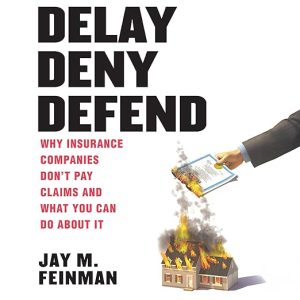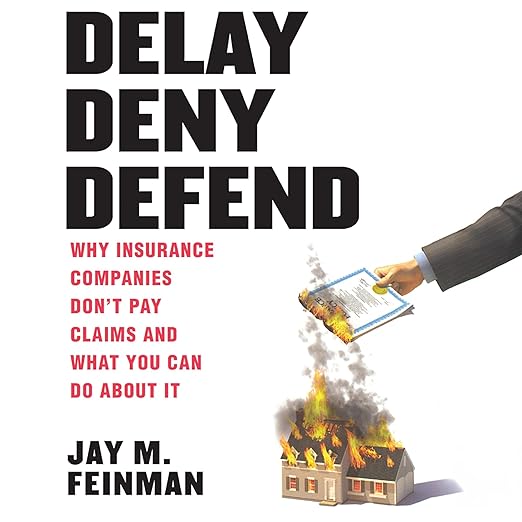
Allstate's claims adjusters work from a playbook, and Jay M. Feinman spent years documenting it. Delay Deny Defend, available as an audiobook narrated by Pat Grimes, is a law professor's systematic account of how major insurance companies, including Allstate and State Farm named specifically, transformed claims handling from a customer service function into a profit center. The title names the three-stage strategy: stretch out the time to resolution, reject or dispute valid claims, then litigate against policyholders who persist. Feinman's central argument, reiterated across the book's nearly nine hours, is that this is not the behavior of rogue employees or individual bad actors. It is deliberate policy, engineered at the corporate level and supported by consulting firms hired specifically to reduce claims payouts.
Feinman is a Rutgers law professor with expertise in insurance law, and that background shapes the book's architecture. He builds his case the way a litigant would: he establishes the historical transformation of the industry, showing how insurers once prioritized claims payment as a competitive advantage before actuarial consultants demonstrated that denial was more profitable. He then documents specific victims whose claims were unfairly rejected, and finally explains the legal mechanisms that make accountability difficult. Reviewer Bernard Patten calls it 'a compelling deep dive into the realities of dealing with the insurance industry,' which is accurate but undersells the anger that accumulates across the book. Reviewer David, in the four-star assessment, flags that Feinman 'dives (too) deep into the history of the transformation of claims,' a legitimate critique for readers who want a shorter, more tactical guide. The historical depth is real and takes up a substantial portion of the runtime.
The specific company documentation is the book's most valuable evidence. Feinman draws on internal documents, whistleblower testimony, and court records to show that the Allstate claims-handling system was redesigned by McKinsey in the 1990s with explicit profit-maximization goals. This is not speculation or pattern inference; these are documented corporate decisions. The detail makes the book genuinely disturbing in a way that more generalized consumer-advocacy writing often fails to achieve. Reviewer Vera King recommends it to 'every homeowner' and 'anyone who has any type of insurance,' which captures how broadly the material applies.
Grimes Gives Case Studies Documentary Weight
Pat Grimes brings the right energy to the narration. The material is legally dense in places: Feinman discusses specific regulations, state-level remedies, and the mechanics of bad-faith litigation in terms that would overwhelm a less composed narrator. Grimes reads with clarity and even pacing, giving the listener enough space to process each argument before the next arrives. At eight hours and fifty-nine minutes, this is a substantial listening commitment, but the structure is organized enough that individual sections on specific companies, specific claim types, or specific legal remedies can be revisited without restarting from the beginning.
The audio format suits this book in one specific way: Feinman's case-study sections, which document individual policyholders who fought their insurers, are more emotionally resonant when heard than when read. The accumulated weight of those accounts, a woman denied disability payments for years, a homeowner litigated into foreclosure after a dispute, an accident victim whose settlement was stretched across a decade, works on the listener the way documentary voice-over works. The argument is the same in print, but Grimes's pacing gives those sections room to land with appropriate weight.
Reforms for Policymakers, Tactics for Everyone Else
The practical consumer guidance is concentrated in the book's later sections. Feinman advises policyholders on how to shop for coverage by looking for companies with clean claims records rather than just low premiums, how to document and pursue a disputed claim, and what to do when delay tactics begin. He also outlines the legal reforms he believes are necessary: expanded bad-faith liability, state insurance commissioners with actual enforcement power, and federal regulation where state systems have failed. Listeners should note that while the book is aimed at a general audience, it assumes a basic familiarity with how insurance policies work in principle. Feinman doesn't spend much time on fundamentals; he assumes you know what you bought and is explaining why you might not get it.
The reform proposals in the book's final section are more relevant to advocates, journalists, and policymakers than to individual consumers, though they provide context for why consumer-level savvy is insufficient on its own. Understanding why the system is structurally designed to resist claims is, Feinman argues, a precondition for knowing why individual tactical adjustments matter less than collective regulatory pressure.
Nine Hours That Name Your Own Tactics
Anyone currently in a dispute with an insurer over a denied or delayed claim will find this audiobook immediately applicable. The case-study sections function as a taxonomy of tactics: recognizing your own situation named explicitly is both validating and strategically useful. Health insurance disputes are covered alongside auto and property claims, since the delay-deny-defend strategy Feinman documents operates across all major insurance lines.
Listeners looking for a shorter, more practical 'here's what to do' guide may find the historical sections more than they need. Feinman is thorough about the origins of the problem, which is intellectually complete but narratively slower than a how-to guide would be. Those willing to engage with the full argument will come away with a more durable understanding of why the system operates as it does, and why incremental consumer savvy alone is not a complete answer. The book's lasting value is that it transforms an experience most people understand only as personal frustration into a systemic phenomenon with documented corporate origins: after nine hours with Feinman and Grimes, you are less likely to blame yourself when your next claim gets delayed.
Good to Know
Does the Delay Deny Defend audiobook give practical advice for disputed insurance claims, or is it mainly policy analysis?
Both, with the practical guidance concentrated in the book's later sections. Feinman covers how to shop for better coverage, how to document a disputed claim, and when to escalate to regulatory bodies or attorneys. The historical and corporate analysis takes up the larger portion of the runtime, but the consumer-focused material is concrete and actionable.
Is this audiobook relevant if my dispute is with a health insurer rather than an auto or home insurer?
Yes. Feinman addresses health insurance claims denial alongside auto and property disputes. The delay-deny-defend strategy he documents operates across all major insurance lines, and his analysis of corporate incentive structures applies to health plans as directly as it does to Allstate or State Farm.