At a Glance
- Read by: Pavi Proczko handles the series' extensive cast and LitRPG stat-reading with practiced efficiency, listeners familiar with his earlier installments will notice continued improvement.
- At its heart: Power escalation and its diminishing returns, the politics of faction loyalty, the cost of being the strongest piece on a board others control
- Vibe: Epic-scale LitRPG with dense worldbuilding and a slower-burn pace than earlier entries, a transitional book in a long series
- Short version: Essential for series readers and largely inaccessible to newcomers, Book 9 is an extended setup chapter that rewards patience from those already invested in Zac Piker's ascent.
I came to Defiance of the Fall 9 having listened to most of the preceding entries, and I want to be honest about what this book is before recommending it to anyone: it is a bridge. It knows it is a bridge. And for a series that has consistently delivered one of the more ambitious LitRPG progressions available in audio, a bridge entry at book nine is both understandable and slightly frustrating.
TheFirstDefier began this series on Royal Road, the web fiction platform that has become one of the primary incubators for English-language progression fantasy. That origin matters for understanding what Book 9 is: it was written serially, chapter by chapter, with readers watching Zac Piker accumulate power, face crises, and climb through the system in real time. Translated to audiobook, the episodic architecture occasionally shows its joints.
First, the Big Picture
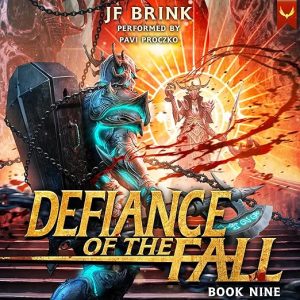
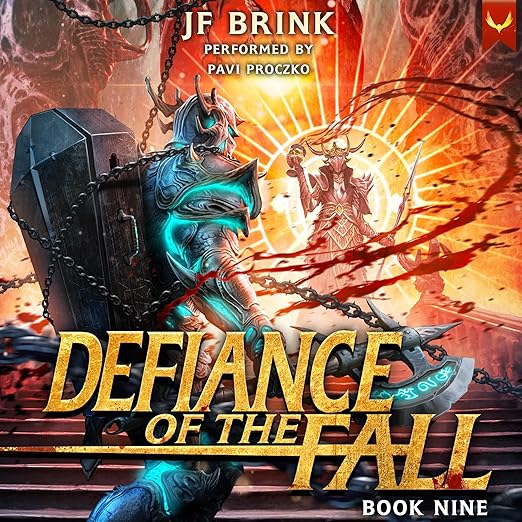
The plot this entry: chaos is building in the City of Ancients. The Twilight Ascent, a major political and power struggle that has been building for several installments, is approaching its boil. The Eveningtide Asura's plans are nearing fruition, various factions are positioning to block his rise, and Zac finds himself tied to one side's agenda whether he likes it or not. Meanwhile, a stolen artifact called the Splinter of Oblivion creates a ticking-clock crisis in Zac's own body. A trap has been set and he has no choice but to walk into it.
This is compelling setup. The problem, as several reviewers identified, is that it functions as almost entirely setup. One reader called it 700 pages of filler, which is harsh but captures something real: the major confrontation that all of this architecture is pointing toward does not arrive in this volume. The payoff is deferred to Book 10.
The worldbuilding remains the series' signature achievement. TheFirstDefier's imagination operates at a scale that is genuinely unusual even in a genre defined by large-scale system-building. One reviewer described it as shaped like an iceberg, what the reader sees is impressive; what is implied to exist beneath the surface is staggering. Book 9 expands the City of Ancients as a setting in ways that matter for what is coming, and readers who care about the political architecture of Zac's world will find substantial new material here.
Pavi Proczko has been the series' narrator throughout, and his performance has grown measurably across the installments. The chapters featuring secondary characters, particularly the Iz Tayn family scenes, which reviewers have singled out as some of the writing's strongest work, benefit from his expanding range. The stat notifications and system announcements, a LitRPG staple that can become numbing, are handled with enough variation to remain functional.
Before You Commit to Defiance of the Fall 9
Two issues are worth naming. First, the proofreading and editing in this entry are looser than in previous installments, a reviewer noted this specifically, citing more errors than usual for the series. At 22-plus hours, this is noticeable. Second, the repetitive description problem that recurs in web-fiction-adapted series, where action beats or stat progressions get described in ways that feel slightly redundant, is more pronounced here than in earlier entries.
Neither issue undermines the book's value for series readers, but both are genuine roughness that a more rigorous editorial pass would have caught.
Is This One for You?
This is for series readers only, full stop. Anyone new to Defiance of the Fall should start at Book 1, the system, the characters, the political factions, and Zac's accumulated power set are all assumed knowledge by this point. Series readers who are current will want to listen even knowing this is a transitional entry, because the setups here are significant. Listeners who find filler-heavy middle-of-series entries frustrating in other LitRPG franchises like Cradle or He Who Fights with Monsters should temper expectations accordingly.
A Few Questions About Defiance of the Fall 9
Can I start Defiance of the Fall with Book 9, or do I need the earlier installments?
You cannot start here. The system, characters, factions, and Zac's entire power progression are assumed knowledge. Start at Book 1.
How does Pavi Proczko handle the LitRPG system announcements and stat readouts across 22+ hours?
With enough variety to keep them functional. The series has trained him across nine entries, and his handling of the mechanical elements has improved noticeably. They do not disappear into monotone.
Does the Splinter of Oblivion subplot resolve within this book, or does it carry into Book 10?
The Splinter of Oblivion crisis is established as a ticking-clock problem in Book 9 but is not fully resolved within this entry. It is part of the larger setup being staged for the next installment.