Before You Press Play
- Narrator: Pavi Proczko handles the LitRPG cultivation hybrid format with practiced confidence, sustaining twenty-three hours of dense worldbuilding and combat without losing listener orientation.
- Subjects: power progression through cultivation, earth's place in a vast universe, chosen identity versus inherited bloodline
- Tone: Epic, propulsive, and built for sustained immersion
- Bottom line: Defiance of the Fall 7 pays off story threads that have been building since book one, but rewards exclusively those who have already put the series mileage in.
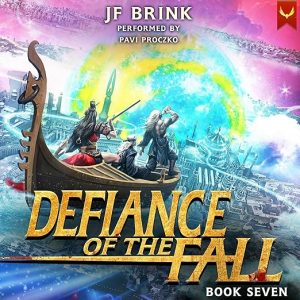
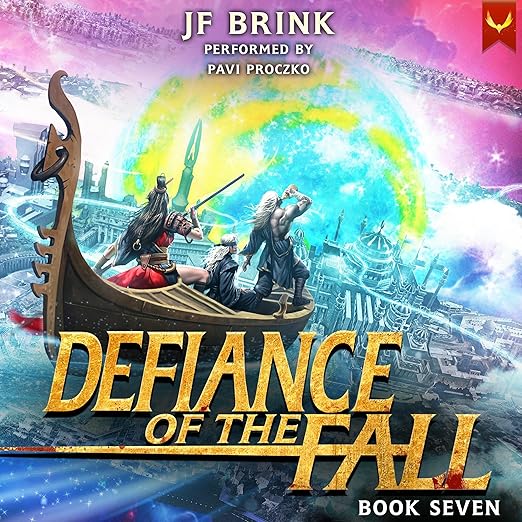
Defiance of the Fall 7 is, by any measure, a substantial audiobook: twenty-three hours and three minutes of TheFirstDefier's LitRPG cultivation hybrid, and the reward-to-investment ratio here depends almost entirely on how many of the previous six volumes you have absorbed. Let me be direct about this at the outset: this is not an entry point to the series. The Dimensional Seed maturation arc, the Karmic Ties storyline now reaching its conclusion, Zac's bloodline questions, the Dominators, the eldritch horrors converging on the Mystic Realm, all of this arrives with the weight of accumulated context that newcomers simply will not have. If you are considering where to begin with Defiance of the Fall, the answer is volume one.
With that established, what does book seven actually deliver for series readers who have earned their place here? One reviewer described it precisely: the Karmic Ties arc ending with a bang and a new arc beginning with the mother of all twists. That framing captures the structural ambition of this volume accurately. This is a book that functions simultaneously as a culmination and a pivot, closing one major narrative strand while aggressively opening the next. The transition between these modes occupies the bulk of the twenty-three hours, and TheFirstDefier manages it with more precision than many LitRPG series bring to their mid-sequence installments.
Is Defiance of the Fall 7 Worth Your Time?
What has always distinguished this series within the LitRPG cultivation hybrid space is its specific tonal balance. The system elements, class mechanics, skill trees, progression gates, are detailed and satisfying for genre readers without overwhelming the narrative with pure stat accumulation. The cultivation framework imported from Eastern genre traditions gives Zac's power development a different texture than Western LitRPG alone provides, and book seven continues to build on that synthesis intelligently. The Mystic Realm setting introduced in the previous volume gets its full resolution here, and the action sequences in these chapters are among the strongest the series has produced.
The bloodline question, which has been threading through the series from the beginning, receives substantial attention in this volume. Without venturing into spoiler territory, the direction TheFirstDefier takes with this material is bold and significantly changes the shape of what the series has been building toward. One reviewer noted that Zac's choice to save Kenzie rather than use his Creation Mark carries consequences that ripple through the rest of the volume. That choice illustrates what has made this series work beyond its mechanical satisfaction: Zac's humanity is consistently placed in tension with the inhuman scales of power that the cultivation world demands of him, and the series does not pretend that tension is easy to resolve.
The Best Parts of Defiance of the Fall 7
Pavi Proczko has narrated the series, and his performance across twenty-three hours reflects the sustained competence of someone who knows these characters and this world deeply. The LitRPG cultivation format presents specific narration challenges: long passages detailing system notifications, skill upgrades, and power assessments that can sound mechanical if handled without care. Proczko keeps these sections from becoming dead weight without artificially dramatizing them, which is harder to achieve than it sounds and is one of the primary reasons long-form LitRPG audiobooks succeed or fail in the format.
At twenty-three hours, this is a commitment that matches the series' overall scale. The Defiance of the Fall series has consistently run at this length per volume, and fans who have invested this much time in the broader story will find the listening experience consistent with what they have come to expect. The pacing is dense rather than rushed, which suits the material's complexity. The cosmological scope of the series, ordinary humans navigating a universe where even random passers-by might hold the power of a god, requires this kind of unhurried construction.
Before You Commit to Defiance of the Fall 7
One recurring critique from within the series community addresses the repetition problem that appears across multiple volumes. Explanations of skills and the protagonist's decision-making process sometimes appear multiple times in different words within the same book. One reviewer called this out explicitly, noting run-on and repeating explanations as the primary complaint. Book seven does not fully escape this pattern, which is characteristic of TheFirstDefier's writing style across the series. Readers who have reached volume seven have presumably calibrated their patience for this tendency; it is not worse here than in previous installments.
The eldritch horror elements drawn into the Mystic Realm add a genuinely unsettling dimension to what is otherwise a cultivation adventure narrative. The blend of genre registers, LitRPG systems, eastern cultivation tropes, and something closer to cosmic horror in the antagonist design, is not always perfectly smooth, but it gives the series a stranger and more ambitious texture than most of its genre peers attempt, and book seven leans into that strangeness rather than backing away from it.
Should You Listen to Defiance of the Fall 7?
Series readers who have completed books one through six and want the payoff on the Karmic Ties arc will find this deeply satisfying. Listeners who enjoy LitRPG cultivation hybrids with genuine cosmological ambition and are willing to invest at serialized novel scale will find the full series worth beginning from volume one. The audiobook format suits the series' length and complexity particularly well, given Proczko's consistent narration across the run. Anyone expecting a standalone story or a shorter genre experience should approach from the beginning rather than here.
Can this audiobook be listened to without reading the earlier Defiance of the Fall volumes first?
No. Defiance of the Fall 7 is the seventh entry in an ongoing LitRPG cultivation series and assumes complete familiarity with the preceding six volumes. The plot, character motivations, and system mechanics all build directly on what came before, and the major story pivots in this volume will be incomprehensible without that foundation.
Is the audiobook narration consistent with the earlier volumes in the series?
Yes. Pavi Proczko narrates this volume, maintaining continuity with previous installments. His performance sustains over twenty-three hours with the same approach he has brought to the series, differentiating characters while keeping the dense system-notification passages from becoming monotonous.
Does Defiance of the Fall 7 end on a cliffhanger or provide resolution?
It provides significant resolution for the Karmic Ties arc that has been building across multiple volumes, while simultaneously launching a new story direction. Readers describe it as ending one arc with a major twist that opens the next phase of the series. It is a turning point rather than a stopping point, meaning the broader story continues beyond this volume.
How does this audiobook compare to other LitRPG series in length and complexity?
At twenty-three hours per volume, Defiance of the Fall runs at the longer end of the LitRPG audiobook market. The cultivation hybrid elements drawn from Eastern genre traditions add complexity that distinguishes it from pure Western LitRPG releases. Listeners familiar with series like Awaken Online will find the ambition and detail comparable, though the tonal blend is distinct and more cosmologically ambitious.