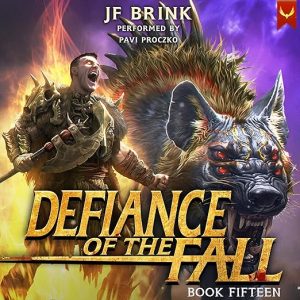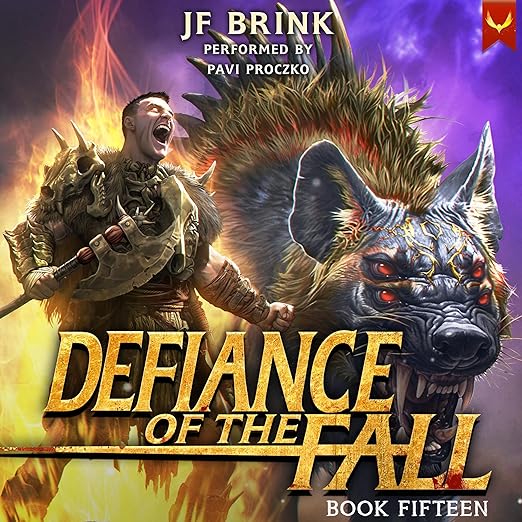
Book fifteen of a LitRPG series carries a burden no standalone novel does, and this audiobook spends more than twenty-one hours carrying it. Zecia is burning. The Kan-Tanu Cult has broken through frontlines that years of resistance failed to hold, the powerful outsiders have abandoned the war to collect seals ahead of Ultom's arrival, and Zac is more or less the only party still trying to save the Atwood Empire. His plan is to find the Centurion Base, hidden deep inside enemy territory, and turn its weapons on the cult.
The Review
This series has always been an unusual hybrid, and the publisher describes it accurately for once: apocalyptic LitRPG welded to eastern cultivation, with class systems, skill systems and a progression ladder that never stops extending. Fifteen volumes in, that combination has produced a universe large enough that the war on Zecia is a regional problem rather than the story, and this installment is visibly aware of the wider board. Seals, factions and an imminent cosmic event sit above the immediate fight, and Zac spends as much time managing alliances as swinging at anything. The war he cares about is, from the perspective of most of the powers involved, a minor matter that will resolve itself.
Jay Scribbles, having read every volume, files the most substantial assessment on the page and calls this one a major shift in pacing and quality. The argument is specific: narrative tension has always been a strength of the series, but pacing has been the recurring weakness, as it is for many LitRPG authors, and this book fixes it. Better still, facets left undefined for seven or eight books finally receive a clear definition and payoff. For a long-runner, that is what readers actually want to hear.
Fifteen books is also long enough that the shape of the whole thing has become legible. Zac began as a mortal trying to survive in a universe of cultivators, and the tension the series runs on is that he is always underpowered relative to the room he is standing in. That has not changed here, which is a discipline a lot of progression fiction abandons by book six, and it is the reason the stakes still register when a faction with real power turns its attention his way.
Why Defiance of the Fall 15 Works as an Audiobook
Scale is the honest draw, and this is a series that rewards volume rather than economy. A file of this length is a full week of listening for most people, which sounds punishing until you remember that a reader fourteen books deep is looking for exactly that. The system elements the publisher advertises, the classes and skills and progression choices, have to be spoken aloud rather than skimmed on a page, which slows the reading and also stops you from skipping the mechanics the way a reader's eye naturally does. Whether that is a benefit depends entirely on whether the numbers are why you are here.
Momentum is the other pleasure, and this installment has plenty. One buyer calls it frantic fun and describes the focus shifting between locations and goals quickly while new twists arrive constantly, adding that the worldbuilding gets more room this time and is probably why the plot moves at the speed it does. That is a fair trade for a mid-series volume, and it points at a genuine quality: nothing here is stalling for time.
Series durability counts for something too, and it is measurable here. Tyler Miller's notice is short and unambiguous, calling the whole run one of the best ever and reporting that every book keeps the reader captivated. Fifteen volumes deep, retaining readers who still describe it in those terms is a harder achievement than any individual book's quality, and it is why a series like this can support installments of this length.
The Caveats
The pool's only four-star notice identifies the structural problem, and it does not contradict the praise so much as read it from the other side. The book hopped around a great deal, that buyer reports, the story suffered because of it, a lot of the storyline felt rushed and forced forward without a solid foundation, and by the end the experience had become hard to summarize. The same notice predicts that the next book will bind everything together. That is the shape of a transitional volume: an author moving pieces into position for a payoff that is not in this file.
Numbers on this listing are broken in a way that is worth flagging before you weigh them. The rating counter reads three, sitting under a 4.5 average, while five reviews are visible on the same page. No combination of three whole-star grades produces 4.5, so the average and the counter cannot both describe the same set of votes, and three would be a handful rather than a verdict in any case. Judge this one on what those five people wrote and on your own history with the series, not on the figure at the top.
Should You Listen to Defiance of the Fall 15?
The audience is people already fourteen books into Defiance of the Fall, and for them the question is not whether to continue but what to expect. Expect the plot to move fast and wide, expect definitions you have waited years for, and expect an ending that points forward rather than lands.
Anyone new should not start here under any circumstances. Zac's history, his Draugur side, the cosmic event everyone is preparing for and the factions circling him are all assumed knowledge, and the description makes no attempt to catch you up. The first volume is where this begins, and fourteen books is a long approach, which is either an argument for starting immediately or an argument for finding something shorter.
Readers who bounce off progression fiction will bounce off this too, and a book this long is an expensive way to discover that. The class and skill machinery is not decoration in this series; it is a substantial part of what the text is doing, and a spoken version makes that impossible to ignore or skim past.
Longtime readers can take this as a strong entry with a caveat attached, and the caveat is simply that a good deal of what happens here is setup. Whether that matters depends on how patiently you wait for a payoff scheduled to land somewhere after the final page of this one.
Can you start the series with this audiobook?
No. Everything that gives this volume weight, from Zac's alliances to the reason the powerful factions want his seals, arrives as assumed knowledge. Every reviewer writes as a long-term reader, and none of them explains anything either. Begin at book one, or accept a very long file full of unattached names.
How long is the Defiance of the Fall 15 audiobook?
Twenty-one hours and thirty-eight minutes, substantial even by the standards of this series. That works out to roughly a week of regular listening, and the length goes on faction politics and worldbuilding as much as on combat, according to the people who have written about it.