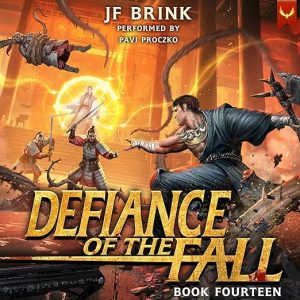
A war fortress surfaces out of the dimensional depths, built long ago by the Limitless Empire, and whichever army reaches it first changes the shape of a conflict that has already ground Zecia down to exhaustion. That is the hook of the fourteenth volume, and this audiobook gives it twenty-one hours and fifty-four minutes, which tells you something about the scale TheFirstDefier now works at and something about what the series has come to expect from anyone still following it.
How Defiance of the Fall 14 Holds Up
Peace is off the table by design here, and the book says so directly: while the System governs the terms of the conflict, the only currency that buys anything is blood and steel. Zac and his elite armies have been pushed onto the frontlines against the Kan'Tanu Cult at precisely the moment the fortress appears, which is the kind of convergence a fourteenth volume needs if it is going to feel like an event rather than an interval. A fortress that could change the balance of the war, rather than simply raise the stakes again, is a sharper object than this series has put in front of Zac for some time.
Answers finally start arriving here, which is what separates this volume from the several before it. Brittany Barton's four-star notice is the most specific account of that on the page, reporting that the book "finally started unraveling truths to the story that have been challenging to understand", and naming the main factions, the role of the Limitless Empire and Zac's own nature and heritage as the things that come into focus. That is a great deal of accumulated mystery to spend in a single volume, and spending it is a decision with consequences for everything that follows.
The same notice is careful about what the payoff costs. Barton wants more of it explained and less of it left implied, singling out how Zac acquired bloodlines from undead as something that "still seems poorly explained" even after the reveals land. A series that has been withholding for thirteen books has trained its readers to expect withholding, and the trick of book fourteen is deciding how much to stop doing that without deflating the rest of the sequence.
Why Defiance of the Fall 14 Works as an Audiobook
Structure rather than drama is the reason to keep going, and Joe Baker's five-star note puts it plainly: the hero starts as nothing and progresses slowly to strength, with what Baker calls "natural progression." That is the entire appeal of the subgenre stated in one line. Readers who came for a power curve want it earned across thousands of pages rather than granted in a chapter, and this series has spent fourteen volumes refusing to take the shortcut, whatever else it has done.
Almost twenty-two hours is a great deal of audio for one entry, and the length alone will settle the decision for some listeners. The scale also suits the format better than it suits the page: siege logistics, faction politics and escalating power tiers are easier to absorb spoken than skimmed, because a reader in a hurry skips exactly the connective material that makes the next escalation legible. Listening at speed converts that liability into an advantage, since the connective tissue arrives whether you want it or not and the payoff chapters land with their groundwork intact.
Weak Spots in Defiance of the Fall 14
The most useful warning on this page comes from Randy Smith, who awards five stars and still concedes the problem. The story, Smith writes, "becomes more and more complicated so many different aspects and open storylines", to the point where each new release means looking back to refresh your memory of what was already in motion. In print you can flip back. In a recording this size, scrubbing to find the thread you lost is genuinely painful.
E. L. Romine, also at five stars, isolates a craft problem rather than a scale problem. The time jumps, Romine says, "just weren't handled or written as well as they could have", leaving gaps to be filled in by imagination and a flow that could have been smoother. Jumps in time are harder to signal in audio than on a page, where white space and a section break do the work silently, so this is the one complaint likely to be amplified by the format.
The numbers on this listing do not survive inspection. A 4.6 average is credited to three ratings, and three whole-star votes cannot average 4.6 under any combination: the only values reachable from three ratings are whole numbers and thirds. The rating count also sits below the five written reviews visible on the same page, which is impossible in the other direction. Ignore the average entirely and read the five accounts, each of which is longer and considerably more specific than the number above it.
One further note on pacing, from a five-star review posted in January that spends most of its length complaining. That listener finds it "taking an in ordinately long time to come to any kind of conclusion", observes that greater power keeps producing greater danger rather than safety, calls the effect annoying, and then says outright they will probably read the next one anyway. That is the most honest summary of the series contract anyone on this page offers.
Who Should Listen to Defiance of the Fall 14
Anyone already thirteen books deep does not need advice from me, but the practical question is whether to re-enter cold, and the answer from the page is no. One reader describes looking back before each new release to recover what was already in motion, and the book itself opens on a war in progress with factions whose alignments are the thing being revealed. A recap of the previous entry, or a run at book thirteen first, will pay for itself. The alternative is spending the opening hours reconstructing alliances from context, which is exactly the complaint the written accounts keep returning to.
For newcomers to progression fantasy who like their systems dense, the series remains a reasonable investment precisely because of the objection Baker raises about slowness. Fourteen volumes of gradual escalation is what the form is for, and Pavi Proczko has carried the sequence long enough that a listener starting from the beginning is committing to a consistent voice rather than a rotating cast of readers.
Who should stop here? Anyone whose patience for deferred resolution has run out, because the most detailed complaint on the page is precisely that conclusions keep receding as the scale grows. Rewinding is unavoidable here too, so it will frustrate anyone who finds that a chore, because the reveals depend on names and factions established books ago and a recording gives you no page to flip back to.
- Narrator: Pavi Proczko takes another twenty-two hour installment solo, which is the main argument for staying with audio across a series this long
- Subjects: Siege warfare under System rules, faction politics, slow-earned power progression, heritage revealed late
- Tone: Relentless and escalating, with the accumulated weight of thirteen prior books
- Bottom line: A payoff-heavy entry for committed followers of the series, sold on a page whose rating data is broken in two directions at once.
Frequently Asked Questions
Can you start the Defiance of the Fall audiobook series at book 14?
Not comfortably. The volume opens mid-war with faction allegiances already established, and its main event is the resolution of mysteries seeded across earlier books. One continuing reader describes going back through the previous volume first, which tells you how much prior context the story assumes before its first chapter.
How long is the Defiance of the Fall 14 audiobook?
Just under twenty-two hours, one of the longer entries in an already long series. The time goes largely on faction politics, siege logistics and the fortress campaign, and the pace is measured rather than headlong, so budget several sittings rather than expecting to finish it over a weekend.
Why does the rating on this listing look wrong?
Because it is broken. Three votes cannot produce 4.6: with whole stars only, three ratings land on a whole number or a third and nothing else. The counter also reports fewer votes than the page displays written accounts. Read those accounts and disregard the score entirely.
Does book 14 answer the long-running questions in the series?
Partly. This volume spends a significant amount of accumulated mystery on disclosure, which is more than the recent entries offered, and the written accounts treat that as the reason to read it. One four-star reader still finds specific mechanics underexplained, so expect movement on the long questions rather than closure.