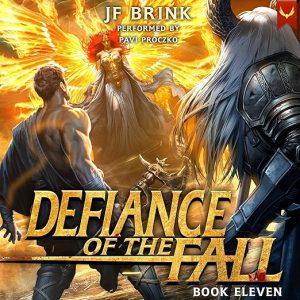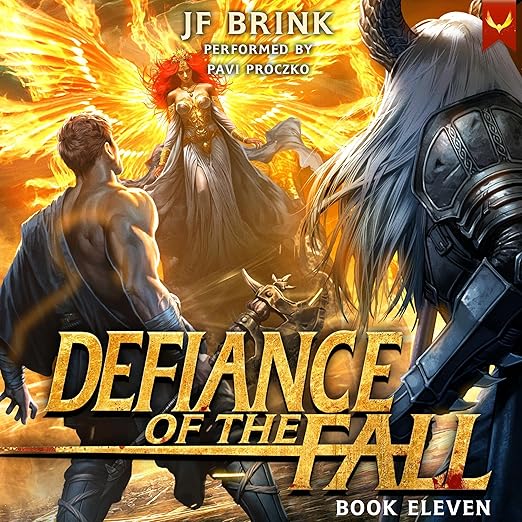
At 24 hours and 47 minutes, Defiance of the Fall 11 by TheFirstDefier is among the longer entries in a LitRPG series that has never been short of material. Pavi Proczko narrates this audiobook as he has narrated the previous ten, which matters in a series where continuity of voice is part of the investment: Proczko's performance of Zac Piker has accumulated a specific texture across hundreds of hours of audio, and Book 11 relies on that accumulation heavily. Listeners arriving here without the prior ten volumes will not merely be confused; they will be encountering a narrative built on so many layers of established lore and character history that entry without preparation is simply not viable.
The setup for Book 11 is appropriately large: the Void Star is at risk of becoming a bridgehead for an invasion by the entity called Ultom, while Zac's own mysterious origin is receiving new scrutiny through what the synopsis calls "a mysterious inheritance rising from the depths of history." Both threads require the kind of sustained attention that 24-plus hours of LitRPG audiobook demands. The series has always been generous with its scope, and this volume continues in that tradition: sometimes to its advantage, sometimes to the slight frustration that at least one reviewer noted in the form of a slow second half.
How Defiance of the Fall 11 Holds Up
The reviews for this volume cluster around a consistent observation: the first half delivers the progression and action that the series does best, while the second half functions more explicitly as a setup for the next entry. One reviewer noted that Zac "pwned some noobs and got some loot" in characteristically satisfying fashion while also flagging that the second half "was slow af" and kept prompting the expectation of renewed momentum that did not fully arrive. That is an honest description of what Book 11 is: a transition volume with strong individual moments rather than a climactic payoff.
What the volume does deliver, and where Proczko earns his keep, is in the character work around the returning figures from the series' earlier stages. Multiple reviewers flagged the return of old companions as a genuine pleasure, and the new characters who appear in this volume as the Multiverse's elites converge on Zecia are handled with enough distinction that they register as individuals rather than filler. Proczko's ability to differentiate voices across a cast that has grown substantial over eleven volumes is a real skill, and Book 11 calls on it more than several of its predecessors.
Why Defiance of the Fall 11 Works as an Audiobook
The argument for the audiobook format with LitRPG at this length and complexity is primarily about immersion. Reading the text of a volume this dense requires active management of information in a way that listening allows you to surrender slightly: Proczko's delivery handles the narrative flow, and the listener can track the escalating stakes without the friction of scanning through pages of system notifications and status updates. For a series this far into its run, where the pleasure is increasingly about inhabiting a known world at deepening levels of complexity, audio has real advantages over print.
The series remains among the most popular in the LitRPG audiobook category for reasons this volume illustrates: TheFirstDefier's system is internally consistent, the progression feels genuinely earned rather than arbitrary, and the larger narrative: the Multiverse's elites gathering, Zac's origin story receiving new dimensions: is ambitious enough to sustain eleven volumes without feeling exhausted. The poem one reviewer singled out as making their day suggests that the author can still find smaller moments of grace inside the epic framework.
Weak Spots in Defiance of the Fall 11
Two developments warrant careful attention across the 24-plus hours. First, the revelation connected to Zac's origin: this is not a new thread: earlier volumes have seeded questions about where Zac came from and what that background means for his relationship to the Multiverse's power structures: but Book 11 advances the answer significantly. Listeners should track this thread because it has implications for the series' endgame that the volume begins to make more explicit than any predecessor.
Second, the geopolitical situation around the Void Star. The Ultom threat and the question of what an Era turning means for the sector's existing power structures is the kind of macro-level worldbuilding that the series has been building toward across multiple volumes. Book 11 does not resolve this question, but it establishes the terms on which future volumes will engage with it. For long-term series investment, this is the structural development worth tracking most closely through Proczko's narration.
Should You Listen to Defiance of the Fall 11?
Listeners who have worked through all ten previous Defiance of the Fall audiobooks and want to continue Zac's journey will find this a solid, if transitional, addition to the series. Fans who prioritize momentum and climactic payoff above lore development and character reunion may find Book 11 slightly less satisfying than some of its predecessors, and the honest reviews in the series confirm this impression. Those approaching LitRPG for the first time should begin with Book 1: the investment required to appreciate where Book 11 is positioned in the series arc is genuinely substantial. For the committed series listener, Proczko's narration at nearly 25 hours is familiar comfort, and the foundation being laid here for what follows is evident even when the pacing momentarily stalls. The audiobook rewards patience, particularly in the second half, where setup work pays off in ways that subsequent installments will make clear.
Before You Press Play
- Voice: Pavi Proczko has been the voice of Zac throughout this series and brings the same controlled intensity to Book 11: essential for a volume this dense with returning characters and escalating political stakes.
- Big ideas: Multiverse war preparation, ancient inheritance and origin secrets, power ceilings in a LitRPG framework
- Atmosphere: Epic and building, heavy with lore and anticipation for what follows
- Worth it?: A strong continuation that deepens the series mythology considerably, though the slower pacing of the second half is something even loyal readers acknowledge as a characteristic of this volume specifically.
Is Defiance of the Fall 11 accessible as a standalone audiobook, or is series reading strictly required?
Strictly required. The audiobook assumes complete familiarity with the preceding ten volumes, including Zac's power progression, the established political relationships between factions, and the running threads around his origin. Attempting to begin here without that foundation would mean following 24-plus hours of content without the context required to understand its significance.
How does Pavi Proczko's narration hold up across such a long audiobook: does the performance feel consistent throughout?
Proczko is experienced with this material across a long series run, and consistency is one of his defining qualities in the Defiance of the Fall audiobooks. The 24-hour-plus format is demanding, but his voice work does not noticeably tire or vary in quality between the opening and closing sections.
Is the pacing of the Book 11 audiobook even throughout, or are there significant slow sections?
Reader reviews are candid about a slower second half. The first portion of the audiobook contains the stronger action and progression sequences, while the second half functions more as setup for Book 12. This is consistent with a series that is building toward something substantial, but listeners who prefer consistent pace throughout each volume should factor this in.