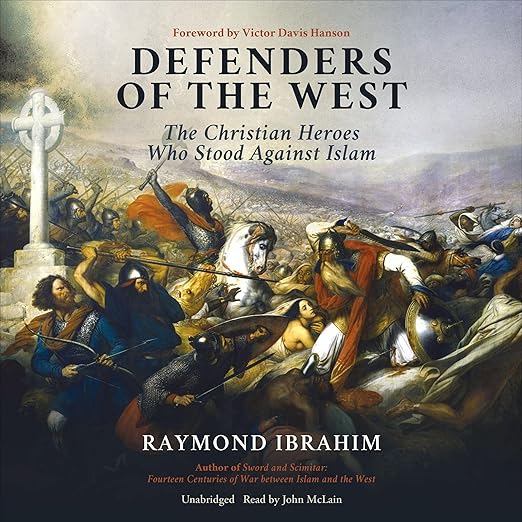
Defenders of the West is a book with a clear argument and an explicit perspective, and Raymond Ibrahim states both up front rather than embedding them in the methodological notes. This is a history of eight historical figures who, in Ibrahim's framing, defended Western civilization against Islamic conquest, and the book's interpretive framework is foundational to its structure rather than incidental to it. I want to acknowledge that framework before anything else because it shapes every biographical choice and every contextual emphasis. Ibrahim is not writing a neutral survey of medieval Christian-Muslim relations. He is writing advocacy history with extensive primary source documentation, and those are two distinct things that need to be held simultaneously to understand what this audiobook actually is and does.
With that framing established, the biographical profiles at the center of Defenders of the West are genuinely absorbing listening. Ibrahim covers eight historical figures: the real historical Vlad III, known to Western popular culture primarily as the inspiration for Dracula, Spain's El Cid, England's Richard the Lionheart, Charles Martel, John Hunyadi, Skanderbeg, Jan III Sobieski, and Don Juan of Austria. These are figures of genuine historical significance, complicated in ways that conventional popular history often flattens into mythology, and Ibrahim's commitment to sourcing from both Western and Islamic primary documents gives each profile a texture that purely Eurocentric accounts would miss entirely.
Hunyadi's Obscure Chapter, Built on Islamic Sources Too
Ibrahim's previous book, Sword and Scimitar, organized itself around decisive battles. Defenders of the West organizes itself around decisive men, and the biographical approach suits Ibrahim's strengths as a writer. He is good at making historical figures feel present rather than distant, at capturing the specific circumstances of specific moments without losing the larger stakes those moments carried. The profile of John Hunyadi, who resisted Ottoman expansion in the Balkans across decades of sustained military and diplomatic effort, is particularly strong. Hunyadi remains obscure in Anglophone popular history despite the scale of what he achieved, and Ibrahim gives him a chapter that reads with genuine narrative momentum and the kind of respect his historical role deserves.
The use of Islamic primary sources is not decorative, and this is worth emphasizing because it distinguishes Ibrahim's method from simpler polemical history. He uses accounts from the Islamic side of these conflicts to verify the scope of military operations, to understand the ideological frameworks that governed expansion, and to establish what both sides agreed happened even when they disagreed about its meaning. When sources from opposing traditions agree on the basic facts of a historical event, that agreement carries more evidential weight than either tradition alone. Ibrahim builds on that evidentiary foundation throughout the book, and it is what gives the profiles their sense of documentary solidity.
Advocacy History That Argues for the Present Too
Ibrahim's positioning of medieval Islamic expansion as a form of violent jihad and his framing of his eight subjects as defenders of Western civilization against existential religious and political threat is accurate as a description of how these historical conflicts were understood by the participants on both sides. It is also a framing that carries contemporary political valence that Ibrahim is clearly aware of and not attempting to conceal. The book's subtitle announces its perspective. This is history in service of an argument about the present as well as the past, which is itself a long and legitimate tradition in historical writing while also being a tradition that requires the reader's awareness.
Readers who find that framing valuable will find Defenders of the West exceptional in its execution. Readers who want historical figures studied in their full complexity, including the ways medieval Christian political violence was itself religiously motivated and sometimes ideologically extreme, may find the selective emphasis frustrating at points. One French reviewer praised the book specifically for refusing what they called self-flagellation, which identifies with precision the political community for whom the book is partly written and toward whom it performs its argument. That is useful information for calibrating expectations before beginning the fourteen-hour commitment the audiobook represents.
McLain Shifts Gears Between Politics and Battle
Nearly fourteen hours of historical biography covering eight different figures across multiple centuries and geographical contexts is a real test of narration, and John McLain passes it. Each biographical profile has its own internal pacing, moving between the documentary detail of political maneuvering and succession and the kinetic energy of battlefield accounts, and McLain adjusts his delivery accordingly. The battle sequences have appropriate urgency and forward momentum. The more analytical passages on theological and political context settle into a measured register that invites absorption rather than passive reception while the audio plays in the background.
Multiple reviewers describe the listening experience as similar to historical drama rather than conventional history, and McLain's narration contributes significantly to that quality. The material is dense with proper names, dates, and political geography across multiple centuries of European and Near Eastern history, but the narrative thread remains clear and accessible throughout. Listeners without detailed prior knowledge of medieval European and Ottoman history will find the context provided generous rather than assumed.
Skanderbeg and Sobieski Get a Rare English Treatment
Listeners who want narrative history of the medieval period with strong biographical focus and extensive primary source grounding will find Defenders of the West genuinely impressive in its execution and its commitment to the material. Listeners who want dispassionate historical survey, or who find Ibrahim's interpretive framework politically uncomfortable in ways that would prevent engagement with the content, should understand that the framework is not separable from the biographical profiles here. It is foundational to how each figure is selected, framed, and interpreted. Listeners looking for an English-language gateway into the history of figures like Skanderbeg, John Hunyadi, or Jan III Sobieski, who remain remarkably obscure in popular non-fiction given their historical significance, will find more accessible and more thorough treatment here than almost anywhere else available to them.