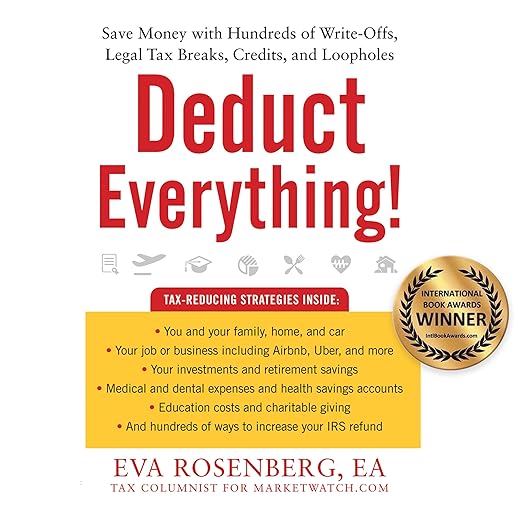
Every April I go through the same ritual: a week before the deadline, I begin accumulating receipts I should have been filing all year, and I have a prolonged conversation with myself about whether I actually understand what I can and cannot deduct. One year I listened to Deduct Everything! while doing exactly this, alternating between audio chapters and my pile of documentation, and I will admit it was more useful in that context than I expected.
Eva Rosenberg, known in tax circles as TaxMama, has built a career on making tax law accessible without dumbing it down. Her previous book on small business taxes apparently set a standard in that space, and this guide to personal and self-employed deductions attempts something similarly ambitious: genuine technical clarity delivered in a voice that does not make you feel like you're suffering through a continuing education requirement.
Building an Argument Instead of an Alphabetical List
The scope is comprehensive. Rosenberg works through record-keeping fundamentals, mortgage and insurance deductions, work-related expenses, medical costs and health savings accounts, and education credits across seven-plus hours of material. The organization is logical rather than encyclopedic - she moves through categories in a sequence that builds on prior concepts rather than delivering an alphabetical index, which makes the audio format work better than it might otherwise. Tax content that reads like a list is near-impossible to follow on audio; content structured as a coherent argument about how the tax code actually works is considerably more tractable.
Reviewer Wayne Davies, who described having read a stack of tax books, singled out Rosenberg's combination of technical expertise and genuinely entertaining delivery as what sets this apart. That observation holds up. There are moments of real humor here - particularly around the more absurd corners of IRS logic - that make the material human without diminishing its seriousness. Another reviewer with professional credentials (describing themselves as someone who has read the book in conjunction with working with an EA or CPA) noted that the book is instructive enough to help readers understand and implement strategies rather than simply acknowledging that deductions exist.
Rosenberg's Seminar Pacing and Unexpectedly Deep HSA Coverage
The author-narration is a significant asset. Rosenberg knows exactly which passages need emphasis and which concepts require a beat of pause to let the listener absorb. She does not read her own work the way a text-to-speech engine would; she explains it, with the cadence of someone who has given this information in seminars and found through trial and error which parts lose people. That institutional knowledge shows up in the pacing.
The breadth of coverage is also genuinely useful. Listeners who approach this as a single-category guide - looking only for home office deductions, say, or only for medical expense strategies - will find considerably more than they came for. The section on health savings accounts is particularly detailed. The education deductions section contains nuances that even reasonably informed taxpayers often miss.
Sound in 2016, Outdated by the 2017 Tax Act
The significant caveat is publication date. This audiobook was released in 2016, and tax law has changed substantially since then. One reviewer specifically flagged having received 2017 information rather than current guidance. The foundational logic of how deductions work remains sound, and many of the strategies Rosenberg describes have structural continuity with current law, but specific dollar limits, phase-outs, and some deduction categories have been altered by subsequent legislation. The Tax Cuts and Jobs Act of 2017, in particular, modified several items the book covers.
The right approach is to treat this as a conceptual framework - learning what kinds of deductions exist and how the IRS expects you to document them - while verifying current figures through the IRS website or a tax professional before applying specific numbers. Used that way, the book is still worth the time even in its current form.
Self-Employed Owners Gain Most, W-2 Workers Gain Some
Self-employed individuals, small business owners, and anyone who has always suspected they are leaving deductions on the table without knowing how to find them. The home-based worker section is particularly detailed. W-2 employees with limited deduction complexity will find less immediate application but will likely still learn something useful about medical and education credits.
Tax professionals looking for a book to recommend to clients who want to understand the landscape before their annual meeting will find this a reasonable suggestion, with the caveat about the publication date attached. It pairs well with a current-year IRS publication or professional consultation rather than replacing it.
Is the information in Deduct Everything! still accurate given the 2016 publication date?
The conceptual framework and documentation strategies remain sound, but specific dollar thresholds, phase-out figures, and some deduction categories have changed since 2016, particularly after the Tax Cuts and Jobs Act of 2017. Treat this as a guide to understanding what deductions exist and how to document them, then verify current figures through IRS publications or a tax professional before applying specific numbers.
Does Eva Rosenberg narrating her own book help or hurt the listening experience?
It helps considerably. Rosenberg delivers her material with the confidence of someone who has explained these concepts in seminars and workshops for years. She knows which passages need emphasis, where to pause, and which details confuse first-time listeners. The result is a more functional audio experience than most tax books managed with a professional narrator reading dense prose.
How does Deduct Everything! compare to working with a CPA or enrolled agent?
Several reviewers, including one with professional credentials, suggest using the book alongside professional advice rather than in place of it. The book helps you understand the landscape - what deductions exist and how the IRS expects them documented - which makes your time with a CPA more productive and reduces the risk of leaving money on the table because you did not know to ask.