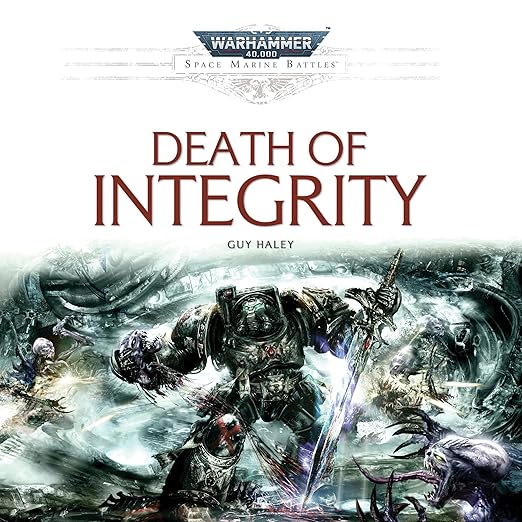
Guy Haley's audiobook Death of Integrity, narrated by Richard Reed, takes its title from the space hulk at the center of the book - a gargantuan conglomeration of wrecked spacecraft, asteroids, and space stations designated for destruction by Imperial command. That the Death of Integrity contains thousands of genestealers is the stated problem. That it contains something the Adeptus Mechanicus wants badly enough to intervene in a Blood Drinkers and Novamarines joint purge operation is the actual problem. This distinction, between the mission that is announced and the mission that is real, is what separates Death of Integrity from the straightforward xenos extermination narrative the premise suggests, and it is what gives Haley's book its staying power within the Space Marine Battles series.
The Warhammer 40,000 context matters here, and for listeners arriving without it: the Blood Drinkers are a Successor Chapter of the Blood Angels, which means they carry the Flaw - the genetic inheritance of Sanguinius that expresses as the Red Thirst and, in its most extreme form, as the Black Rage. Chapter Master Caedis walks a documented tightrope throughout the book, operating in an environment designed to trigger the bloodlust that makes his warriors both more lethal and less controllable. The Novamarines, descended from the Ultramarines and Guilliman, are the structural counterpoint - disciplined, precise, operating according to the Codex in ways the Blood Drinkers cannot. This theological and tactical opposition is the book's deepest structural tension.
Our Take on Death of Integrity
Haley manages something that is technically difficult in shared-universe fiction: he gives both Chapters their own distinct identity without making either seem like the wrong answer to the story's central questions. The Novamarines' Codex discipline is not framed as cold or bloodless; the Blood Drinkers' volatility is not framed as simple weakness. When rivalries and competing agendas manifest between the two Chapters mid-operation, Haley has prepared the reader sufficiently to understand that both positions are internally coherent, which makes the conflict feel earned rather than arbitrary.
The Adeptus Mechanicus plotline is the book's most sophisticated contribution to the 40K universe. One reviewer describes Haley packing 'a Mechanicus Explorator chasing a priceless treasure' alongside the Chapters' established backgrounds and the genestealer threat, and calling all of it woven together and developed rather than merely adjacent. That weaving is the technical achievement. The dark secret at the heart of the hulk is the kind of revelation that reframes the preceding action rather than simply adding to it, which is a rarer accomplishment in action-dominant fiction than it should be.
Richard Reed's narration is the right voice for this material. The Warhammer 40,000 lexicon is dense even by science fiction standards - Chapter designations, battle cry traditions, Imperial terminology, Mechanicus protocols - and Reed delivers it with the assurance of someone who has lived in this universe rather than the careful self-consciousness that can mark narrators encountering unfamiliar nomenclature. The battle sequences in particular benefit from Reed's ability to track multiple points of action simultaneously without losing the tactical clarity that makes a Space Marine engagement meaningful as a reading experience rather than as pure kinetic spectacle.
The audio format is a natural fit for this book's scale. Death of Integrity runs just over thirteen hours, which gives Haley room to develop both Chapter's internal cultures before putting them under the specific pressure of a joint operation inside a genestealer-infested hulk. A reviewer who identifies as an enthusiast of 40K fiction describes the book as 'a fully deserved entry in the Black Library Hall of Fame,' which is the series' most prestigious designation and one that the book earns through sustained execution rather than through any single set piece.
What to Watch For in Death of Integrity
The 'all is not as it first seems' framing in the synopsis is not decorative. Listeners who approach this as a straightforward Space Marine purge operation will find themselves recalibrating somewhere past the midpoint when the Mechanicus agenda becomes clear. Haley has built the first half of the book to allow this recalibration to feel like a revelation rather than a reversal - the information was present in the early chapters but coded in ways that only become legible once the full picture emerges. This kind of structural layering is not common in the Space Marine Battles catalog, and it is one of the specific reasons the book has acquired the reputation it has.
For Warhammer 40,000 newcomers: this book is set within a shared universe that assumes some basic familiarity with the setting. The Imperial system, the role of Space Marine Chapters, the nature of genestealers, and the position of the Adeptus Mechanicus are not explained from first principles. Listeners entirely unfamiliar with 40K fiction will be able to follow the narrative, but they will miss some of the theological and political resonance that makes the Blood Drinkers' predicament specifically meaningful. One prior exposure to a Blood Angels or successor chapter story would make this entry significantly richer.
Who Should Listen to Death of Integrity
Warhammer 40,000 readers who have existing affection for the Blood Angels lineage and the psychological complexity of the Flaw will find this among the most satisfying treatments of that theme in the Black Library catalog. Readers of the Space Marine Battles series who want an entry with layered narrative architecture rather than pure action delivery should seek this one out specifically. Newcomers to 40K fiction can follow the story but should expect a steeper reading curve than a self-contained universe would require. For established 40K listeners who have not yet encountered Guy Haley's work in this universe, Death of Integrity is a strong introduction to an author who handles the setting's theological weight with serious attention.
Is Death of Integrity a good entry point to the Space Marine Battles audiobook series?
It is one of the better entry points specifically because it has internal narrative complexity beyond the standard purge-mission structure. The Space Marine Battles books are generally standalone stories within the shared 40K universe, so you do not need to have read earlier volumes in the series. This book's Hall of Fame designation reflects its quality relative to the series average.
How does Richard Reed handle the technical Warhammer 40,000 terminology in the audiobook?
With genuine authority. Reed delivers the Chapter designations, battle terminology, Mechanicus protocols, and 40K nomenclature without the hesitancy that can undermine narrators encountering unfamiliar fictional lexicons. The battle sequences particularly benefit from his ability to track multiple points of action clearly, which is a real narration skill in a universe with complex tactical scenarios.