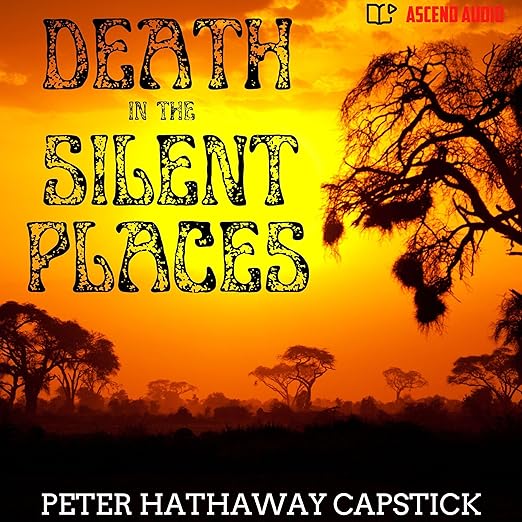
Peter Hathaway Capstick wrote this audiobook the way a good taxidermist works: with obvious reverence for the subject, a steady hand, and no interest in prettifying what was genuinely dangerous. Death in the Silent Places, narrated by Luke Oldham and running just over eleven hours, is a collection of biographical portraits of history's most celebrated hunters and trackers, and it reads less like a safari catalog than like a dispatch from a world that no longer exists. Capstick profiles Colonel J.H. Patterson, who hunted the Tsavo man-eaters; Jim Corbett, who stalked leopards and tigers through the Indian hill country; the extraordinary Karamojo Bell, widely considered the greatest elephant hunter of all time; and Sasha Siemel, who tracked killer jaguars through the Matto Grosso armed with nothing but a spear. These are not mythologized legends. Capstick knew the terrain himself, and his authority shows on every page.
What keeps the listening experience elevated above the generic adventure anthology is Capstick's insistence on interiority. He doesn't just recount what these men did. He reconstructs what it felt like: the acrid taste of fear when a gun jams mid-charge, the particular exhilaration of closing a pursuit that has stretched across days, the strange nobility that emerges in men who perform with precision under conditions designed to kill them. One reviewer captured it succinctly: you can almost feel the dirt and grit of the trail and the sun burning your skin. That's not hyperbole. It's an accurate description of what Capstick achieves.
The Review
The craft Capstick deploys here has a specific texture. He writes from experience rather than from archives, which means the details carry the weight of someone who has waited in the dark for something large and dangerous to make its move. His chapter on Patterson and the Tsavo lions is probably the most gripping extended narrative in the book, building through the construction of the Uganda Railway with the patience of a man who has tracked quarry over long distances and understands that timing is everything. The Corbett chapters benefit from a different kind of power: Corbett's territory was the Indian hill country, and Capstick's biographical rendering gives that landscape a specific menace that feels nothing like the Africa passages. Each portrait has its own climate.
The book also does something less common in the genre: it ends each chapter with a bibliography of cited works. This structural choice signals something important about Capstick's intentions. He's not writing pulp adventure. He's doing biographical history with the storytelling instincts of a novelist, and he wants you to be able to verify and extend what you've read. More than one listener has reported stopping mid-read to seek out one of the cited titles, which is precisely the effect good literary nonfiction should produce.
The Best Parts of Death in the Silent Places
Luke Oldham's narration is well-matched to the material. His voice carries the kind of unhurried weight that Capstick's prose requires. This is writing that doesn't rush, and a narrator who pushed the pace or injected theatrical urgency would undermine the whole enterprise. Oldham understands that the tension is already built into the sentences. He doesn't reach for it. The audiobook format suits this book particularly well because Capstick's rhythms are oral: long, looping sentences that build momentum and then arrive at a moment of visceral precision. Hearing that rhythm rather than reading it sharpens the impact considerably.
The eleven-hour runtime is well-paced across the various subjects. The Patterson and Tsavo sequence takes up significant space, as it deserves to, while the Siemel chapters on jaguar hunting in Brazil provide a change of geography and technique that keeps the collection from feeling monotonous. Bell's elephant hunting chapters are perhaps the most technically detailed, covering the firearms knowledge and tracking methodology that made his career possible, and Capstick contextualizes that expertise with enough historical background to give it meaning for listeners who are not themselves firearms specialists.
The Caveats
Listeners who come to this expecting a straightforward true-crime or adventure format may initially be surprised by how much time Capstick spends on the biographical context surrounding each hunter. He wants you to understand who Patterson was before the lions, what shaped Corbett's particular methods, why Bell approached elephant hunting as a discipline rather than a sport. Some reviewers have noted this density as a limitation, and it is fair to say that patience is required. But for listeners who give the book that patience, the effect is cumulative. Each portrait deepens the others, and by the time you reach the final chapters, the collective picture of what these men shared, and what made them exceptional, is considerably richer than any single profile could have produced.
There is also an ethical dimension here that the modern listener will engage with differently than Capstick intended. These men were hunters. The book does not apologize for that, nor does it moralize about it. Capstick writes from inside the hunting tradition, and he assumes a reader who understands that tradition on its own terms. Listeners who cannot bracket that context will struggle. Those who can will find a portrait of courage, skill, and the particular psychological demand of placing yourself between a village and something that has decided humans are prey.
The Right Listener for Death in the Silent Places
This audiobook is well-suited for listeners with a genuine appetite for adventure biography and historical nonfiction about the natural world. Fans of Corbett's own books, of John Taylor's African Rifles and Cartridges, or of Hemingway's nonfiction will feel immediately at home. It will also appeal to anyone who has ever been drawn to accounts of extreme endurance and the specific courage required to operate in wilderness environments where the stakes are absolute. Listeners who need modern conservation framing or who find the hunting tradition morally indefensible should look elsewhere. Capstick is writing from inside that world, with affection and unambiguous respect for the men he profiles.
- Narration: Luke Oldham brings Capstick's prose the muscular, unhurried authority it demands, holding steady through both the blood-and-adrenaline passages and the quieter stretches of biographical reconstruction.
- Themes: Big-game hunting history, human courage under mortal pressure, wilderness as psychological extreme
- Mood: Tense and atmospheric, like a fire lit against an enormous dark
- Verdict: Listeners drawn to old-world adventure writing and authentic hunting biography will find this audiobook hard to set down.
Is Death in the Silent Places audiobook suitable for listeners unfamiliar with big-game hunting history?
Yes. Capstick provides enough historical context around each hunter that you don't need prior knowledge of the field. He explains the significance of the Tsavo man-eaters, the techniques of elephant hunting, and the geography of each setting in terms accessible to general listeners.
Does the audiobook follow a chronological structure or jump between time periods?
It jumps. Each chapter profiles a different hunter across different eras and continents. Patterson's Tsavo lions are late nineteenth century; Bell's elephant hunting spans the early twentieth; Corbett's work in India runs into the 1940s. Capstick contextualizes each period, so the shifts don't feel disorienting.
At eleven hours, does the audiobook sustain its energy across the full runtime?
Mostly yes. The variety of subjects and geographies helps. The Patterson chapters are the longest and most sustained, the Siemel and Corbett sections provide welcome contrast in setting and tone. A small number of listeners find the Bell chapters overly technical, but those with an interest in firearms history will find them rewarding.