In Brief
- Voice: Michael Carman narrates with steady gravity; none of the attached reviews single out his performance specifically, but the register suits true crime testimony.
- Big ideas: outlaw motorcycle gangs, police informants, organized crime in Australia
- Atmosphere: Tense and unsettled, a confession delivered under real threat
- Worth it?: Strong for true crime and organized-crime listeners who don't mind a one-sided, unverified account carrying the whole story.
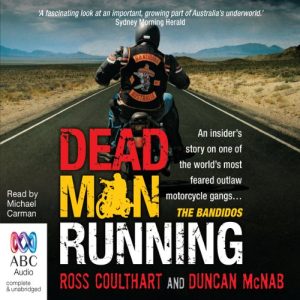
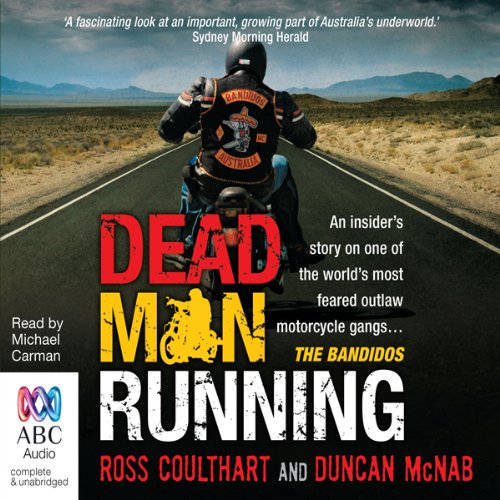
Steve Utah spent ten years inside the Bandidos motorcycle gang before deciding to walk into a Federal Police station and hand over everything he knew, a decision this audiobook builds its entire ten-hour, fifty-three-minute runtime around. He arranged clubhouse security, cooked ecstasy and ice for the club, sat in on meetings where interstate and overseas drug and weapons smuggling was planned, and says he watched men beaten and executed. Dead Man Running is Utah’s own name for himself now, someone who assumes the outlaw code will eventually catch up with him no matter what he does. Ross Coulthart, identified by one reviewer here as a journalist by trade, builds the book around Utah’s confession, and the audiobook carries the tension of testimony from someone who genuinely believes he is running out of time.
Dead Man Running Swaps Passivity for Flight
The book’s spine is Utah’s insider account of a specific criminal underworld: club security arrangements, drug manufacturing, stolen military weapons changing hands, and the escalation from intimidation to violence. It is framed explicitly as an Australian story, tied to “the relentless rise of sophisticated organised crime networks inside outlaw motorcycle gangs,” and the synopsis is candid that part of its purpose is criticizing how slowly Australian policing and the legal system adapted to that threat.
One detail worth flagging plainly: the listing credits only Ross Coulthart as author, but reviewer Victor Preacher Shurtz describes the reporting as a joint effort, naming Duncan McNab, identified as a private investigator, as having done research alongside him. That is not confirmed anywhere else on this listing, but it is worth knowing before assuming Coulthart worked entirely alone on the material.
The title itself rewards a second look. “Dead man walking” is the familiar idiom, resigned, passive, waiting for the end. Utah’s own phrase, dead man running, swaps that passivity for active flight, someone still trying to outrun a fate he believes is coming rather than simply accepting it, and that distinction shapes the tension running through the whole account.
Utah’s specific role inside the club matters for how seriously to weigh his account. Arranging clubhouse security is not a peripheral, low-level job; it implies real trust from senior members and genuine access to the operational side of the gang’s business, which is part of what gives his eventual decision to inform its narrative weight. Someone trusted with security duties who then hands everything over to the Federal Police represents a far deeper breach than a low-level associate flipping would, and the book’s tension depends on the listener understanding just how far inside the organization Utah actually was before he walked away from it.
Carman's Narration Goes Unmentioned by Any Reviewer
None of the three reviews attached to this listing single out Michael Carman’s narration specifically, which is worth naming honestly rather than guessing at a performance quality no one on record has confirmed either way. What the format clearly demands, and what true crime narration generally rewards, is restraint: letting testimony this disturbing carry its own weight rather than performing shock on top of it.
The real urgency comes from the subject matter itself. Reviewer nannajan calls the book “a terrible eye-opener when you consider it to be fact,” adding that it “leaves one worried as to how the police will ever cope with the bikie situation now if they were so complacent back then.” That is the book’s real hook: not just one man’s story, but what his story implies about institutional failure.
The scale described goes well beyond one clubhouse’s internal business. Utah says stolen military-grade weapons changed hands in front of him and that club leadership coordinated with contacts well outside state lines, details that push the book past a single-chapter character study into something closer to an organized-crime network exposé.
Australian outlaw motorcycle gang culture remains a relatively under-told corner of true crime for listeners outside Australia specifically, compared to the heavily mined American mafia and biker narratives that otherwise dominate the genre internationally. That regional specificity (the Bandidos’ Australian chapter, the country’s particular policing response and legal system) gives the book a genuine freshness for listeners who feel like they have already heard every angle of the more familiar American organized-crime story, without requiring an entirely unfamiliar country or culture to get there.
Rating the Writing High, the Subject Low
This is Utah’s account as relayed through Coulthart, with no independent corroboration described in the synopsis itself. Victor Preacher Shurtz’s review captures the moral complexity some listeners will feel, opening flatly with “I don’t like snitches,” yet the same reviewer still rates the book highly for its literary quality while giving the underlying subject only one star, a genuinely split verdict worth sitting with before diving in.
The content itself is genuinely graphic. Utah describes witnessing vicious beatings, helping dump corpses, and seeing men executed in front of him, delivered without much softening for a general audience. Listeners sensitive to sustained violent content, even in a nonfiction true-crime frame, should know that going in rather than discovering it mid-listen.
The synopsis itself editorializes rather than staying neutral, criticizing “the apparent inability of the Police and legal system to deal with” organized bikie crime directly in its own marketing copy. That framing signals this leans toward advocacy-minded true crime rather than dispassionate reportage, worth knowing before expecting a neutral procedural account.
Ten hours and fifty-three minutes is a substantial commitment for testimony centered on one informant’s decade inside a single organization, and listeners should go in expecting depth and repetition of theme rather than a fast-moving, multi-perspective investigative structure. The book’s power comes from sustained, detailed testimony rather than narrative variety, which rewards patient listeners more than those wanting a brisk true-crime pace.
True Crime Built on Confession Over Corroboration
True crime listeners drawn to organized crime specifically, and anyone with an interest in Australian policing history, are the clearest audience here. The insider-informant angle, rare enough in published true crime, adds a real reporting hook beyond the shock value of the violence it describes.
Fans of insider-informant true crime specifically, accounts told from inside a criminal organization by someone who eventually turned on it, are a natural fit here, since that specific subgenre convention, confession over external investigation, is exactly the structure Coulthart builds the book around.
Listeners drawn to the specific vocabulary of criminal informant culture, what it actually means to roll over on an organization you were once trusted inside of, will find Utah’s own account unusually candid about that calculated, fear-driven decision-making process, not just the aftermath of having made it.
Corroboration beyond Utah’s own account is thin on the ground in what the synopsis describes, and listeners who want a dispassionate, multi-source investigative structure, rather than one man’s testimony carrying the narrative almost unchallenged, should adjust their expectations before starting.
Is the Dead Man Running audiobook based on a real police informant's account?
Yes. It's presented as Steve Utah's own confession about ten years inside the Bandidos motorcycle gang, told to journalist Ross Coulthart.
Does the Dead Man Running audiobook credit Duncan McNab as a co-author?
The listing credits only Ross Coulthart, though one listener review describes Duncan McNab, identified as a private investigator, as having done research alongside him.
How graphic is the violence described in this audiobook?
Utah describes witnessing beatings and executions and helping dispose of bodies, so listeners should expect the content to be graphic and unflinching, not softened for a general audience.
Is this audiobook specific to Australian organized crime?
Yes, the Bandidos chapter and the policing response described are specifically Australian, which matters if you're expecting a broader or US-focused true crime account.