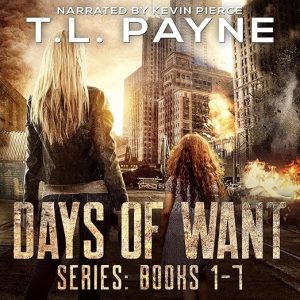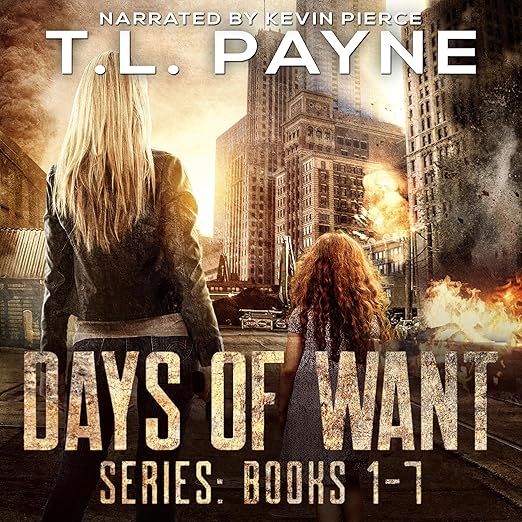
Maddie Langston is a college freshman stranded in a Chicago airport when an EMP attack kills every light, phone, and engine across the country, and this audiobook bundles her entire fight to get home into one forty-three-hour, seven-book collection. Her father's warning is blunt: get out before the city descends into chaos. What the provided synopsis actually describes, in detail, is only the opening premise, book one's airport-to-safety sprint, while the full Days of Want series spans Maddie's brother Zach's own parallel struggle to reach his family and their mother Beth's dangerous detour on the road back to her children, threads that presumably develop and reconverge across the remaining six installments.
What We Made of It
The premise is grounded, technological collapse rather than supernatural catastrophe, and the family-separation structure gives the series three converging storylines instead of one: Maddie navigating a collapsing city while taking on responsibility for an orphaned ten-year-old girl she meets along the way, Zach fighting his own way home, and Beth facing a dangerous detour of her own while refusing to let anything stop her from reaching her children. Maddie's specific circumstances, a college freshman with no prior survival training thrown immediately into crisis, also make her a relatable entry point rather than an implausibly capable action hero, a choice that keeps the earlier chapters grounded even as the stakes escalate.
The orphaned ten-year-old girl Maddie takes responsibility for partway through the opening book adds a found-family dimension that distinguishes this from a pure solo-survival narrative. Protecting a child while barely capable of protecting herself raises the emotional and practical stakes of every subsequent decision Maddie makes, and that dynamic, an adult suddenly responsible for a vulnerable child mid-catastrophe, is one of the more reliably effective structural choices in post-apocalyptic fiction generally, since it forces a protagonist to think beyond immediate self-preservation.
At forty-three hours and forty-two minutes across seven books, that is roughly six hours per installment on average, a normal length for this kind of series rather than a sign of padding or abridgment. The structure suggests a genuinely plotted, escalating survival story rather than one stretched-thin premise repeated seven times.
T. L. Payne is working in well-established post-apocalyptic and prepper-fiction territory, EMP collapse as the inciting catastrophe rather than zombies or nuclear war, which tends to appeal specifically to readers interested in plausible, procedural survival detail over more fantastical apocalypse scenarios. That grounded quality carries through all seven books based on how consistently reviewers praise the series' realism rather than its spectacle.
Payne has built a career specifically within the prepper and post-apocalyptic fiction space, and the Days of Want series reflects the genre conventions that space's readers have come to expect: practical detail over exposition, escalating stakes across a long series run, and protagonists whose survival depends on specific, learnable skills rather than luck or plot convenience alone.
Why Listen to Days of Want Series, Books 1-7
One reviewer, drawing on personal experience in the Marine Corps and later law enforcement, called the series 'TERRIFIC,' specifically praising its 'amazing real world, real gear references,' detailed enough that the reviewer found themselves checking Google Maps against the story's Chicago geography. That kind of specific, credentialed praise for accuracy is a meaningful signal for a genre where plausibility is often the whole appeal.
EMP-collapse fiction has an established readership built on exactly the kind of plausibility that review praises, in the tradition of genre landmarks like William R. Forstchen's One Second After, where the appeal comes from imagining a specific, technically grounded catastrophe rather than a supernatural or extraterrestrial one. Payne's series fits squarely into that lineage, prioritizing believable infrastructure collapse and practical survival response over any invented threat requiring its own mythology.
Kevin Pierce narrates, and his grounded, unshowy delivery style, already established across other post-apocalyptic and survivalist fiction, suits exactly this kind of gear-accurate, procedural realism. A narrator who oversells the drama can undercut a survival thriller's believability; Pierce's more measured approach keeps the tension feeling earned rather than manufactured.
A second reviewer specifically praised the series for not being run of the mill, citing a cast that gets added to, removed, and sometimes brought back in ways that keep the storyline genuinely interesting across a long series run, rather than settling into a predictable rhythm once the initial premise is established.
What Might Not Land
The synopsis attached to this listing covers only the opening premise, essentially book one's setup, rather than previewing the full seven-book arc, so listeners should not expect the provided description to spoil or summarize where Maddie, Zach, and Beth's threads ultimately go. Treat it as an introduction to the starting scenario, not a full-series overview.
One reviewer, while positive overall, noted that character development could have been a little better and wanted more detail added toward the ending, a fair caveat for listeners who prioritize deep interior character work over plot momentum and survival mechanics.
Tagged science-fiction-fantasy in the broader catalog, this is really techno-thriller and prepper-fiction territory, grounded technological collapse rather than space opera or magic systems, so listeners browsing for more traditional science fiction should recalibrate expectations toward the EMP-thriller subgenre specifically.
Buying all seven books as one forty-three-hour bundle is a meaningfully different commitment than sampling book one alone, both financially and in terms of time investment. Listeners new to Payne's writing might reasonably consider whether they want to commit to the full series upfront or test the premise with a shorter sample first, since post-apocalyptic prepper fiction is a genre where personal taste for procedural detail versus faster-paced plotting varies widely.
Who Should Listen to Days of Want Series, Books 1-7
This collection suits fans of post-apocalyptic and prepper fiction who want plausible, gear-accurate survival detail grounded in real technological failure rather than an invented threat, along with readers who appreciate a family-separation structure spread across multiple converging storylines rather than a single protagonist's journey.
It also works well for listeners who prefer committing to a long, binge-able series in one purchase rather than buying seven separate audiobooks individually, given the full run is bundled here into one forty-three-hour collection. Listeners who enjoyed other prepper-fiction franchises built around ordinary civilians rather than trained military protagonists will recognize the same appeal here: survival skill as something learned under pressure in real time, not a preexisting superpower the protagonist happens to already have when disaster strikes.
The full seven-book bundle also suits listeners who prefer knowing a series' complete arc is already finished and available rather than waiting on a still-releasing series, since every installment promised by the title is included here in a single, complete purchase.
Readers who prioritize deep character development over plot and survival mechanics, per one reviewer's specific caveat, or who want more traditional science fiction rather than grounded technological collapse, should sample a single volume before committing to the full seven-book bundle.
- Narrator: Kevin Pierce's grounded, unshowy delivery suits this EMP thriller's gear-accurate realism.
- Subjects: EMP collapse, family separation and reunion, survival under pressure.
- Tone: Tense, procedural, high-stakes.
- Bottom line: A binge-friendly pick for post-apocalyptic thriller fans who want seven books of plot in one purchase.
Before You Listen
Does this audiobook cover all seven Days of Want books, or just the first one?
It bundles all seven books into one forty-three-hour collection, though the provided synopsis text only describes the opening premise from book one.
Is Days of Want closer to science fiction or post-apocalyptic thriller?
It is closer to a grounded post-apocalyptic and prepper-fiction thriller built around an EMP collapse, despite being filed under the broader science-fiction-fantasy category.
How accurate is the survival and gear detail in this audiobook?
Reviewers with real Marine Corps and law enforcement backgrounds specifically praise the gear and real-world accuracy, with one noting they checked Google Maps against the story's Chicago setting.
Do Maddie, Zach, and Beth's storylines eventually reunite?
The synopsis frames all three as working toward reunion, Maddie and Zach's mother Beth included, though the provided description does not confirm how or when that reunion happens across the seven books.